JUGS Indoor Pickleballs Review: My 10–30 Hour Test
My JUGS indoor pickleballs review after approximately 10–30 hours of real play: I like these soft, slow yellow balls for gentle touch play, where they have given me predictable bounce and easier dinks and resets. But I struggle more with fast volleys, and the pace feels too slow for my normal game. Although I have not seen cracks or deformation yet, I personally prefer the AMOSWIZ Indoor and GAMMA Photon Indoor balls I have also played with.
This is my firsthand experience, not a review rewritten from other buyers’ feedback. I purchased the balls myself approximately one month before November 10, 2026, without a discount, free products, sponsored arrangement, or compensation. My 10–30-hour range is my own stated playtime, not a claim calculated from their appearance in my photo.
Affiliate disclosure: As an Amazon Associate I earn from qualifying purchases. The linked Amazon product below carries an affiliate tag; a qualifying purchase may earn this site a commission at no extra cost to you. I paid for my JUGS balls myself and received no free products, discount or payment for this review.
JUGS Indoor Pickleballs: my 3.4/5 real-world verdict
What worked for me: A soft, slow-feeling indoor ball with an even, predictable bounce. I found dinks and resets easier to manage, and the bright yellow balls were easy for me to see.
My biggest limitation: They are too slow for my usual game, and I found it harder to play quick volleys. The same softer tempo that can be useful for beginner drills is less useful to me when rallies speed up.
Best suited to: Beginner and practice situations where my observed soft, slow ball feel is an advantage. Less suited to: Players who, like me, prioritize fast exchanges and a livelier indoor feel.
- Soft, slow ball feel that made short-game practice comfortable for me
- Predictable bounce throughout my 10–30 hours
- Easier dinks and resets in my own play
- Suitable for beginner and practice play in my experience
- Easy-to-see yellow color
- No cracking or deformation observed so far
- The pace feels too slow for my usual games
- Fast volleys were harder for me
- I personally prefer both AMOSWIZ Indoor and GAMMA Photon Indoor from separate use
- Not enough evidence to promise long-term durability across months of club rotation
- Amazon.com live price and my exact receipt amount cannot currently be verified
Bottom line: useful for control drills, but not my favorite indoor ball
My first-hand rating is 3.4/5. I can recommend considering JUGS for players who want a slow, forgiving indoor session, but for my own pace and fast exchanges, the drawbacks matter. The two indoor alternatives I have personally played with — AMOSWIZ and GAMMA Photon — are my preferred choices. This is an individual preference, not a controlled head-to-head test.
What I actually bought and tested
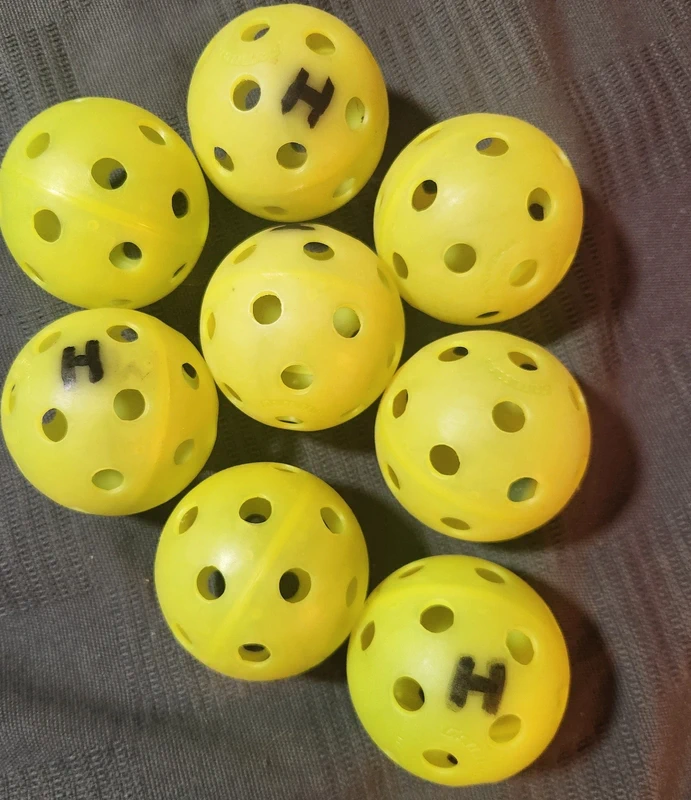
- Product: yellow/lime-looking JUGS indoor pickleballs, named in my original photo folder; the eight loose balls shown in my own image are the review sample.
- Purchase: approximately October 2026, bought with my own money at the ordinary Amazon.com price; no discount, free products or payment.
- Actual playing time: approximately 10–30 hours, based on my recollection.
- Colors and markings: yellow balls; several appear to have a black handwritten “H.” I am not claiming to know when or why those marks were added.
- What I can document: the ball’s softness and slow pace in my play, consistent bounce, short-game control, difficult fast volleys, good yellow visibility, and no observed cracks or deformation during the test period.
- What I did not document: measured bounce height, measured ball mass, exact hours per individual ball, controlled side-by-side trials, original pack size, or an Amazon invoice price.
The older JUGS indoor design is often offered as a 26-hole indoor ball. You can find specifications from a published JUGS product overview or specialist retailer listing. Those are product descriptions, not measurements I made, and my loose-ball photographs alone do not confirm the exact factory SKU.
The soft, slow feel: a benefit for dinks, a drawback for faster games
My immediate impression was that these JUGS balls have a very soft, slow feel. I am describing a relative playing sensation, not a measured ball speed or rebound test. The softer pace was not all bad — I found it easier to control dinks and resets, which is exactly where a bit of extra time to shape the shot can be useful to me.
There is a real trade-off. When exchanges accelerated, I found quick volleys harder. The balls felt too slow for my normal game. That means I can understand why a beginner or practice group may enjoy them while still personally preferring a different match ball.
I have not supplied a documented rally sequence or a stopwatch measurement, so I will not invent an exact point, opponent, failed shot count or numerical pace difference.
Bounce consistency was a genuine positive
Despite my reservations about pace, I experienced a regular, predictable bounce. That helped make the ball feel manageable in slower exchanges and was part of why I liked the short-game control. My observation is qualitative: I have not measured rebound heights or compared individual balls on calibrated flooring.
Yellow visibility and the condition of my eight balls
The yellow color was easy to see in my own playing conditions. I did not make a controlled comparison of the yellow balls against white or other colors under identical lighting, so I cannot generalize that the color is best for every gym.

After 10–30 hours of my own play, I have not observed a crack or an obviously deformed ball. That is a useful positive finding for an early ownership period, though it is not a guarantee that a large batch will last months. I cannot establish how much court time each individual ball received from a photo alone.
My comparison: JUGS versus AMOSWIZ and GAMMA Photon
In my own separately conducted play, I prefer the AMOSWIZ indoor balls and I also prefer the GAMMA Photon indoor balls over JUGS. I am not claiming that I tested all three simultaneously, that I isolated the balls under identical court conditions, or that either is mathematically faster. What I know is which ball I personally enjoyed using more.
My recent Niupipo indoor review offers another early-use indoor-ball perspective, but I have not confirmed a direct JUGS-versus-Niupipo head-to-head result and I will not add one.
First-hand rating breakdown: 3.4/5
I used six relevant criteria that I can fairly judge from my actual answers. The score is my editorial assessment of firsthand impressions, not a measured performance result or an average of Amazon ratings. The weights total 100%, and I have deliberately not created a separate price/value score without a verifiable purchase receipt.
| Criterion | Weight | My editorial score | Evidence |
|---|---|---|---|
| Dinks and resets | 20% | 4.2/5 | My short-game control felt easier with these balls. |
| Bounce consistency | 15% | 4.1/5 | I experienced a predictable, even bounce, despite the deliberately soft and slow feel. |
| Fast volleys and normal match pace | 25% | 2.0/5 | Fast volleys were harder for me and the ball was too slow for my usual game. |
| Visibility | 15% | 4.2/5 | The bright yellow balls were easy for me to see. |
| Condition after 10–30 hours | 10% | 4.0/5 | I have not seen cracking or deformation so far; this is not a long-term lifespan claim. |
| Personal preference vs alternatives | 15% | 2.5/5 | I prefer both AMOSWIZ and GAMMA Photon in my separate firsthand experience. |
Calculation: (4.2 × 20%) + (4.1 × 15%) + (2.0 × 25%) + (4.2 × 15%) + (4.0 × 10%) + (2.5 × 15%) = 3.36/5, rounded to 3.4/5. The five-star graphic is filled to 68% to match. The condition score reflects only what I have observed over my stated 10–30 hours, not a long-term endurance guarantee.
How JUGS fits alongside my other firsthand indoor-ball reviews
| Review | Published editorial rating | Recorded use | Distinct firsthand takeaway |
|---|---|---|---|
| JUGS Indoor (this review) | 3.4/5 | 10–30 hours | Soft, slow, predictable bounce and useful dink/reset control, but too slow for my fast volleys; no observed cracking so far. |
| AMOSWIZ Indoor | 3.7/5 | About 6 hours | Soft and slow, with excellent visibility in the earlier test. I have explicitly confirmed a personal preference for AMOSWIZ over JUGS. |
| GAMMA Photon Indoor | 4.2/5 | About 9 months of mixed club rotation | A more competition-oriented indoor ball in that earlier review, with documented mixed long-term outcomes. I prefer GAMMA to JUGS. |
| Niupipo Indoor | 2.4/5 | 1–3 hours | Early concerns about fast-rally control and lighting-dependent visibility; no confirmed direct JUGS comparison. |
These are separately published firsthand reviews from different dates, usage periods and playing conditions. Each numeric rating reflects the evidence and scoring criteria used at that time; this table is NOT a controlled same-session head-to-head test.
For choosing between indoor and outdoor balls, see my indoor vs outdoor pickleball guide. My best pickleball balls comparison contains a separate ranked set of four longer-tested picks; adding this JUGS review does not retroactively change that guide’s rankings or historical count.
Amazon.com price and buying the right JUGS pack
The closest identified Amazon.com listing for this indoor JUGS model is JUGS Sports Vision-Enhanced Green, one dozen (12 pack), ASIN B004VXSI1K. However, my original photograph contains eight loose yellow balls, so I cannot infer that my purchase was a 12-pack. I bought at the ordinary Amazon.com listing price approximately one month before this review, but the numerical checkout amount was not supplied and Amazon’s live price is not independently available for verification here.
For a comparison only, another retailer lists a JUGS vision-enhanced lime-green 12-pack at $35.99 as checked on November 10, 2026. This is not a verified Amazon.com price or proof of my past purchase amount. Amazon prices and selected pack variants can change.
Short FAQ
Have I actually played with JUGS indoor pickleballs?
Yes. I personally bought the balls and reported approximately 10–30 hours of real use. My verdict is based on my own play, not on other people’s reviews.
Are JUGS good for beginners?
In my experience, yes for beginner-style practice: I experienced a very soft, slow feel, predictable bounce, and easier control of dinks and resets. That doesn’t mean experienced players will all enjoy that same pace.
Are they good for competitive, fast indoor volleys?
Not for the style of play I prefer. I found them too slow and harder to use during quick volleys, even though their short-game control was appealing.
How durable are the JUGS balls?
Mine showed no cracks or deformation during my stated 10–30 hours, but I am not claiming a precise failure rate or months-long lifespan.

Jonathan Grøn created The Pickleball Wise. He coaches beginner pickleball players and captains a pickleball team in Series 2. He combines on-court experience with official rules and coaching resources to write practical guides on doubles strategy, skills, and training.