Pickleball Apes Pulse X Review: My 3–10 Hour Test (Purple, Elongated)
My Pickleball Apes Pulse X Purple review after 3–10 hours: I bought the elongated purple Pulse X myself and played primarily indoor doubles. I liked the precision of my dinks and third-shot drops, depth control, stable blocks, forgiving sweet spot, good spin and comfortable grip. There were two important limitations: slow-feeling direction changes in fast exchanges and, in my separate first-hand use, more spin from the JOOLA Perseus Pro IV. The Pulse X still felt like good value to me.
Related shape, separately tested: I have published my Pickleball Apes Pulse S Hybrid Purple review (3–10 hours). I liked its short-game control, topspin and quick net handling but wanted more finishing power. This is the S hybrid, distinct from the elongated Pulse X reviewed here. I did not report a direct overall preference between these two models.
I bought this paddle myself roughly one month before writing, around October 2026, with no discount, free product, sponsorship or paid promotion. My 3–10-hour playing window is the range I reported myself, not an estimate inferred from the clean-looking product photo. I did not provide a receipt or exact Amazon checkout amount. I therefore do not claim to know how many dollars I personally paid.
Affiliate disclosure: As an Amazon Associate I earn from qualifying purchases. The Amazon US link below contains affiliate tag owlratings08-20, so qualifying purchases may earn a commission for this website without extra cost to you. I purchased this paddle independently and was not paid or given the paddle to review it. The Amazon destination is an affiliate-tagged search-results page, not a confirmed exact Pulse X checkout listing.
My 4.2/5 verdict: forgiving control, but slower in hand battles
What worked: My dinks, third-shot drops and depth control felt accurate. I also liked stable blocks, placement under pressure, a large-feeling sweet spot and a good power/control balance.
What I would change: Quick changes of direction at the net felt slow. Although I liked the Pulse X spin, my JOOLA Pro IV gave me more, and it remains my overall preferred paddle.
Feel and early break-in: The paddle felt soft yet solid, and I noticed it become softer with use. I had only 3–10 hours on it, so this is an early impression, not long-term durability proof.
Value: I thought it was good value at the price I paid, but did not report the exact figure; it would be misleading to claim a specific Amazon receipt total.
- Precise dinks, third-shot drops and depth control
- Stable blocking and good placement when pressured
- Large, forgiving sweet spot
- Good power/control balance and good spin
- Soft yet solid hit, comfortable grip and softer feel after some use
- Direction changes felt slow during fast rallies
- Less spin than my JOOLA Perseus Pro IV
- I still personally prefer the JOOLA Pro IV overall
Bottom line: 4.2/5 after 3–10 hours
In my short but genuine indoor-doubles test, the Pulse X gave me accurate touch shots, useful defensive stability and forgiving contact. My main reservation is net-hand speed, and I prefer the JOOLA Pro IV’s spin and overall play. I found the Pulse X good value, but the unverified exact price paid and short test window limit what I can say about price competitiveness and durability.
The exact model and the photo
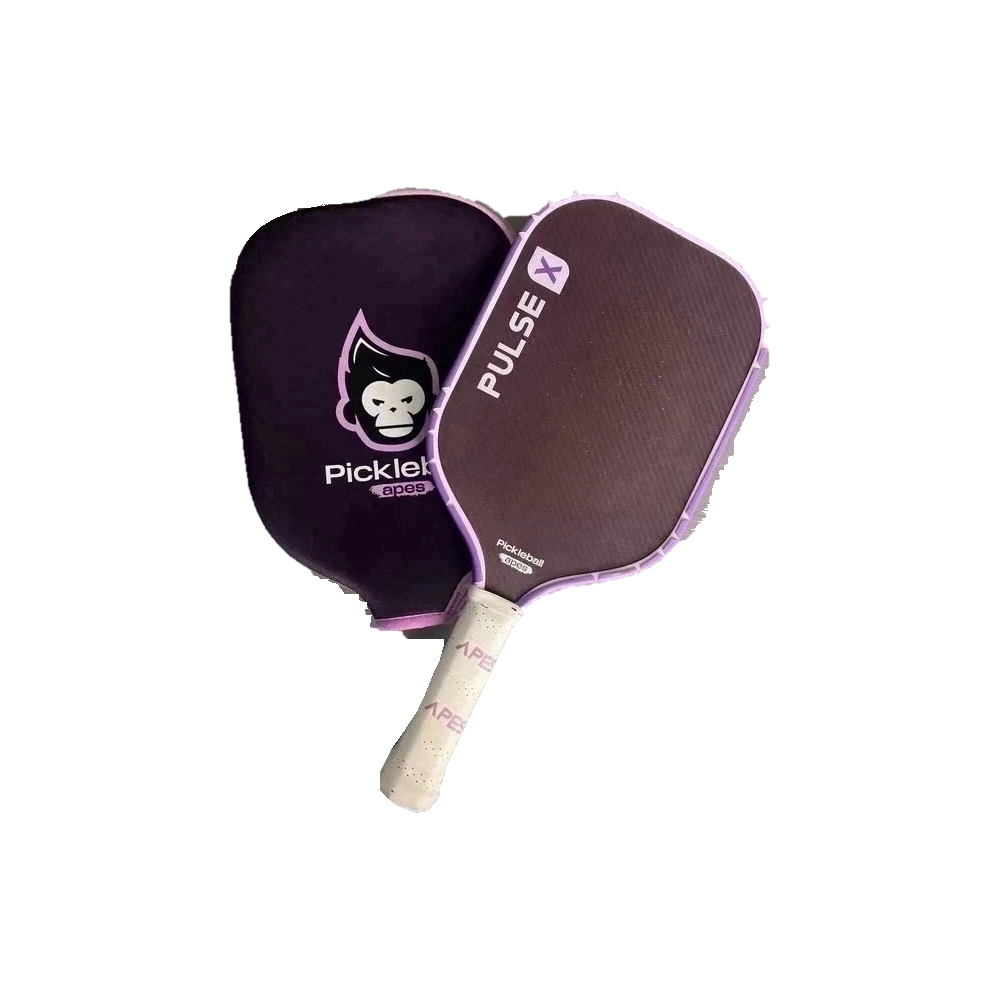
My real product is the purple Pickleball Apes PULSE X with an elongated face, lavender edge guard and white grip. The original owned photo also includes the matching black-and-purple Pickleball Apes cover; both are visible in the one genuine background-removed product image used in the review card. The crop removes background pixels while retaining the original paddle and cover, not a generated replacement.
This is the X shape, not the S hybrid, V widebody or E extra-elongated version. Retailer specifications describe a 16.5-inch length, 7.5-inch width, approximately 16.5 mm core, 8.2–8.4 oz stock weight, a poly-aramid face and a factory leather-style grip. These are published specs, not my own weighings or measurements. Exact handle dimensions vary across public listings; I have not measured the photographed paddle. The independent PPA Tour / John Kew test data separately lists 16.5-inch length, 7.5-inch width, swingweight 122.4 and twistweight 6.20 for its measured example. None of these numbers describe measurements I made personally.
My test context: indoor doubles, 3–10 hours
My first-hand experience is limited to approximately 3–10 hours of predominantly indoor doubles. This is enough to describe my early control, spin, grip and handling impressions, but not a defensible long-term wear rate or a year-long durability verdict. I did not specify a particular indoor ball, playing level, overgrip, added weights or controlled head-to-head setup, so I have not filled those gaps from general assumptions. The paddle in my photo has a white grip; I did not report changing it.
Dinks, third-shot drops and depth: precise in my game
I reported three separately positive soft-game observations: precise dinks, accurate third-shot drops and good control over ball depth. These were my own experiences, not a manufacturer promise of accuracy. I did not log shots into a target zone or count how many third shots landed in a given match.
The combination matters. A paddle could feel precise for dinks but difficult for longer drops; in my short trial of the Pulse X, I selected both kinds of touch shot as positives. I did not report a named rally or an individual opponent, so I won’t construct one for the sake of making the story more vivid.
Blocks and defensive placement under pressure
I selected stable blocks and an ability to place the ball accurately under pressure. These are useful first-hand findings for doubles, where incoming pace can make defensive control difficult. My recorded response did not specifically address the height of resets or whether the ball popped up, so I am not treating that as tested evidence.
For me, this controlled defensive response belongs with the accurate dinks, drops and depth control: they form the strongest group of positives in my own reported test.
Sweet spot: large and forgiving for me
The Pulse X sweet spot felt large and forgiving in my early play. That is a personal subjective assessment. It does not mean I measured the exact impact region or rebound speed at different points on the face. The independent twistweight benchmark gives context on off-center stability, but cannot replace my own playing impression or guarantee the same forgiveness for everyone.
It is notable to me that I previously described the original Pickleball Apes Pro Line Energy’s sweet spot as small in a separate 30–100-hour review. That older review is context, not proof that I played both paddles side by side under identical conditions, and I did not explicitly select a direct Pulse X-versus-Energy sweet-spot winner in this intake.
Power and control: an encouraging balance
I described the Pulse X as having a good balance between power and control. That was my entire confirmed power result. I did not separately check an option claiming maximum drive speed, greater power than the JOOLA, consistently deep serves or aggressive speed-ups, so I will not present those claims as personal test results.
This overall balanced feeling sits well with my accurate soft-game results and stable blocks. For buyers, it is a qualitative playing impression, not a radar-gun measurement of ball speed.
Spin: good on Pulse X, but JOOLA Pro IV gave me more
I found the Pulse X capable of good spin. That is a direct, positive observation from my own use. However, in my separate play with JOOLA Perseus Pro IV, I personally generated more spin with the JOOLA. I also prefer the JOOLA overall. Both those comparison answers were explicitly provided.
That does not mean the Pulse X failed on spin, or that the JOOLA is measurably higher-RPM in a laboratory test. The external Pulse X lab report records 2,184 RPM on the tested sample, but that is another tester’s instrument result. I have not reused that number as my own performance result or used it to assign my spin sub-score.
Fast hand exchanges: direction changes felt slow
The clearest downside was slow-feeling direction changes in fast net exchanges. I did not say that every volley was unstable, that counters lacked power or that the grip slipped. My selected observation was specifically about the speed of changing paddle direction when rallies sped up.
That is relevant to anyone comparing an elongated paddle with a shorter or lighter-handling alternative. Independent swingweight data can add context, but I cannot say my specific paddle weighed the same as the laboratory example. In my test, the direction-change limitation was real enough to temper otherwise strong control impressions.
Soft, solid contact and a comfortable white grip
I selected two related positives: a soft but dense, solid-feeling impact and a comfortable white grip. Neither statement implies a measured vibration reading, specific grip circumference or a proven reduction in arm pain. I did not report those outcomes.
The appearance of the included cover and factory-looking handle is visible in the authentic photo, but my comfort assessment comes from playing with the paddle, not from a visual inspection of the grip material.
Break-in: I noticed the paddle becoming softer
After some play, I felt that the paddle became softer. Because my total reported use was only 3–10 hours, I cannot pinpoint a specific number of minutes or hours when that happened. I am not claiming a diagnosed core change, a measurable trampoline effect or a defect. This is a firsthand change in feel over my short test window.
Manufacturer materials may describe structural support or an immediate ready-to-play feel, but that does not negate what I personally felt. Equally, my experience does not establish a universal break-in curve. It is useful to compare the feel early and later, but 3–10 hours do not demonstrate long-term durability.
Which should I choose: Pulse X, JOOLA Pro IV or Pro Line Energy?
| My tested paddle | Firsthand use | Editorial review score | Supported personal finding |
|---|---|---|---|
| Pickleball Apes Pulse X Purple – this review | 3–10 hours | 4.2/5 | Precise dinks and drops, stable defense, forgiving feel, good spin; slow-feeling hand direction changes. |
| JOOLA Perseus Pro IV 16mm | ~8 hours in original review | 4.6/5 | In my separate use I got more spin from JOOLA and prefer it overall. |
| Pickleball Apes Pro Line Energy, original 17″ | 30–100 hours | 3.9/5 | My separate review praised drives, dinks, resets and reach, but recorded a small sweet spot and smoother texture with use. No controlled Pulse X vs Energy preference stated. |
The scores reflect separate first-hand editorial ratings and different exposure times, not controlled simultaneous testing. The two explicit comparisons I personally confirmed for this article are that JOOLA Pro IV had more spin and that I prefer it overall. I did not select a direct Pulse X-versus-Energy winner.
For other models, see my best pickleball paddles guide. For how to interpret forgiveness more generally, see paddle twistweight and off-center stability. For surface textures and spin claims see my pickleball spin and paddle grit guide. This additional first-hand page does not retrospectively change the guide’s existing ranked count.
Is it good value? My view versus the unverified Amazon receipt
I selected that the Pulse X was worth the money. That is my genuine personal value judgment. I did not supply an exact amount paid, however, and a current Amazon.com listing cannot prove what its price was when I checked out roughly a month earlier.
For public market context only, Pickleball Galaxy listed the exact Pulse X elongated at about $139.99, reduced from $199.99. The manufacturer’s Pulse-series page has promoted a roughly $99.99 starting price, but availability and exact X-variant selection can affect the final price. Neither is proof of my own checkout total, and a live Amazon.com exact-ASIN offer was not independently confirmed.
Rather than invent an Amazon SKU, the product card uses an honest Amazon.com search for Pickleball Apes Pulse X Purple (affiliate link). Confirm the X elongated shape, matching version, seller and live price before buying.
How I calculated my 4.2/5 first-hand editorial rating
This is a transparent seven-criterion score based only on the qualitative experiences I selected, not an external customer average or a laboratory result. The numeric sub-scores are editorial judgments. Criteria weights total 100%, and I have deliberately avoided an unsupported long-term durability sub-score or a numeric price-efficiency claim without my receipt.
| Criterion | Weight | My editorial score | Firsthand basis |
|---|---|---|---|
| Dinks, drops and depth control | 20% | 4.6/5 | I reported precise dinks, accurate third-shot drops and good length control. |
| Blocks and placement under pressure | 15% | 4.4/5 | Blocks felt stable and I could place the ball accurately under pressure. |
| Sweet spot forgiveness | 15% | 4.5/5 | The sweet spot felt large and forgiving to me. |
| Power and control balance | 10% | 4.3/5 | A good overall balance of power and control, without separately reporting top speed. |
| Spin in my game and JOOLA comparison | 15% | 3.9/5 | Good spin on Pulse X; my JOOLA Perseus Pro IV gave me more. |
| Soft, solid feel, comfort and break-in | 10% | 4.4/5 | Soft but solid contact, comfortable white grip, and softer feel after some use. |
| Fast hands and relative preference | 15% | 3.2/5 | Direction changes felt slow in fast exchanges; I prefer JOOLA Pro IV overall. |
Weighted calculation: (4.6 × 20%) + (4.4 × 15%) + (4.5 × 15%) + (4.3 × 10%) + (3.9 × 15%) + (4.4 × 10%) + (3.2 × 15%) = 4.190/5, rounded to 4.2/5. The five-star display fills 84% of the stars in agreement with the displayed rating and Product/Review schema.
Frequently asked questions
Did I really play with the purple Pulse X?
Yes. I bought the paddle myself, with no discount, free sample or paid promotion, and used it approximately 3–10 hours in primarily indoor doubles. Its actual photo and cover are featured here.
Is the Pulse X forgiving on off-center hits?
I found the sweet spot large and forgiving. This is a short-term personal impression, not a mapped sweet-spot measurement.
How were dinks, third-shot drops and blocks?
I reported accurate dinks and third-shot drops, good length control, stable blocks and good placement under pressure.
Does Pulse X produce more spin than JOOLA Perseus Pro IV?
Not in my game. I liked the Pulse X’s spin, but I got more spin from JOOLA Pro IV, which I also prefer overall. This is based on separate firsthand playing experiences.
Did the paddle change after break-in?
Yes, I felt it become softer over my 3–10 hours. I did not measure a before-and-after change or identify any equipment fault.
How much did I pay on Amazon.com?
I reported paying Amazon.com’s price when I purchased it around October 2026, but provided no transaction amount or order record. The exact historical checkout price is therefore unverified; public promotional prices are not substitutes for a receipt.

Jonathan Grøn created The Pickleball Wise. He coaches beginner pickleball players and captains a pickleball team in Series 2. He combines on-court experience with official rules and coaching resources to write practical guides on doubles strategy, skills, and training.