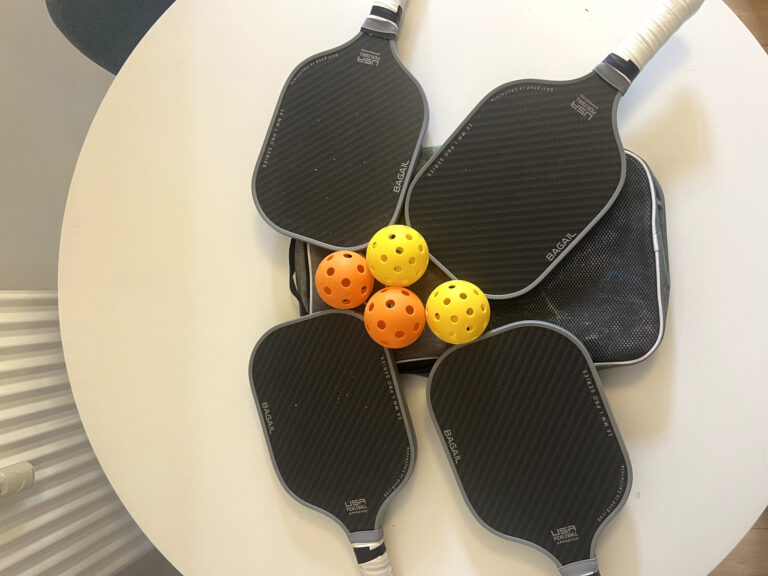
Why Two Identical Pickleball Paddles Can Weigh Differently
Two pickleball paddles with the same model name, thickness and shape can still feel different in your hand.
The most obvious reason is simple: individual paddles can vary in weight.
A manufacturer may list a model at 8.0 oz, but real production paddles can land above or below that number. Even a small difference can matter if the extra mass sits near the head rather than near the handle.
This does not mean one paddle is defective. It means published weight is often better understood as a target or range than as a guarantee that every unit is identical.
The useful questions are:
- how much variation is normal enough to expect;
- whether a few grams actually matter;
- why two paddles with the same static weight can still feel different;
- how to compare or match multiple paddles;
- when paying for exact weight selection is worth it.
Why identical paddle models can weigh differently
Pickleball paddles are built from multiple materials and layers.
Small production differences can add up across:
- core material;
- face layup;
- resin or adhesive;
- foam placement;
- edge guard;
- handle construction;
- grip and finishing materials.
No individual part needs to vary dramatically for the finished paddle to end up several grams heavier or lighter than another unit.
Listed weight is not always one exact number
Some product pages show a single nominal weight. Others show a range.
A single number such as 8.0 oz may therefore represent:
- a typical unit;
- a target production weight;
- a rounded specification;
- the approximate center of a wider range.
That is why the exact paddle in your hand can differ from the website number.
How many grams are in one ounce?
One ounce is about 28.35 grams.
That means a difference of:
- 0.1 oz is about 2.8 g;
- 0.2 oz is about 5.7 g;
- 0.3 oz is about 8.5 g.
Those numbers sound small, but paddle feel depends on where the mass is located.
Static weight is only the first measurement
Static weight is simply the total mass of the paddle.
It matters, but it does not tell you how that mass is distributed.
Two paddles can both weigh 8.1 oz and still feel different because one carries more mass toward the head.
That is why static weight should be considered together with:
- balance point;
- swing weight;
- twist weight;
- grip setup.
Our paddle weight guide explains the basic tradeoff between lighter and heavier setups.
Why the same weight can feel different
Imagine two paddles that both weigh 230 g.
Paddle A has more mass near the handle.
Paddle B has more mass near the top of the face.
They can have the same scale weight but different:
- hand speed;
- plow-through;
- power feel;
- fatigue;
- timing in counters;
- overhead feel.
This is why players sometimes say, “These two are the same weight, but one feels heavier.”
They may be describing swing weight or balance rather than total mass.
Swing weight often explains the difference better
Swing weight describes how difficult the paddle is to rotate through a swing.
Mass farther from your hand increases rotational resistance more than the same mass close to the handle.
So a small production difference near the paddle head can be more noticeable than a larger difference near the butt cap.
Our swing-weight guide explains why identical ounces do not always create identical swing feel.
Balance point matters too
Balance point tells you where the paddle’s mass is centered along its length.
A more head-heavy unit may feel:
- more powerful through contact;
- more stable on some shots;
- slower in fast hands exchanges;
- more demanding over long sessions.
A more head-light unit may feel faster even if the total weight is the same.
See our paddle balance guide for the difference between head-heavy and head-light feel.
Twist weight can vary independently
Two paddles can also differ in how resistant they are to twisting on off-center hits.
That is related to mass distribution across the paddle width.
A unit that carries slightly more mass around the sides may feel more forgiving even if the static weight difference is tiny.
Our twist-weight guide explains how this affects off-center stability.
Will you notice a 2-gram difference?
Maybe, but not always.
Whether you notice it depends on:
- where the 2 g are located;
- how sensitive you are to equipment changes;
- how light or heavy the paddle already is;
- whether you play fast hands or more baseline-heavy pickleball;
- whether your comparison is immediate or separated by days.
For many players, a couple of grams near the handle will be hard to identify reliably.
A couple of grams near the top can be easier to feel.
Will you notice a 5-gram difference?
Five grams is roughly 0.18 oz.
That is large enough that many players may notice a difference, especially if the heavier unit also has a more head-heavy balance.
Possible effects include:
- slower paddle acceleration;
- more stability;
- more momentum through the ball;
- different counter timing;
- more arm fatigue.
Again, distribution matters more than grams alone.
Why this matters when buying two of the same paddle
If you carry a backup paddle, you probably want it to feel similar to your primary one.
Two randomly selected units may not match perfectly.
If the difference is large enough, switching mid-match can affect:
- serve depth;
- drive timing;
- reset touch;
- hand speed;
- overhead timing.
For a casual player, this may not matter much.
For a tournament player who wants a true backup, matching can be worth the effort.
What should you match first?
If you are trying to create two similar paddles, prioritize:
- same model and thickness;
- similar static weight;
- similar balance or swing feel;
- same grip setup;
- same added tape or weighting.
If you have access to swing-weight measurements, that can improve the match further.
Do not forget the grip
Grip setup can change weight enough to complicate comparisons.
Differences can come from:
- different overgrip brands;
- one vs two overgrips;
- different overlap during wrapping;
- replacement grip thickness;
- finishing tape.
Before comparing two paddles, make sure they have the same grip setup.
Our overgrip guide explains how wrapping and replacement affect handle feel.
Edge tape also changes the number on the scale
Protective edge tape adds mass around the perimeter.
If one paddle has tape and the other does not, the comparison is no longer stock vs stock.
The same applies to:
- tungsten tape;
- lead-free weighted strips;
- grip rings;
- extra finishing tape.
Weigh paddles in the same configuration.
How to weigh a pickleball paddle accurately
You do not need expensive equipment.
A small digital kitchen scale that reads in grams is usually enough for practical comparison.
Use this process:
- Place the scale on a flat surface.
- Zero the scale.
- Remove loose accessories.
- Place the entire paddle on the scale without touching anything else.
- Record the weight in grams.
- Repeat once to confirm the reading.
Grams are useful because they give you more precision than rounded tenths of an ounce.
Weigh before customizing
If you plan to add overgrip, edge tape or tungsten, measure the stock paddle first.
That gives you a baseline.
Then record:
- stock weight;
- weight after grip setup;
- weight after edge protection;
- final playing weight.
This makes future matching much easier.
How to compare balance without special tools
You can do a simple home comparison by balancing the paddle on a narrow edge or dowel and identifying approximately where it balances.
This is not laboratory-grade measurement, but it can reveal obvious differences between two units.
For more repeatability:
- use the same setup;
- measure from the butt end;
- keep grips identical;
- repeat the test.
Use blind comparison when possible
If two units are close, expectation can influence feel.
If possible, have a partner hand you the paddles without telling you which is which.
Test:
- fast volleys;
- blocks;
- serves;
- drives;
- resets.
If you cannot reliably distinguish them, the measurement difference may not matter for your game.
Do not chase perfect numbers unnecessarily
It is easy to become obsessed with matching paddles to the gram.
But two paddles that measure differently can still play close enough that you cannot tell in real points.
Your goal should be:
functionally matched, not mathematically perfect.
When exact weight selection is worth paying for
Some retailers or specialty shops may offer exact-unit weight selection or measured specs.
That can be useful when:
- you know your preferred playing weight;
- you are matching a tournament backup;
- you are very sensitive to head weight;
- you plan a specific tungsten setup;
- you want to avoid adding unnecessary weight later.
It may be less useful for a beginner who is still learning what paddle feel they actually prefer.
Should you choose the lightest unit available?
Not automatically.
A lighter unit gives you more room to customize later, but stock stability and balance still matter.
A very light unit may require more perimeter weight to reach your preferred feel.
A slightly heavier unit might feel perfect without any modification.
Choose based on the final setup you want, not the lowest scale number.
Why lighter stock units are popular with tuners
If you already know you like adding tungsten around the lower sides or top, a lighter stock paddle gives you more mass budget.
You can then place the extra grams where you want them.
That is often more useful than buying a heavy unit whose mass is already distributed in a way you cannot change.
Our tungsten-tape guide explains why placement matters more than total grams alone.
What if your new paddle is heavier than advertised?
First check the comparison conditions.
Ask:
- Does it have an overgrip?
- Did the listed number refer to an average or range?
- Are there accessories still installed?
- Is your scale accurate?
If the paddle is materially outside the seller’s stated range, contact the seller or manufacturer.
If it is simply a little above a nominal number, it may still be within ordinary production variation.
What if your new paddle is lighter than advertised?
The same logic applies.
A lighter unit is not automatically worse.
It may:
- feel faster;
- offer more customization room;
- have slightly less stock stability;
- feel different from demo units you tried.
Evaluate the actual playing characteristics rather than assuming the scale number alone determines quality.
Could weight variation explain why a friend’s paddle feels better?
Yes, but it is only one possibility.
Two supposedly identical paddles can differ because of:
- unit weight;
- balance;
- surface wear;
- break-in or lifecycle change;
- grip setup;
- added tape;
- manufacturing variation.
If your friend’s paddle feels clearly different, compare them in the same configuration before concluding that the entire model varies dramatically.
Do demo paddles represent every retail unit?
Not perfectly.
A demo paddle may differ from the unit you buy because:
- its weight is slightly different;
- it has been used extensively;
- the face is worn;
- the grip has changed;
- it has undergone normal lifecycle changes.
Demos are still extremely useful, but understand that you are testing one unit, not every possible unit of that model.
How much variation should you tolerate?
There is no single number that applies to every manufacturer or model.
Instead, use a practical threshold:
If the difference changes how the paddle performs for you, it matters. If you cannot detect it in play, it probably does not.
For backup matching, you may want tighter tolerances than for an ordinary purchase.
Use the final playing setup, not just stock weight
Your real paddle is the paddle you use on court.
That means the useful number is often:
final playing weight
after:
- overgrip;
- edge tape;
- weighting;
- other removable accessories.
Two stock paddles can start different and still be tuned to finish nearly identical.
How to match two paddles at home
A simple process:
- Weigh both in stock form.
- Install identical grips.
- Compare balance.
- Play-test both before adding weight.
- Add small amounts of tungsten to the lighter or less stable unit if needed.
- Re-test hand speed, stability and timing.
- Stop once they feel functionally similar.
Do not add weight simply to make the scale numbers equal if the paddles already feel matched.
Common mistake: matching only static weight
Equal grams do not guarantee equal feel.
Always consider where the mass sits.
Common mistake: comparing paddles with different grips
One extra overgrip can erase the meaning of a stock-weight comparison.
Standardize the setup first.
Common mistake: buying heavy and planning to make it lighter
Removing meaningful mass from a paddle is difficult.
Adding a few grams is easy.
If you know you like custom weighting, starting slightly lighter is usually more flexible.
Common mistake: assuming heavier means better quality
More grams do not mean better construction.
They simply mean more mass.
Quality should be judged by consistency, durability, finish and performance—not by whether one unit is heavier.
Common mistake: assuming every difference is manufacturing error
Accessories, wear and break-in can all change how a paddle feels after purchase.
Compare true stock units before blaming production variation.
A practical buying checklist
If exact paddle feel matters to you:
- check whether the manufacturer lists a range;
- ask the retailer whether exact-unit weights are available;
- choose a stock weight that leaves room for your preferred grip and tape setup;
- record the weight when the paddle arrives;
- keep your setup consistent if buying a backup.
The bottom line
Two pickleball paddles of the same model can weigh and feel different because real manufacturing produces small unit-to-unit variation.
Static weight matters, but it is only part of the story.
The feel of a paddle depends on:
weight + balance + swing weight + twist weight + grip setup.
If you are buying one paddle, do not obsess over tiny differences you cannot feel.
If you are matching a tournament backup or building a specific custom setup, exact-unit weight selection can be genuinely useful.
Measure the paddle you actually own, evaluate the final playing setup, and optimize for how it performs—not just for the number printed on the product page.

Jonathan Grøn is a pickleball player and racket-sports enthusiast who focuses on practical doubles strategy, rules, skills, and training. He combines regular on-court experience with research from official rules, coaching resources, and other authoritative sources to create clear, useful pickleball guides.