
GAMMA Photon Indoor Pickleball Review: 9 Months Later
I bought a 6-pack of green GAMMA Photon Indoor pickleballs on January 5, 2026 for $21.97 with my own money. They have been in club rotation for about nine months, mostly on indoor badminton-hall and sports-floor surfaces, usually around once a week for roughly three-hour sessions.
Need help choosing or verifying a ball? Use the Pickleball Ball Selector & Approved Ball Database to match conditions, search approved models and find our hands-on tested picks.
Buying guide: See why I rank the Photon as my best indoor pick in my best pickleball balls guide.
The six balls have not all had the same amount of use because they were mixed into a larger club ball pool. Of the original six, one cracked, one became oval, three disappeared from the club, and one is still in my possession. The surviving ball is still round, still bounces well and measured 24 g on my home digital scale.
My overall take is positive: the GAMMA Photon is my preferred indoor ball over the AMOSWIZ 26-hole ball I tested. It plays at a medium pace, gives me a relatively high and consistent bounce, tracks well in most halls and feels appropriate for more serious club or competitive indoor play. The main downside is price, especially at the $21.97 I paid.
Affiliate disclosure: As an Amazon Associate I earn from qualifying purchases. If you buy through a paid link on this page, The Pickleball Wise may earn a commission at no extra cost to you. I bought this 6-pack myself and received no discount, free product, sponsorship or compensation.
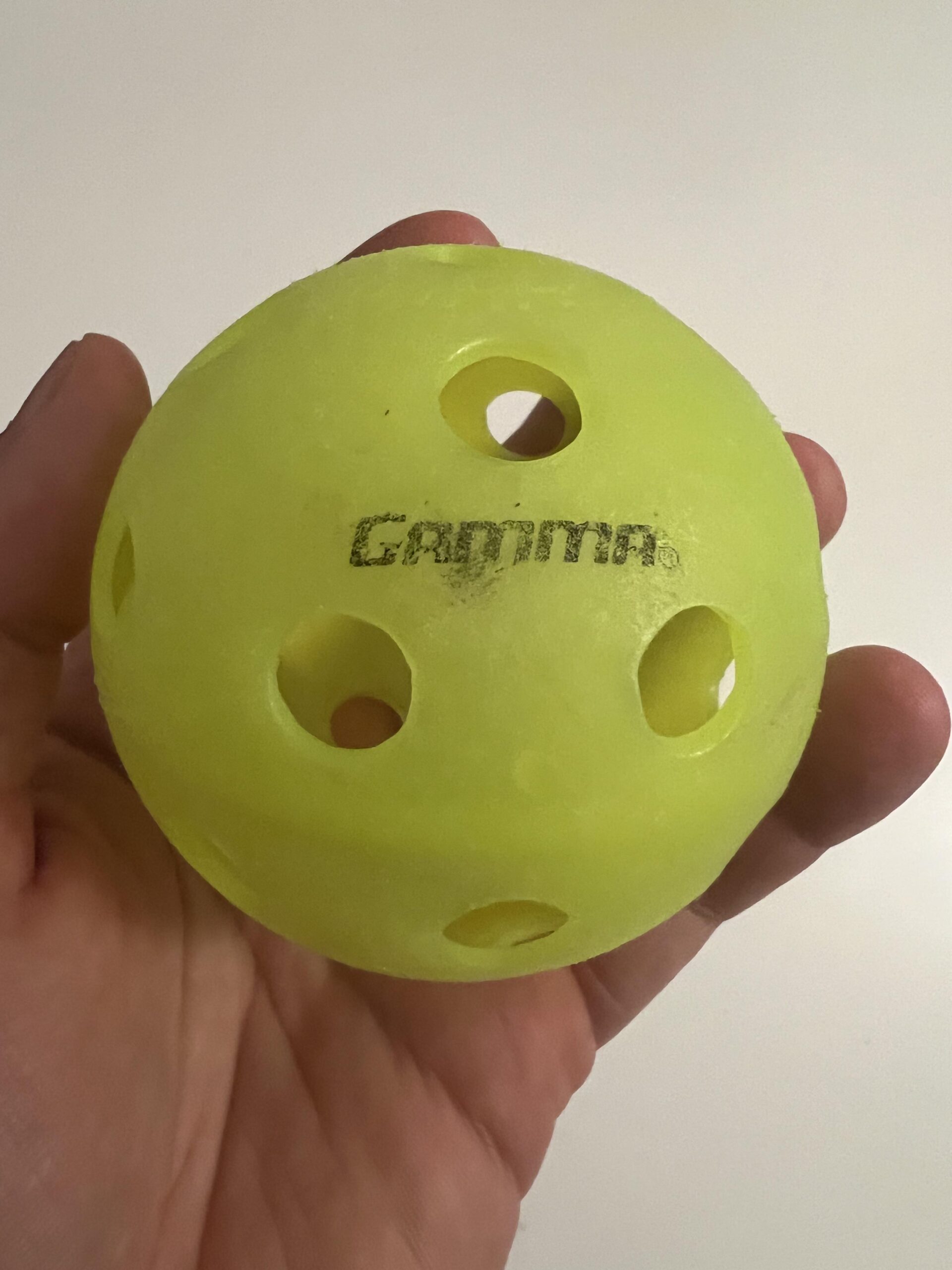
GAMMA Photon Indoor Pickleballs — 4.2/5
Quick verdict: A strong indoor ball for club and competitive use. Mine played at a medium pace with a relatively high, predictable bounce, stable flight and good spin response. One of the six cracked and one became oval after several months of mixed club rotation; three others disappeared, while the one I still have remains round and playable.
Best for: indoor clubs, competitive indoor players and groups that want a recognized 26-hole ball with a lively, consistent bounce.
Skip if: you are a casual beginner who does not care about using a more established indoor ball, or if cheaper indoor balls meet your needs.
- Relatively high, predictable bounce in my indoor use
- Stable flight with no recurring wobble or strange behavior
- Good topspin and slice response
- Good visibility in most halls
- Feels suitable for serious club and competitive indoor play
- The one surviving ball is still round and bounces well after about nine months since purchase
- I personally prefer it to the AMOSWIZ 26-hole indoor ball
- One known ball cracked after roughly four to five months
- One other known ball became oval
- Three disappeared, so I cannot judge their final durability
- $21.97 for six felt somewhat expensive
- Green visibility can be less ideal in halls with green-heavy backgrounds
Bottom line
I rate the GAMMA Photon Indoor 4.2/5. It is my favorite of the two 26-hole indoor balls I have tested so far, mainly because I see it as the more established competitive indoor option and I like its bounce, stability and overall playability. The durability evidence is mixed rather than perfect, and value is the main thing holding the score back.
How I tested the GAMMA Photon Indoor
- Exact product: green GAMMA Photon Indoor, 26-hole, 6-pack
- Purchased: January 5, 2026
- Price paid: $21.97 for 6 ($3.66 per ball)
- Compensation: none; I paid for the full pack myself
- Use period: about nine months since purchase
- Typical frequency: roughly once per week in a mixed club-ball rotation
- Typical session length: around three hours
- Surfaces: indoor badminton halls and sports floors
- Outdoor use: none
- Activities: doubles, singles and drills
- Users: both me and other club players
- Current outcome: one cracked, one became oval, three disappeared, one remains
- Measured weight: surviving used ball displayed 24 g on my home digital scale
- Pressure check: surviving ball flexed slightly under hard thumb pressure, roughly similar to my Franklin X-40 and Selkirk Pro S1 checks
The biggest limitation in this review is that these six balls were never isolated as a controlled test batch. They rotated with many other club balls, and I cannot tell you the exact number of hours or hits each individual Photon received. I therefore treat the durability observations as real-world club evidence rather than a controlled crack-rate test.
What happened to all six balls?
Because only one ball remains in my possession, it would be misleading to write that five of six “failed.” That is not what happened.
- 1 ball cracked: the plastic developed a crack/tear around a hole.
- 1 ball became oval: shape was no longer acceptably round.
- 3 balls disappeared: they were lost or taken from the club, so I do not know their final condition.
- 1 ball remains: still round, still bounces well and is still playable.
The crack and oval ball appeared after roughly four to five months, but because the balls were sharing court time with many others, I cannot translate that into a precise number of playing hours.
The surviving ball is still round and playable after about nine months
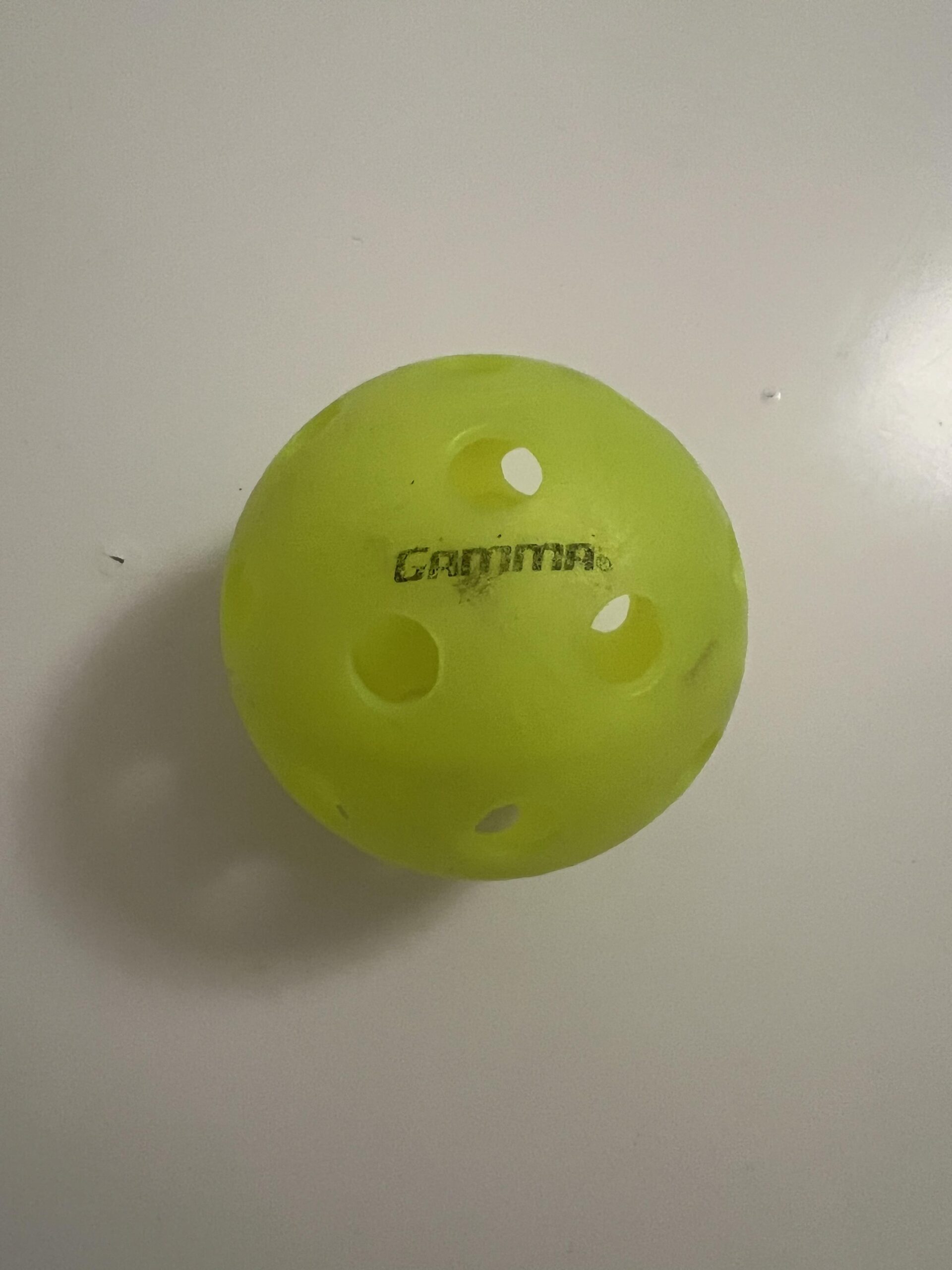
The remaining ball has visible surface wear, but it has not become obviously oval and I have not noticed a meaningful loss of bounce. I also do not see an exposed seam or obvious failure point in the two-piece construction.
My surviving Gamma Photon measured 24 g
I put the one surviving used ball on my home digital scale and it displayed 24 g. I did not weigh the balls when new, so I cannot say whether this represents any meaningful weight change over time.
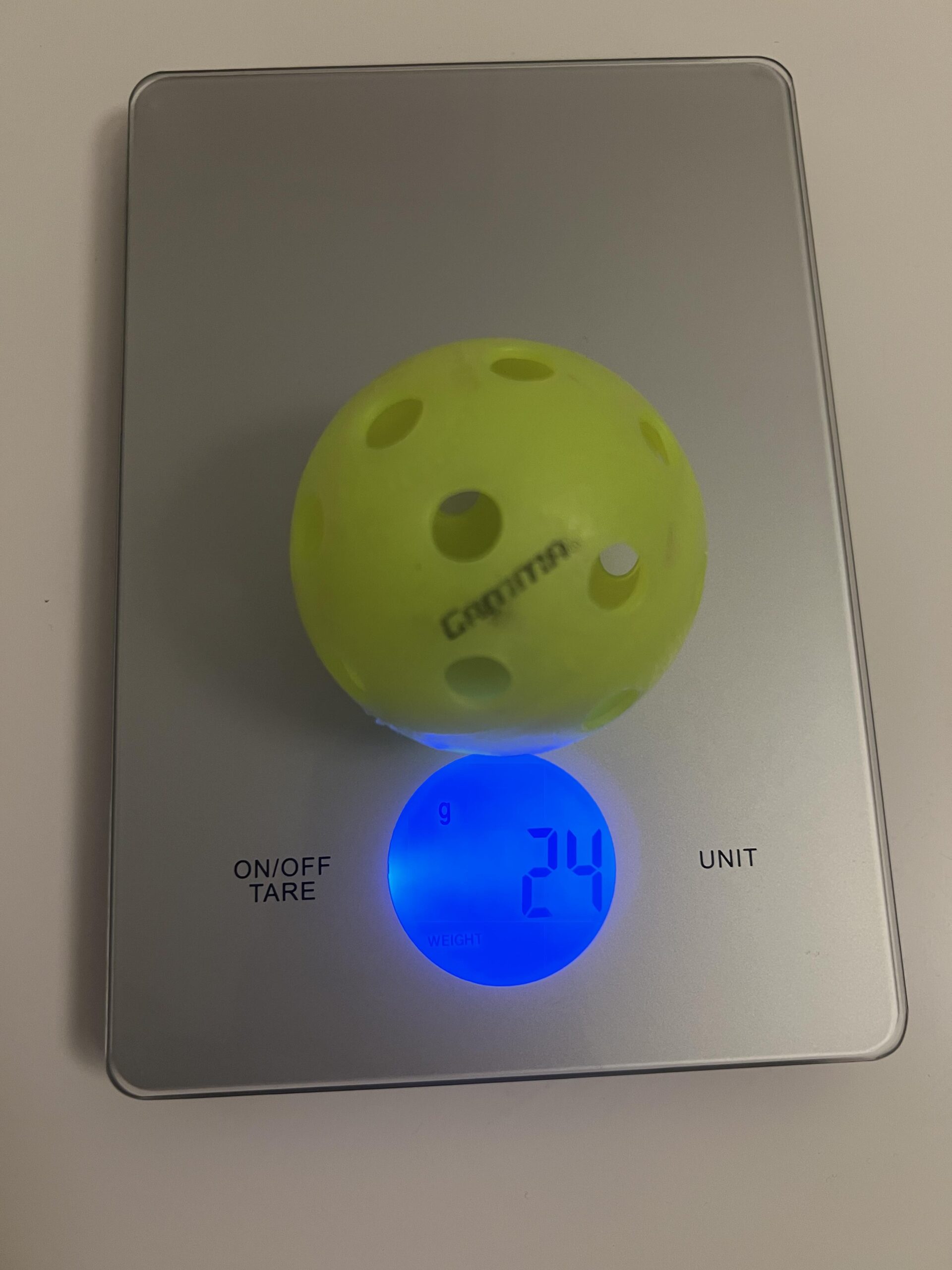
This is one home-scale reading, not a calibrated laboratory measurement or an average across the six-pack.
It flexes slightly under hard thumb pressure
I also did the same informal thumb-pressure check I have used on some of my other pickleballs. The used Photon can be pressed in slightly. It feels roughly similar to the Franklin X-40 and Selkirk Pro S1 under my thumb, perhaps a little easier to flex—but this Photon has also been in circulation much longer than some of those comparison balls.
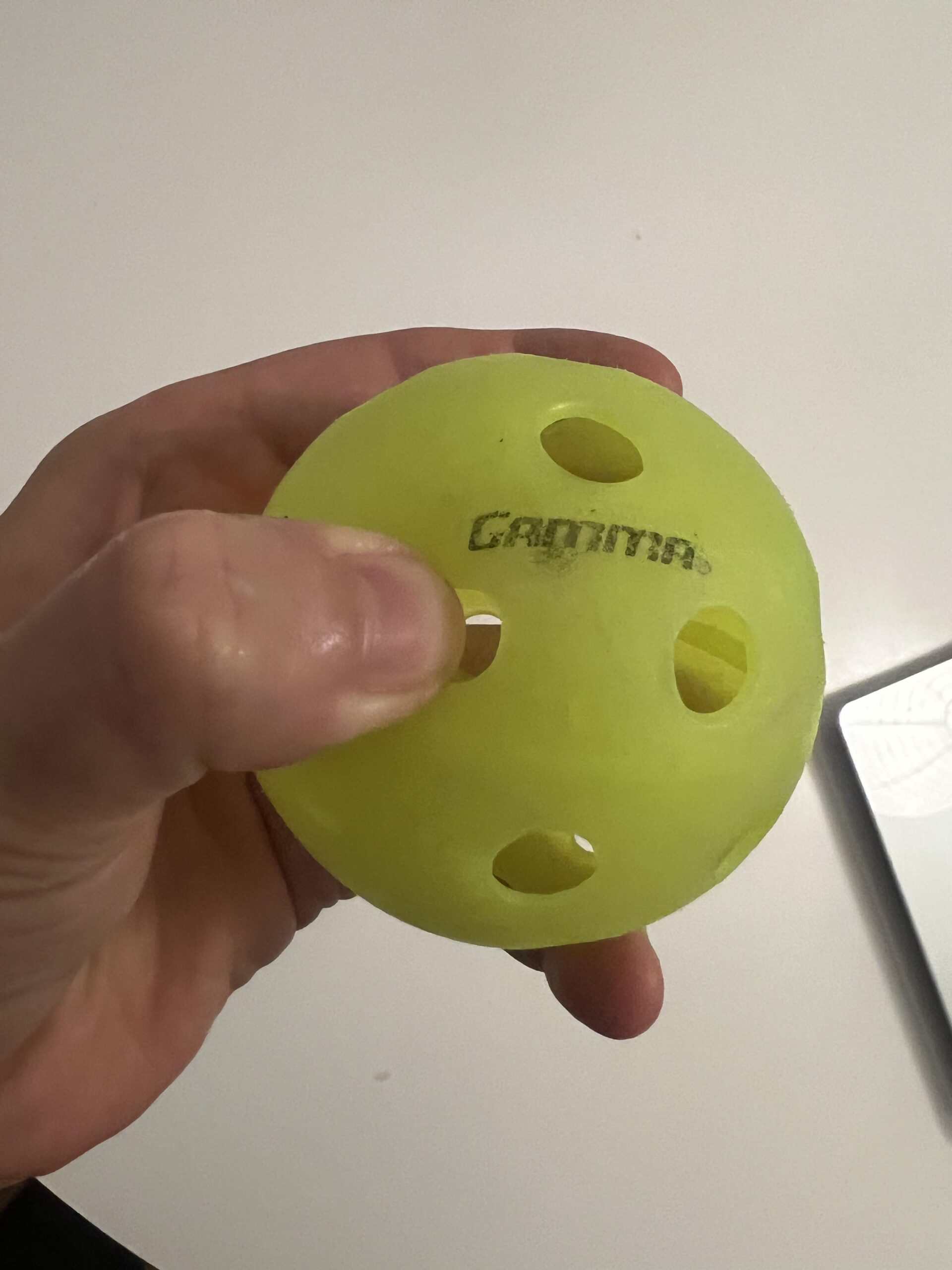
I would not use this hand test to claim a numerical softness or stiffness difference. It is just another piece of first-hand evidence about the condition of the used ball.
How the Gamma Photon plays: medium pace, lively bounce
I would describe the Photon as a medium-paced indoor ball. I would not force it onto the same 1–10 speed scale I use for the Franklin X-40 and Selkirk Pro S1, because those are 40-hole outdoor balls and the comparison is not truly like-for-like.
What matters more is how the Photon behaves within the indoor-ball category. In my experience it gives a relatively high, lively bounce without feeling unpredictable. That makes rallies feel active without turning the ball into something that plays exactly like an outdoor tournament ball.
Compared with the AMOSWIZ 26-hole indoor ball, the Photon feels slightly softer to me, but not dramatically so.
Bounce and flight have been consistently good
Bounce is one of the strongest parts of the Photon for me. I would call it relatively high, but still consistent. I have not experienced a recurring problem with one Photon suddenly bouncing strangely compared with another.
Flight stability has also been good. I have not noticed meaningful wobble, unpredictable movement or a recurring tendency for the ball to veer off line.
That lines up with GAMMA’s current positioning of the Photon as a 26-hole indoor ball designed for stable flight and consistent bounce, but my score here is based on my own play rather than the marketing description.
Spin response and sound are both good
I have no major complaint with topspin or slice. The ball responds well to both, and spin has not been a limitation for me in club play.
I also like the sound. I would describe it as completely fine for indoor play—nothing about the impact noise bothers me or makes the ball feel unusually dead.
Visibility depends more on the hall than the ball
The high-vis green is easy for me to track in many indoor venues. In some halls I actually prefer it to the pink AMOSWIZ.
But I also play in halls with a lot of green in the visual background. In those settings, the Photon can blend in more than a bright pink ball. So I would not call green universally better; visibility depends heavily on court and wall colors.
Gamma Photon vs AMOSWIZ: I prefer the Photon indoors
This is the fairest direct comparison because both are 26-hole indoor-style balls that I have personally used.
| What I notice | GAMMA Photon Indoor | AMOSWIZ 26-hole |
|---|---|---|
| Pace | Medium | Slow |
| Feel | Slightly softer to me | Soft, slightly dead |
| Bounce | Relatively high and lively | Consistent but more subdued |
| Flight | Stable | Stable in my use |
| Spin | Good | Good |
| Visibility | Good, hall-dependent | Excellent in my green-heavy hall |
| Competitive indoor fit | My preference | Better suited to casual/beginner play for me |
| Price I paid | $21.97 / 6 | €11.99 / 6 |
I would buy the Photon again before buying the AMOSWIZ again for indoor use. The main reason is not that the AMOSWIZ is bad; it is that I see the Photon as the more established and more appropriate choice for serious indoor club play.
What GAMMA says about the Photon Indoor
GAMMA currently describes the green Photon Indoor as a 26-hole, high-visibility indoor ball using an Ultra-Balanced two-piece construction. The company says the hole pattern and construction are intended to provide stable flight and consistent bounce on indoor surfaces. GAMMA also lists the model as USA Pickleball approved.
I cannot independently prove that the two-piece construction is the reason the ball flies or bounces the way it does. I also do not see an obvious seam or failure point on the surviving ball. Those construction details are manufacturer specifications; the performance observations elsewhere in this review are mine.
See GAMMA’s current Photon Indoor 6-pack →
Value: $21.97 felt a little expensive, but still acceptable
I paid $21.97 for six, or about $3.66 per ball. I would describe that as toward the expensive side for an indoor six-pack, but still acceptable.
My personal ceiling would be roughly $25 for six, or about $4.17 per ball, if I specifically wanted the Photon.
GAMMA’s own website currently lists the green six-pack below what I paid, which makes the value proposition better at current direct pricing. Current prices can change, so I would still compare the actual delivered cost where you live before buying.
Check the current GAMMA Photon price on Amazon (paid link) →
Who should buy the Gamma Photon Indoor?
I think it makes the most sense for:
- indoor pickleball clubs;
- players who want a recognized, competition-oriented indoor ball;
- players who like a relatively high, lively bounce;
- groups that want a stable 26-hole indoor ball for regular play;
- competitive indoor players who care about practicing with a more established ball.
I would skip it if:
- you are a complete beginner or casual social player and a cheaper indoor ball already works fine;
- you mainly play outdoors, where I would choose a proper outdoor ball such as the Franklin X-40 or Selkirk Pro S1;
- the green color blends into your specific indoor background.
Why I rate the GAMMA Photon Indoor 4.2/5
My overall rating is 4.2/5. This is an editorial score based on the first-hand evidence above, not a laboratory measurement.
| Criterion | Weight | Score | Why |
|---|---|---|---|
| Playability / feel | 30% | 4.2/5 | Medium pace, relatively high lively bounce, good spin and sound; slightly softer than AMOSWIZ in my feel. |
| Consistency | 20% | 4.5/5 | No recurring odd bounce or flight problem; surviving ball remains round and plays normally. |
| Durability | 20% | 3.8/5 | One cracked and one became oval after several months; one survivor is still good, while three missing balls cannot be scored either way. |
| Visibility | 5% | 4.4/5 | Good in most halls, though green can blend into some green-heavy backgrounds. |
| Value | 15% | 4.0/5 | $21.97 for six was acceptable but on the expensive side; I would pay up to roughly $25 for six. |
| Competitive / club fit | 10% | 4.6/5 | My preferred indoor ball over AMOSWIZ and a strong fit for clubs and competitive indoor play. |
| Weighted rating | 4.2/5 | Weighted result before display rounding: 4.20. | |
My final verdict after about nine months
The GAMMA Photon Indoor is currently my preferred indoor pickleball of the dedicated indoor balls I have tested. I like the relatively lively bounce, stable flight, spin response and overall club-play feel.
The durability story is mixed but not bad: one crack and one oval ball are real negatives, but they appeared only after months in an uncontrolled club rotation, and the one survivor I still own remains round and playable. Because three of the six simply disappeared, I do not have enough evidence to claim either an unusually high or unusually low failure rate.
For serious indoor play, I would buy the Photon before the AMOSWIZ. For outdoor play, I would still move to an outdoor-designed ball such as the Franklin X-40 or Selkirk Pro S1.
Frequently asked questions
How durable was my GAMMA Photon 6-pack?
One ball cracked, one became oval, three disappeared from the club and one remains round and playable. The crack/oval issues showed up after roughly four to five months, but the balls rotated with many others, so I cannot assign exact play hours to each.
How much did my used GAMMA Photon weigh?
The one surviving used ball displayed 24 g on my home digital scale. I did not weigh it when new, so I cannot claim that its weight changed with use.
Is the GAMMA Photon fast?
I would call it medium-paced for an indoor ball. I would not directly equate that with my 1–10 speed ratings for outdoor balls like the Franklin X-40 or Selkirk Pro S1 because they are different ball designs.
GAMMA Photon or AMOSWIZ?
I personally prefer the GAMMA Photon for indoor play. I find it better suited to serious club or competitive indoor use, while the AMOSWIZ feels slower and more recreational to me.
Can I use the GAMMA Photon outdoors?
I did not use mine outdoors. It is a dedicated 26-hole indoor ball, and for outdoor play I would choose a proper outdoor ball such as the Franklin X-40 or Selkirk Pro S1.
Review methodology and sources
This review is based primarily on my own purchase of six balls, about nine months since purchase, repeated indoor club rotation, direct use by me and other club players, inspection of the one surviving ball, a 24 g home-scale reading and an informal thumb-pressure check.
Manufacturer information about the 26-hole design, high-vis green color, Ultra-Balanced two-piece construction and USA Pickleball approval comes from GAMMA’s current official Photon Indoor 6-pack page. I keep those manufacturer specifications separate from my first-hand observations.

Jonathan Grøn is a pickleball player and racket-sports enthusiast who focuses on practical doubles strategy, rules, skills, and training. He combines regular on-court experience with research from official rules, coaching resources, and other authoritative sources to create clear, useful pickleball guides.