
Best Pickleball Balls (2026): 4 I’ve Actually Tested
I ranked four pickleball balls I have actually used enough to judge rather than padding this guide with products I have never played with. For outdoor play, the Franklin X-40 is my best overall pick because it combines familiar competition-style play, consistency and strong real-world durability in my 36-pack. The Selkirk Pro S1 is the better choice if durability is your top priority. Indoors, I prefer the GAMMA Photon Indoor over the slower, softer AMOSWIZ 26-hole.
Need help choosing or verifying a ball? Use the Pickleball Ball Selector & Approved Ball Database to match conditions, search approved models and find our hands-on tested picks.
This is not a claim that these are the only good pickleballs on the market. Current “best ball” lists also include models such as the Dura Fast 40, Life Time LT Pro 48 and other indoor balls, but I have not tested those enough to rank them honestly yet. My rule for this guide is simple: if I have not actually used the ball, it does not get a ranked slot.
Affiliate disclosure: As an Amazon Associate I earn from qualifying purchases. This page contains paid Amazon links. If you buy through one of them, The Pickleball Wise may earn a commission at no extra cost to you. Rankings are editorial and are not based on commission.
Quick picks
Best pickleball balls at a glance
| Pick | Ball | My rating | Evidence | Best for | Main trade-off |
|---|---|---|---|---|---|
| Best overall outdoor | Franklin X-40 | 4.6/5 | ~40 hours; 36-pack | Tournament-style outdoor play, clubs, practice | Not my absolute durability winner |
| Best for durability | Selkirk Pro S1 | 4.6/5 | 3+ months club rotation; 10 known survivors | Hard hitters, clubs, outdoor play | Less common than X-40 in my competitive environment |
| Best indoor | GAMMA Photon Indoor | 4.2/5 | ~9 months mixed club rotation | Competitive/club indoor play | One cracked, one became oval; pricier than AMOSWIZ in my purchase |
| Best casual indoor | AMOSWIZ 26-hole | 3.7/5 | ~6 hours club play | Beginners, casual indoor groups, visibility | Too slow and soft for my preference |
Outdoor pickleballs
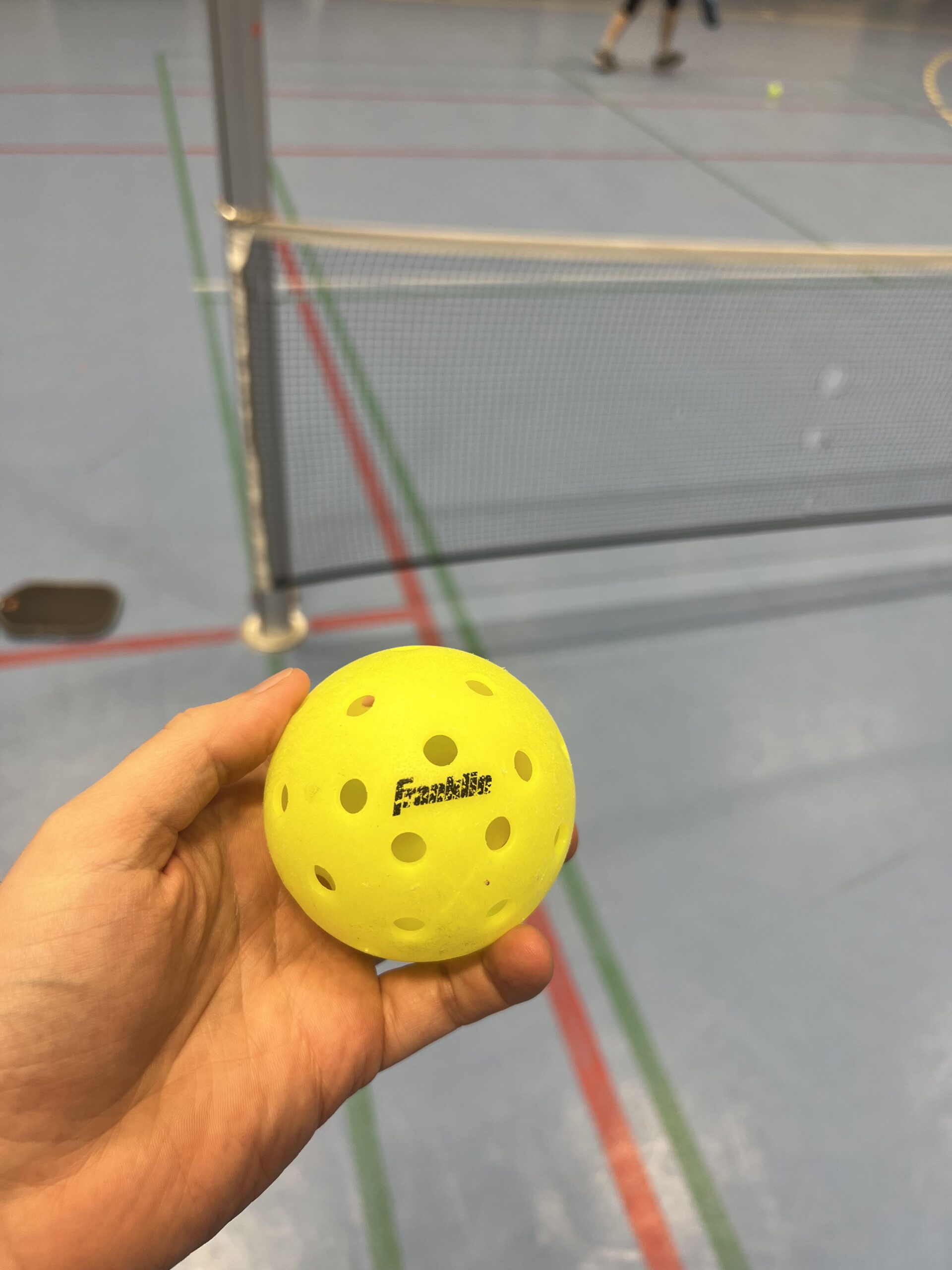
Franklin X-40 — Best Overall Outdoor
Best for: most outdoor players, tournament preparation, clubs and anyone who wants a crisp, familiar competition-style ball.
Skip if: maximum crack resistance matters more to you than playing with the ball I encounter most often in competitive settings.
Why it wins: the X-40 gives me the best overall balance of speed, crisp paddle contact, predictable bounce, stable flight, spin response and familiarity. All 36 balls in my pack were still usable after roughly 40 hours of hard practice and play.
- Fast, lively and crisp without feeling erratic
- Very consistent across my 36-pack
- No cracks or retired balls in my pack after ~40 hours
- Good spin, bounce and stable flight
- Widely recognized and useful for tournament preparation
- I have seen other players’ X-40s crack even though mine have not
- Selkirk Pro S1 still looks stronger to me on durability
- Optic yellow can blend into some yellow/green backgrounds
Bottom line
If I could recommend only one outdoor ball to most players, this is the one I would choose because familiarity and consistency matter as much as any single laboratory-style metric.
Franklin currently lists the X-40 as a 26 g, 74 mm, 40-hole one-piece outdoor ball and identifies it as USA Pickleball approved and the official ball of the US Open Pickleball Championships. Those are manufacturer/tournament facts; my ranking is based on my own use plus the role familiarity plays in real competition.
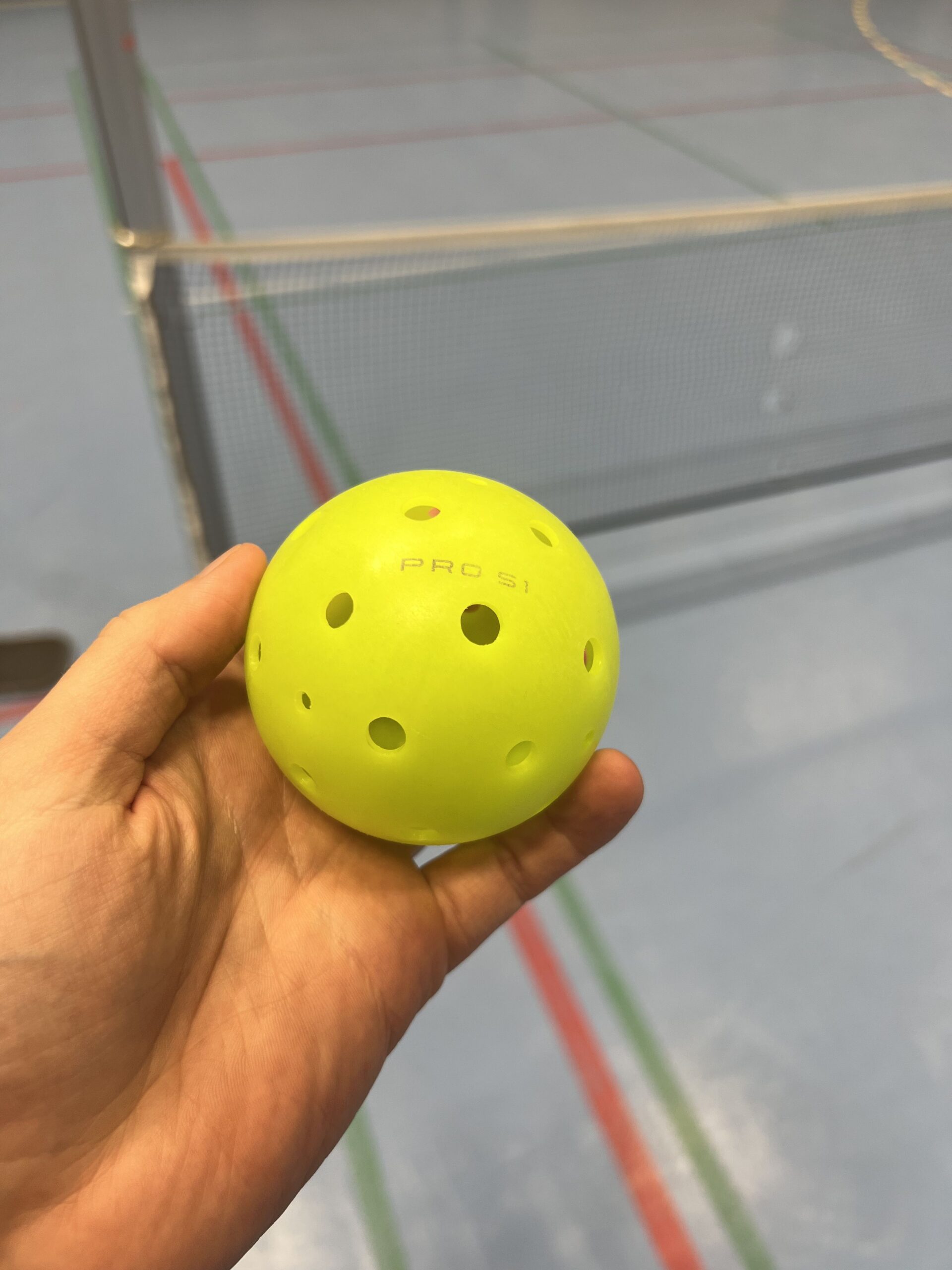
Selkirk Pro S1 — Best for Durability
Best for: clubs, hard hitters and outdoor players who are tired of cracked balls.
Skip if: your main priority is practicing with the exact ball your local competitive scene uses most often.
Why it ranks here: if I ignore tournament familiarity and judge the ball itself, I actually lean toward the Pro S1. It is slightly faster than the X-40 in my feel, stable in flight and has the strongest durability evidence of the outdoor balls I have tested.
- No cracks among the 10 balls still accounted for after 3+ months
- No obvious warping or soft spots in those 10
- Fast, lively pace with consistent bounce and flight
- Two different used balls both measured 26 g on my home scale
- Excellent value at the price I paid
- Slightly harder contact and sharper sound than the X-40
- Less common than Franklin in my own competitive environment
- Two balls disappeared from the club, so their final condition is unknown
Bottom line
For a club or hard hitter who cares most about useful life, the Pro S1 is my strongest pick. I still put Franklin first overall because ball familiarity matters when I am preparing for competition.
Selkirk currently lists the Pro S1 at 38 holes, 0.93 oz and 2.8 inches, identifies it as USA Pickleball approved, and backs it with a one-year no-crack warranty. My durability ranking is based on my own balls rather than the warranty claim.
Indoor pickleballs
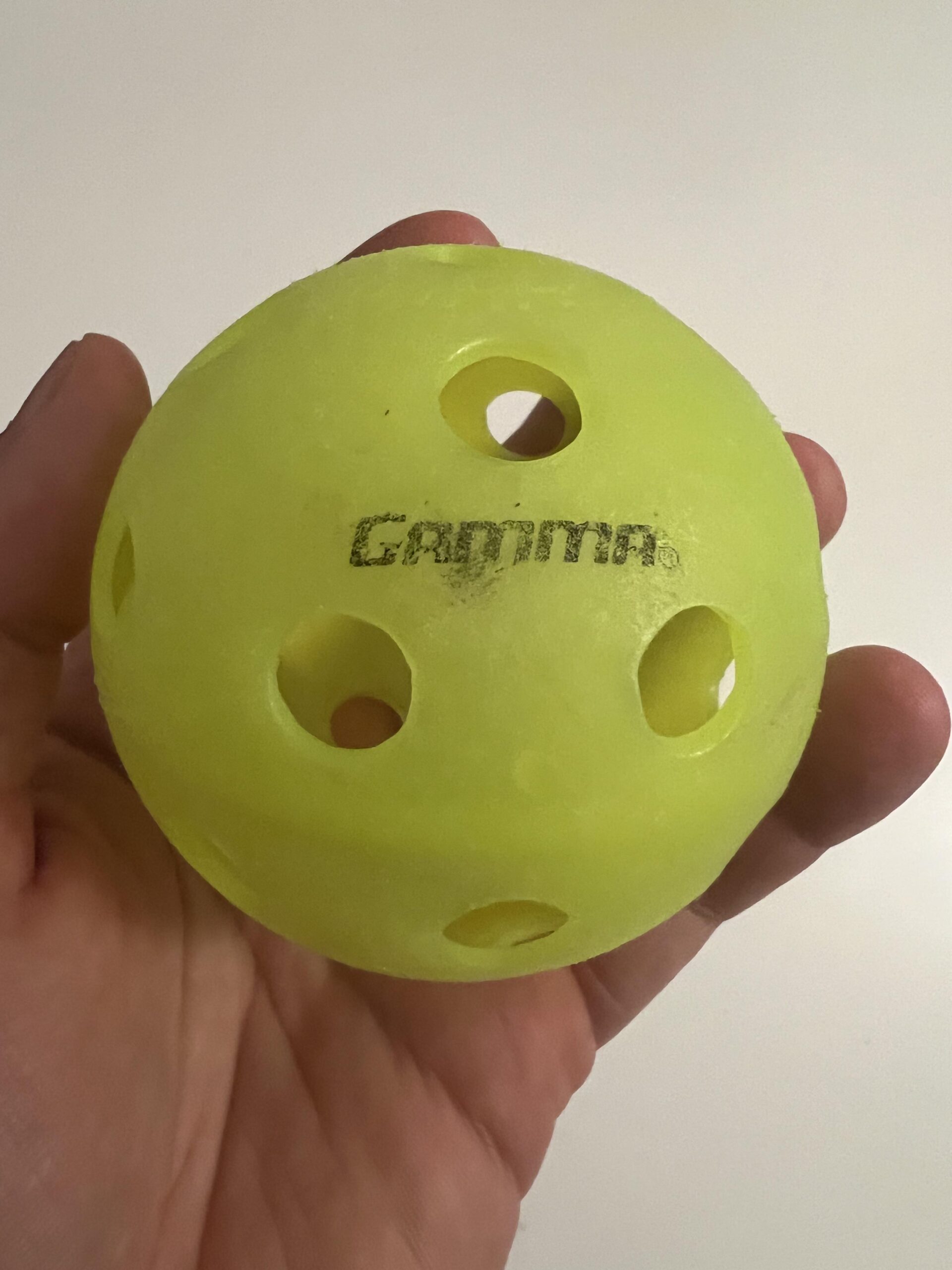
GAMMA Photon Indoor — Best Indoor
Best for: indoor clubs and players who want a more competition-oriented 26-hole ball with a lively, predictable bounce.
Skip if: you mainly want the cheapest casual indoor ball or you play mostly outdoors.
Why it wins indoors: the Photon gives me a medium pace, relatively high bounce, stable flight and good spin. I prefer it to AMOSWIZ for serious indoor play because it feels like the stronger overall club/competitive option.
- Relatively high, predictable indoor bounce
- Stable flight and good spin response
- Good visibility in most halls
- The one surviving ball remains round and playable
- My preferred dedicated indoor ball so far
- One ball cracked and one became oval after several months
- Three balls disappeared, so their durability outcome is unknown
- The price I paid was on the expensive side
- Green can blend into green-heavy indoor backgrounds
Bottom line
If I am choosing specifically for indoor club or competitive play, the GAMMA Photon is the one I would buy from the dedicated indoor balls I have tested.
GAMMA currently describes the Photon Indoor as a high-vis green, 26-hole indoor ball with an Ultra-Balanced two-piece construction and USA Pickleball approval. My score is based on how my six-pack actually behaved in club rotation, not on the marketing claims.
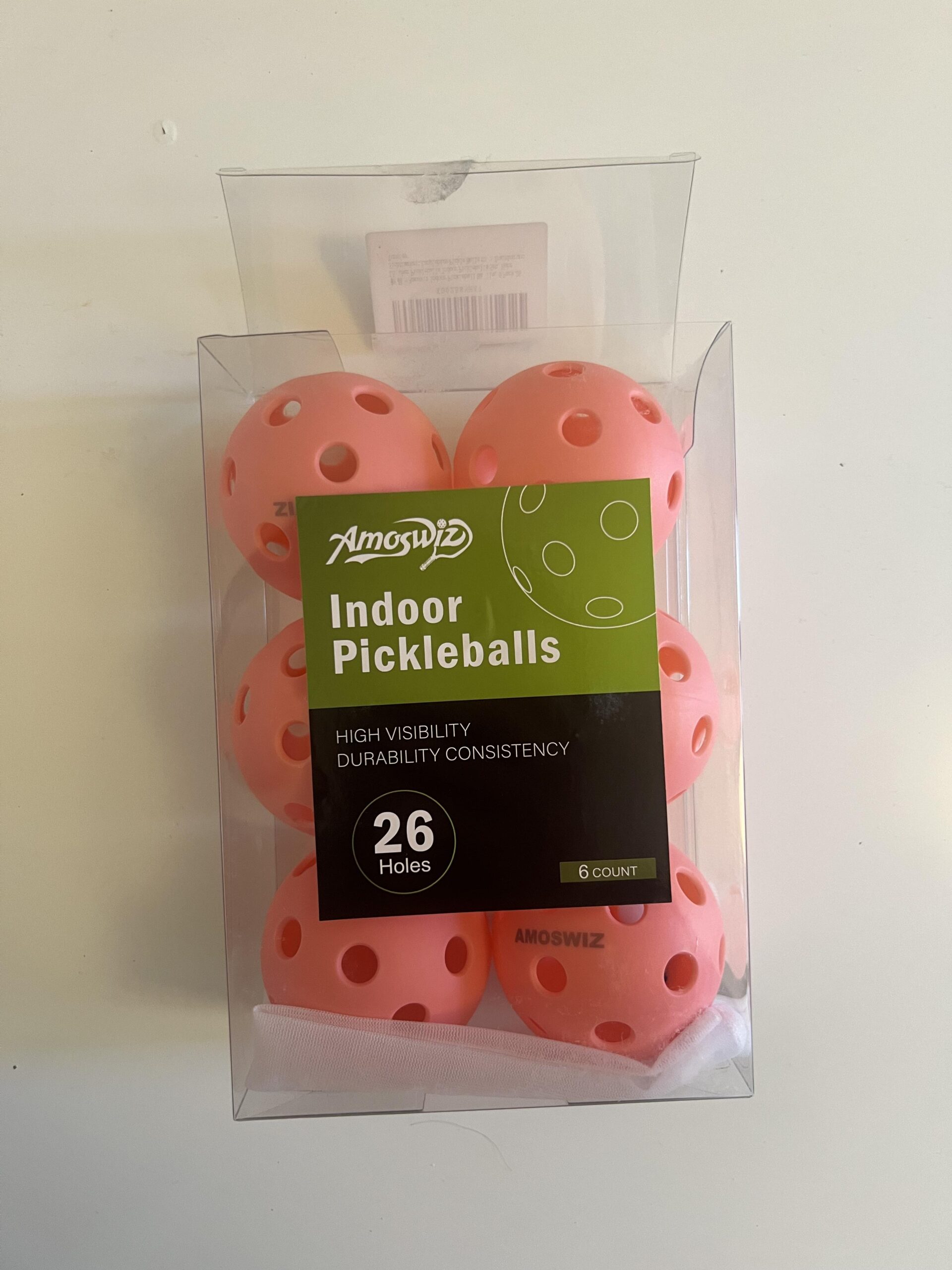
AMOSWIZ 26-Hole — Best for Beginners/Casual Indoor Play
Best for: beginners, casual indoor groups, warm-up drills and players who like a slower, softer ball.
Skip if: you want a faster, more competition-like feel.
Why it makes the list: the AMOSWIZ does not match my preferred pace, but that is exactly why it can suit newer players. The pink color has also been particularly easy for me to see in green-heavy indoor halls.
- Excellent pink visibility in my indoor environment
- Consistent bounce and flight in the early test
- Slower pace can be beginner-friendly
- One tested ball measured 24 g
- Affordable at the price I paid
- Noticeably slower and softer than I prefer
- Can feel a little dead compared with Franklin/Selkirk
- Only ~6 hours of first-hand use so far, so long-term durability is still unproven
- I prefer GAMMA Photon for serious indoor play
Bottom line
AMOSWIZ is not my performance pick, but it makes sense for casual groups that value visibility, a softer pace and lower-pressure rallies.
How I choose between Franklin X-40 and Selkirk Pro S1 outdoors
These two are much closer than a simple #1 and #2 suggests. I rate both 4.6/5, but for different reasons.
I choose the Franklin X-40 when tournament familiarity matters. It is the outdoor ball I personally encounter more often in competitive environments, and I would rather practice with the ball I expect to see in important matches.
I choose the Selkirk Pro S1 when durability matters more. If popularity and tournament familiarity disappeared from the decision, I would lean toward the Pro S1. It feels slightly faster to me, and its condition after months of club rotation has been impressive.
| Factor | Franklin X-40 | Selkirk Pro S1 |
|---|---|---|
| My rating | 4.6/5 | 4.6/5 |
| My rough pace feel | ~8/10 | ~8.5/10 |
| Contact | Crisp, familiar | Slightly harder |
| Bounce / flight | Consistent | Consistent |
| Durability evidence | 0 cracks in my 36-pack after ~40 hours | 0 cracks among 10 known balls after 3+ months |
| My competitive familiarity | Winner | Less common around me |
| If popularity did not matter | Second | My personal preference |
How I choose between GAMMA Photon and AMOSWIZ indoors
The indoor decision is easier for me. I would buy the GAMMA Photon for serious indoor club play. It feels more appropriate for competitive indoor use, with a relatively high lively bounce, stable flight and medium pace.
The AMOSWIZ is a more relaxed ball. It is slower and more subdued in play; in my direct feel comparison, the GAMMA was actually a little softer, but the AMOSWIZ still played less lively overall. I prefer it for beginners, casual groups and situations where visibility matters more than reproducing a faster competition-style rally.
Indoor vs outdoor balls matters more than the number of holes alone
A common shortcut is “26 holes = indoor, 40 holes = outdoor.” That is useful as a rough convention, but it is not a rule you should use blindly. The Selkirk Pro S1, for example, uses 38 holes and is still designed as a serious performance ball.
For everyday play, match the ball to the actual court and group. Smooth gym floors commonly suit softer/lighter indoor-style balls, while rough hard courts and wind usually favor outdoor-style balls. My full indoor vs outdoor pickleball balls guide explains those differences in more detail.
For tournaments, use the exact event ball — not simply my #1 pick
My ranking is a buying recommendation, not a tournament rule. In USA Pickleball-sanctioned competition, the Tournament Director selects the event ball from the current approved-ball list.
That means the best preparation strategy can be simple: if your upcoming event announces a specific approved ball, practice with that exact model even if another ball ranks higher in this guide.
See my tournament ball selection guide for the 2026 rule and preparation advice. You can also check the current USA Pickleball approved-ball list.
What pickleball ball specs actually matter?
Hole count alone does not tell you how a ball will play. In practice, I care about:
- Pace: how quickly the ball gets through the court after contact.
- Bounce consistency: whether repeated bounces feel predictable rather than random or dead.
- Flight stability: whether the ball tracks cleanly without obvious wobble.
- Firmness / contact feel: crisp and hard versus soft and muted.
- Durability: cracking, warping, soft spots and performance change with use.
- Visibility: heavily dependent on court, wall, lighting and background color.
- Approval / event familiarity: important if you compete.
- Value: useful life matters more than purchase price alone.
If you want the legal size, weight, bounce and approval framework behind those differences, see my pickleball ball specifications guide.
Price paid vs value: why the cheapest ball is not always the best value
These are the historical prices I personally paid, not current market prices:
| Ball | Pack I bought | Price paid | Approx. paid per ball | Value takeaway |
|---|---|---|---|---|
| Franklin X-40 | 36 | €110 | ~€3.06 | Worth it to me for high-volume practice and familiarity |
| Selkirk Pro S1 | 12 | €26.22 | ~€2.19 | Excellent value given durability so far |
| GAMMA Photon Indoor | 6 | $21.97 | ~$3.66 | A little expensive, but acceptable for serious indoor use |
| AMOSWIZ Indoor | 6 | €11.99 | ~€2.00 | Cheap entry point, but slower than I prefer |
Current prices move, currencies differ, and pack sizes affect unit cost, so I would not use this table as a live price comparison. It is first-hand context showing what I actually paid.
Why only four balls?
Because I would rather publish four rankings backed by real court use than add six research-only products to make the article look bigger.
There are important balls I have not ranked yet. Current market guides prominently discuss models such as the Dura Fast 40 and newer competition balls such as the Life Time LT Pro 48, and Franklin also sells the X-26 specifically for indoor play. I will add another product only after I have enough evidence to say something more useful than a manufacturer-spec summary.
This also means the order can change. If I test another ball that is clearly better for a specific use case, this guide should evolve rather than protect the current winners forever.
Which pickleball ball should you buy?
Frequently asked questions
What is the best pickleball ball overall?
Of the balls I have personally tested, I choose the Franklin X-40 as the best overall outdoor ball because it combines consistent play, competition familiarity and strong durability in my 36-pack. Indoors, I prefer the GAMMA Photon.
Which pickleball lasts the longest?
The Selkirk Pro S1 has the strongest durability case in my testing so far. Ten of the 12 I bought are still accounted for after more than three months of club rotation, and none of those ten has cracked, become obviously oval or developed a soft spot. The other two disappeared, so I cannot score their final condition.
Franklin X-40 or Selkirk Pro S1?
I choose Franklin when tournament familiarity matters and Selkirk when durability matters more. If both were equally common in my competitive environment, I would personally lean toward the Pro S1.
What is the best indoor pickleball?
Of the dedicated indoor balls I have tested, GAMMA Photon is my pick for serious indoor play. AMOSWIZ is slower and softer and makes more sense to me for beginners or casual groups.
Are 26-hole balls always indoor and 40-hole balls always outdoor?
No. Those are useful conventions, not absolute rules. The exact model, design and intended use matter more than counting holes alone.
Should I use the same ball my tournament uses?
Yes, when you know the designated event ball. Practicing with the exact model helps you calibrate serve depth, bounce, drops, drives and touch before competition.
Methodology and sources
This guide is a hands-on buying guide for the four ranked products. Each ranked ball has a separate full review based on my own purchase/use, and the ratings shown here are copied from those reviews rather than recalculated for this page.
I also checked current primary sources for exact product positioning and approval context:
- Franklin Sports — X-40 official product information
- Selkirk — Pro S1 official product information
- GAMMA — Photon Indoor official product information
- USA Pickleball — current approved-ball list
I have not independently verified AMOSWIZ as a sanctioned tournament ball, so I recommend it here for casual indoor use based on my experience rather than tournament approval.

Jonathan Grøn is a pickleball player and racket-sports enthusiast who focuses on practical doubles strategy, rules, skills, and training. He combines regular on-court experience with research from official rules, coaching resources, and other authoritative sources to create clear, useful pickleball guides.