Niupipo Indoor Pickleballs Review: My 1–3 Hour Test
Niupipo indoor pickleballs review after 1–3 hours of play: I bought these yellow and orange balls myself around October 2026, without a discount, free product, sponsorship or payment. My early verdict is cautious and mostly negative: they were difficult for me to control during fast exchanges, visibility depended on the hall lighting, and I preferred the AMOSWIZ indoor balls I have also used. I would choose another brand next time.
This is a genuine first-hand early-use review, not a laboratory test or a claim about long-term performance. I have not timed an exact three-hour test or measured bounce, speed, weight or spin.
Affiliate disclosure: As an Amazon Associate I earn from qualifying purchases. The Amazon link below is a search-results link, not a verified checkout listing for the exact photographed variant. If you follow it and buy a qualifying item, this site may receive a commission at no extra cost to you. I bought my own balls at the ordinary price and did not receive any compensation for this review.
Niupipo Indoor Pickleballs — my early 2.4/5 verdict
My real-use verdict: I found the balls hard to control when rallies got fast. Their visibility depended on the lighting in the hall, and I preferred the AMOSWIZ indoor balls I have personally tried.
What went well: I have seen no cracks or deformation so far, but that is only after 1–3 hours — not a meaningful durability test.
Who should skip them: Players who prioritize dependable control in rapid exchanges, or anyone who already likes AMOSWIZ and expects these to be an upgrade.
- None of the balls I used has shown a crack or deformation during my short trial.
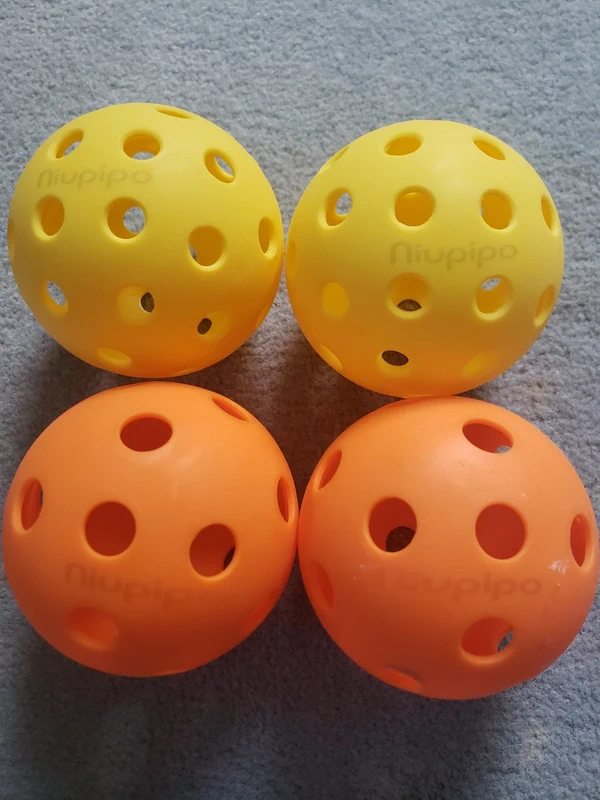
- The photographed balls are clearly identifiable as niupipo and come in yellow and orange.
- Harder for me to control in fast exchanges.
- Visibility changed with the lighting conditions in my hall.
- Worse for me than the AMOSWIZ indoor balls I have also used.
- I would personally buy another brand next time.
- Only 1–3 hours of use: I cannot fairly judge durability yet.
Bottom line
2.4/5 from my early first-hand use. Niupipo did not win me over. The negative control experience and my preference for AMOSWIZ matter more to my buying decision than the absence of cracks after just a few hours. My recommendation could change after further use, but I would not currently choose these again.
Exactly what I used — and what I have not verified
- Brand: niupipo, identified on my own yellow and orange balls.
- Type: large-hole indoor-style pickleballs. Niupipo markets a 26-hole indoor ball, but the precise SKU or Amazon variant cannot be confirmed solely from these loose-ball photographs.
- Purchased: approximately one month before this November 10, 2026 review; I paid myself, without a discount, gift or sponsorship.
- Actual playtime: approximately 1–3 hours.
- Photos: four loose balls — two yellow, two orange. This does not establish the original retail pack size.
- Not measured or verified: ball weight, exact bounce height, deformation rate, number of rallies, purchase receipt price, and exact Amazon ASIN.
The short trial is enough to report my immediate control and visibility experience, but not enough to make claims about long-term crack resistance, consistency over months, or performance in every kind of gym. I have not claimed to have run standardized tests or compared products simultaneously under identical conditions.
Fast exchanges: where these balls disappointed me
My clearest negative observation was control during fast exchanges. When the pace picked up, I found the Niupipo balls difficult to control. That is a real impression from my own play, not a measured difference in speed or bounce. I cannot honestly tell you that a particular third-shot drop, reset or named match turned out differently: I did not document that level of detail during this short test.
For me this is important because a ball needs to feel manageable when reactions are quick. I do not want to call a ball objectively inconsistent or defective based on one person’s early impression. I can say these balls were not the ones I would choose for that part of my play.
Yellow and orange visibility depended on the hall lighting
The bright colors may look easy to track in photographs, but my actual experience was more conditional: visibility depended on the lighting in the hall. I did not establish that orange was always easier to see than yellow, or vice versa. Lighting and background matter, so I would not promise better visibility just because a ball has a vivid color.
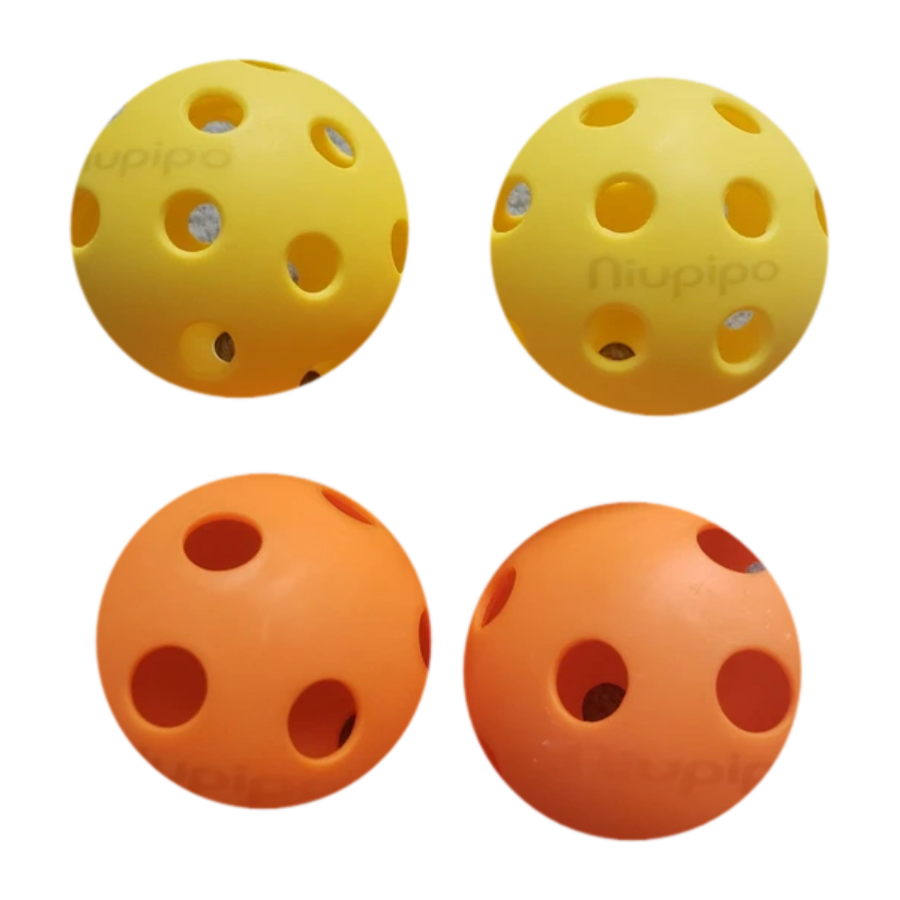
No cracks yet — but I cannot judge longevity
After approximately 1–3 hours I have not seen cracks or deformation. That is encouraging as a basic early-condition check, but it tells me very little about what might happen after ten, fifty or a hundred hours. I am not calling them durable or claiming they will never split.
Similarly, I cannot estimate an accurate playing-hour count from the photo surface alone. The playtime stated here is my own confirmed recollection, not an estimate based on cosmetic wear.
Would I buy Niupipo again? No — I prefer AMOSWIZ
I have also played with AMOSWIZ indoor 26-hole pickleballs, and my genuine preference is AMOSWIZ over these Niupipo balls. That is a subjective comparison based on my actual experience with both products, not a controlled head-to-head test or a claimed performance percentage.
I would choose a different brand rather than repurchase these Niupipo balls. I do not have a verified invoice amount or matching live Amazon US checkout price for the exact photographed product, so I will not invent a “price paid,” discount, dollar-per-ball calculation, or price-based value score.
My first-hand rating: 2.4/5
This is my editorial judgment from the specific observations above. Four criteria are used, weighted to 100%. The preliminary physical-condition category is neutral because a few hours without damage cannot establish durability. No figures are borrowed from other reviewers.
| Criterion | Weight | Score | Evidence |
|---|---|---|---|
| Control in fast exchanges | 40% | 2.0/5 | I found control difficult as the pace increased. |
| Visibility in my hall | 20% | 3.0/5 | It depended on the lighting; I have no consistent winning color to report. |
| Initial physical condition | 15% | 3.0/5 | No cracks/deformation observed, but only 1–3 hours of use. This is not a durability score. |
| Comparison and repurchase decision | 25% | 2.0/5 | I prefer my AMOSWIZ balls and would choose another brand next time. |
Calculation: (2.0 × 40%) + (3.0 × 20%) + (3.0 × 15%) + (2.0 × 25%) = 2.35, rounded to 2.4/5. The visible stars show the same 48% proportion. This is not a laboratory-grade measurement or an average of customer reviews.
How Niupipo compares with my other published indoor-ball reviews
| Personally reviewed ball | Published rating | Documented use | Decision-relevant experience |
|---|---|---|---|
| Niupipo (this review) | 2.4/5 | 1–3 hours | Harder to control in fast exchanges; visibility depends on lighting; I would not repurchase. |
| AMOSWIZ 26-hole indoor | 3.7/5 | About 6 hours of club use | Softer, slower indoor feel, good visibility in that earlier test. My confirmed preference is AMOSWIZ over Niupipo. |
| GAMMA Photon Indoor | 4.2/5 | About 9 months in club rotation | Preferred indoor performance in that earlier review, alongside a mixed long-term damage/loss record. I did not confirm a direct Niupipo–GAMMA trial. |
These are separately published, first-hand editorial ratings from different periods and different evidence bases. They are not the results of a simultaneous, standardized side-by-side test. Scores and criteria can differ between reviews.
For more context, see my hands-on pickleball balls buying guide and the Pickleball Ball Selector. Neither guide’s previous tested-product count should be treated as automatically updated by this newly published early review.
FAQ about these Niupipo balls
Have I tested Niupipo indoor pickleballs myself?
Yes. I personally used the yellow and orange Niupipo balls for approximately 1–3 hours after buying them with my own money. This is an early first-hand review, not a long-duration club test.
Are they good for quick indoor exchanges?
Not in my early experience. I found them hard to control during fast exchanges. That is a qualitative judgment from my play, not a measured flaw affecting every player.
Are Niupipo balls durable?
I have not seen cracks or deformation yet, but 1–3 hours is not enough to tell whether they last. I am explicitly leaving long-term durability unresolved.
What is the Amazon.com price?
I could not reliably verify the current Amazon.com price or exact ASIN for the yellow and orange balls pictured here on November 10, 2026. The paid Amazon search link above lets buyers identify the right variant and check the seller’s live price themselves; the cost of a different Niupipo paddle-and-ball set must not be mistaken for this ball price.
Source for manufacturer-listed model features: Niupipo Indoor Pickleball Balls (manufacturer storefront; marketed as 26-hole indoor balls). Manufacturer marketing statements are not treated as findings from my personal test.

Jonathan Grøn created The Pickleball Wise. He coaches beginner pickleball players and captains a pickleball team in Series 2. He combines on-court experience with official rules and coaching resources to write practical guides on doubles strategy, skills, and training.