Omega Evolution Extreme 12.7mm Demo Review: My 6–15 Hour Test (4.3/5)
My Omega Evolution Extreme 12.7mm DEMO review after 6–15 hours: I bought this exact 1/2-inch (12.7mm), standard-shape Omega Evolution Extreme as a used, DEMO-marked paddle in August 2026 for $45.00 USD. I paid for it myself, without a discount or sponsorship. I mainly used it in indoor doubles with indoor pickleballs. I enjoyed the precise dinks, controlled third-shot drops, quick hands, forgiving-feeling sweet spot and firm but comfortable contact.
My biggest adjustment was that some balls went too long while I learned the paddle’s response. That is a genuine negative and helps keep this from becoming an unqualified five-star assessment. I also found the playing surface grippy, the paddle lighter than I expected, and the grip comfortable in my hand. Compared with my earlier experiences of Engage Pursuit and Encore paddles, I personally preferred the Omega Evolution Extreme, although I did not identify the precise versions of those comparison paddles.
Overall editorial rating: 4.3/5. This is an original weighted editorial judgment based on my verified firsthand answers—not a number I chose or an average of other people’s reviews. The detailed seven-category calculation is shown below. The earlier use history of this particular DEMO paddle is unknown, so I will not attribute the visible scuffs or grip marks to my own test, or pretend the review establishes long-term durability of a new sample.
Amazon affiliate disclosure: As an Amazon Associate I earn from qualifying purchases. The Amazon.com search links on this page use tag owlratings08-20, which may generate a commission for qualifying purchases at no additional cost to you. My reviewed sample was self-purchased as a used DEMO paddle, not supplied by a sponsor. The links open Amazon US search results, not an independently verified exact-item checkout or ASIN. Check the standard Omega Evolution Extreme 1/2-inch model carefully; this is not the elongated Extreme X or the thicker 5/8-inch version.
My verdict: easy placement and fast hands, with pop to learn
Dinks and drops: I could place dinks accurately and play controlled third-shot drops.
Quickness: the paddle felt lighter than I expected, and I could react quickly during hands battles.
Sweet spot: I found the contact area large and forgiving, though I did not measure it.
Pop adjustment: I sent some balls too long while adapting to the paddle’s response.
Face feel: the surface felt grippy against the ball; this is not an instrumented spin-rate result.
Grip and impact: the grip as received felt good, impact felt firm and solid, and I noticed less vibration than with my previous unnamed paddle.
Personal preference: I liked this Evolution Extreme more than Pursuit and Encore paddles I’d played; exact comparator versions weren’t supplied.
Value: I felt the $45.00 used-DEMO purchase was worth it, without knowing the unit’s prior play hours.
What I personally liked
- Precise dink placement and controlled third-shot drops
- Light-feeling, responsive handling in fast hands battles
- Large, forgiving-feeling sweet spot
- Good subjective ball grip from the textured face
- Firm, solid contact and less felt vibration than an earlier paddle
- Grip fitted comfortably in my hand
- Preferred it overall to the Pursuit and Encore paddles I had tried
What I actually disliked or cannot verify
- Some balls went too long during the adjustment period
- Earlier use of this DEMO sample is unknown, even though I bought it used
- I cannot assign the photographed face/grip marks to a specific owner or playing session
- No long-term face, core, edge guard or grit durability test
- No measured speed, spin RPM, scale weight or exact grip-modification history
Bottom line: 4.3/5 editorial rating
In my 6–15 hours of indoor doubles, this used 12.7mm Omega demo impressed me most for soft-game placement, quick handling, forgiveness and solid contact. It also required adjustment: some balls flew long. I preferred it to the Pursuit and Encore paddles I had tried, but the previous models and demo’s earlier use were not specified. The editorial 4.3/5 reflects my firsthand strengths, the power-control drawback and the limits of this particular sample.
Which Omega Evolution Extreme did I actually test?
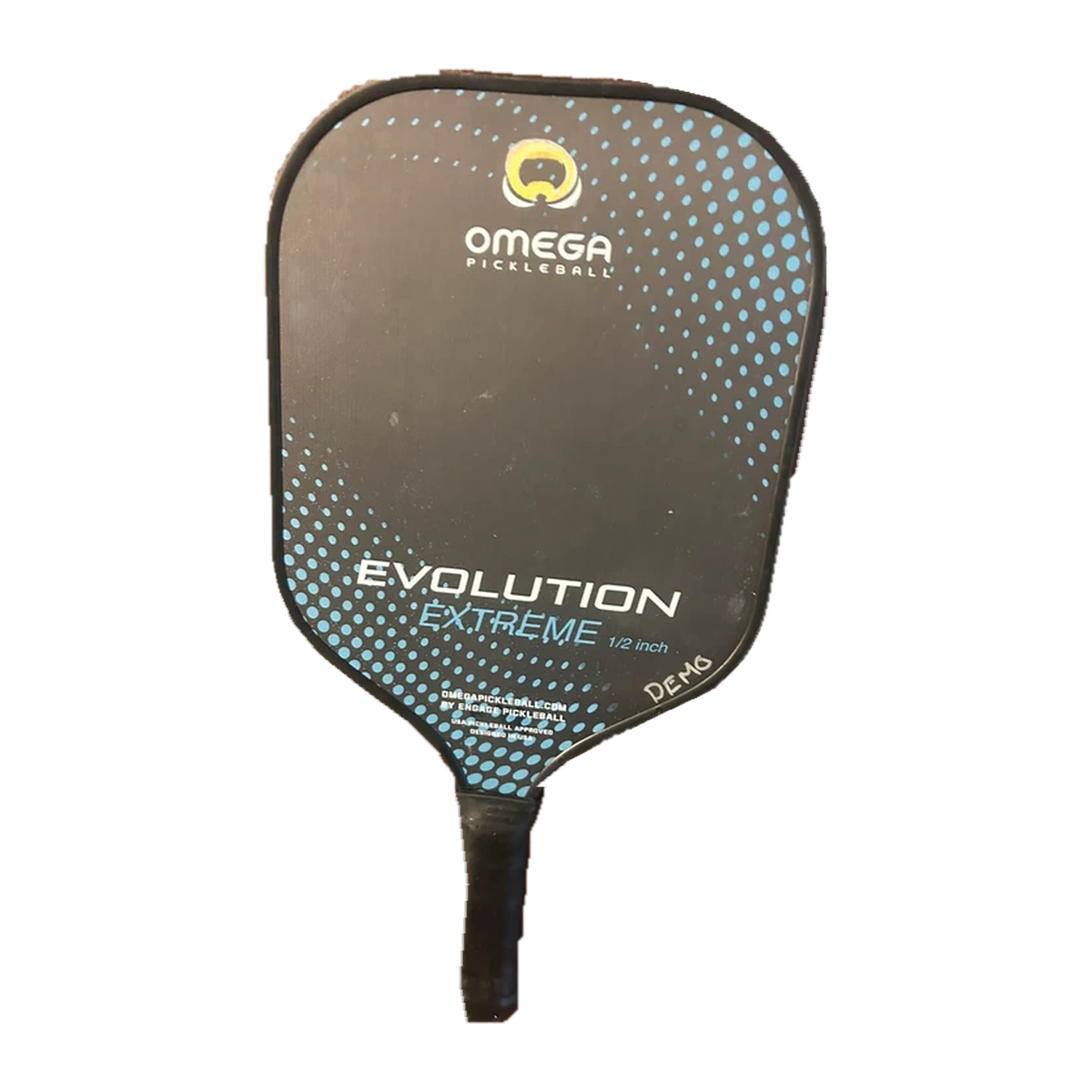
My original photograph shows a black Omega Pickleball face with blue dot patterns, a yellow Omega logo, the printed EVOLUTION EXTREME model name, a clear 1/2 inch thickness marking, a black edge guard and dark grip. The word DEMO is written diagonally near the lower-right face. This image is a genuine photographed sample with the background removed; the paddle graphics, handwritten label and visible condition were retained.
This is the original standard-shape Evolution Extreme, not the longer Evolution Extreme X and not the thicker 5/8-inch (about 16mm) Evolution Extreme. A seller’s newer image of a similar Omega or Engage paddle should not override what is printed on my actual sample.
There are two distinct facts about provenance. First, I bought this exact paddle as a used DEMO for $45.00 USD in August 2026 without a discount or sponsor. Second, I do not know how many hours other players might have put on it beforehand. The DEMO writing and visible surface/grip marks do not, on their own, establish those earlier hours or where any wear originated.
My firsthand test: 6–15 hours of indoor doubles
I played mainly indoor doubles with indoor pickleballs for 6–15 hours after acquiring this unit. I did not provide exact session counts, ball brand, court type beyond indoor play, scale measurements or a controlled pre-demo baseline. My impressions are therefore a real but limited on-court test of one previously used paddle.
Dinks and third-shot drops: my main control strengths
I found that I could place dinks accurately, and I could also make controlled third-shot drops. That is meaningful because these two shots demand well-judged placement even though their tactical situations differ.
These observations share a broader soft-game theme and are combined in one rating criterion. I did not report precise dink depth on every attempt, a shot success percentage, measured drop accuracy or a separate defensive-reset result, so those details are not claimed here.
Light feel and quick reactions in hands battles
The paddle felt lighter than I expected. I could also react quickly in fast hands battles at the net. Together they made the handling feel like one of the successful parts of my indoor doubles test.
I did not weigh this particular used DEMO paddle or measure swingweight. The subjective light feeling should not be mistaken for a verified manufacturing weight specification, and my quick reactions are not a standardized test against another bat.
Sweet spot: large and forgiving to me
I reported that the sweet spot felt large and forgiving. This is a direct firsthand impression of how the standard-shaped paddle responded when I played.
I did not supply a measured sweet-spot area, a location-by-location comparison with another paddle, or a test of how every edge contact performs. It would be too much to claim that the demo had perfect consistency across the entire face or that it had no internal wear.
Some balls went long while I adjusted
One clear limitation was that I hit some balls too long during the adjustment period. That is a genuine issue for power management and shortens my praise for the paddle.
I did not state that every drive or serve was especially powerful, or that this paddle caused permanent overhitting. The careful conclusion is narrower: its response required me to adapt my shots and sometimes produced more depth than I intended early on. My editorial power/pop-management score is lower because I actually experienced this trade-off.
Grippy surface: what I felt versus what I measured
I felt that the face grabbed the ball well. That was a positive contact impression, consistent with the advertised textured-carbon face.
However, I did not submit an independent firsthand result for measured topspin, dipping drives, slice or spin rate, nor did I establish how long the texture lasts. I therefore rate surface grip feel, not a fabricated spin-RPM result or verified long-term grit retention.
Solid contact and reduced felt vibration
Contact felt firm and solid, and I noticed less vibration than with a paddle I had used previously. I also liked the grip as I received it.
The earlier paddle was not named, and no vibration instrument was used. This is a relative comfort impression, not a claim about medical benefits, elbow pain treatment or guaranteed vibration absorption. I identified the grip as original in my answer, but the demo’s earlier modification history is not independently known, so I cannot prove no one had ever changed the wrap.
Why I preferred it to Pursuit and Encore
I also confirmed that I preferred the Evolution Extreme overall to the Engage Pursuit and Encore paddles I had tried. In a second answer I restated that I chose the Omega over both after playing it. Those are two expressions of the same overall comparison; I do not count them as separate weighted performance categories.
I did not name the exact Pursuit and Encore versions or test protocol. It would be misleading to turn my preference into a claim that the Omega always delivers more spin, control or power than any Pursuit or Encore version. The review records the preference without inventing a head-to-head specification table.
Buying an actual used DEMO paddle: why the history matters
My unit had a visible DEMO inscription, and I bought it as a used demo. What I cannot say is whether it had been used for two sessions or many months before I bought it, whether anyone else had changed its grip, or whether a specific scuff came before or after my own sessions.
That distinction matters in particular for durability. I left the wear and long-term core/edge/face questions unanswered, so the score does not silently treat the demo as either factory fresh or damaged. I have not assigned a durability subscore. At most, this review documents that the paddle provided the playing impressions described during my own 6–15 hours.
For another buyer considering an older demo, inspecting the face, edge guard and grip and asking about its prior use would be sensible. That is general buying advice, not proof that my unit was structurally compromised.
Published model specifications – not measurements of my DEMO
| Specification | Manufacturer-/retailer-described original ½-inch Evolution Extreme |
|---|---|
| Version | Omega Evolution Extreme standard shape, ½ inch / approximately 12.7mm, physically marked on my face |
| Length × width | About 16 × 8 inches |
| Core | HoldTEK polymer honeycomb |
| Face | Textured omni-directional friction-enhanced T700 carbon fiber |
| Handle length | About 5 inches |
| Grip circumference | Approximately 4¼ inches before any unknown history of a demo wrap |
| Advertised weight | Retailer values conflict: JustPaddles lists 7.4–7.7 oz, while PickleballWholesale lists 7.8–8.1 oz for its 13mm version. My own unit was not weighed |
| Sample-specific label | Handwritten ‘DEMO’ visible near the lower-right face; prior usage details unknown |
Sources: JustPaddles’ exact ½-inch listing, PickleballWholesale’s 13mm/16mm listings, and Approach Pickleball’s historical product page. These descriptions are external specifications, not measurements I made or firsthand evidence of my sample’s spin or performance. Current retailer availability and event approval were not verified for my used DEMO unit.
External player perspectives – separated from my test
In a 2022 Reddit discussion, a player who had just acquired the original Omega Evolution Extreme said they liked it more than their Pursuit and Encore. In a separate discussion, another owner said they chose to keep the Omega after using other Engage models. The commenters did not independently identify a half-inch DEMO unit like mine, so their accounts remain distinct from my own comparison.
Another reported experience on a retailer aggregation page concerned the thicker 5/8-inch original Evolution Extreme, where a user described an adjustment to extra response and less felt vibration. That is not the same core thickness, and it cannot establish those results for my 12.7mm example. This review’s performance statements are based instead on my own answers.
Why the editorial rating is 4.3/5
I did not select an overall 1–5 score. The following seven subscores are original editorial interpretations of the areas I genuinely tested. They are weighted to 100% without inventing results for categories I left unanswered. Repeated questionnaire choices—for example, my two versions of preferring Omega to Pursuit and Encore—are consolidated rather than rewarded twice.
| Firsthand-supported criterion | Weight | Editorial subscore | Rationale and limit |
|---|---|---|---|
| Dink and third-shot drop placement | 25% | 4.5/5 | I placed dinks accurately and made controlled third-shot drops. Related soft-game skills are grouped, not counted as several independent scores. |
| Maneuverability and quick hands | 15% | 4.5/5 | The paddle felt lighter than expected and I reacted quickly in hands battles. Both observations support a single handling theme. |
| Sweet-spot forgiveness | 15% | 4.5/5 | The sweet spot felt large and forgiving, without a measured sweet-spot map or detailed edge-response test. |
| Power/pop management during adaptation | 15% | 3.6/5 | Some balls went too long while I adjusted. This is a real negative, but I did not measure serve/drive power or report a systematic power advantage. |
| Face traction feel | 10% | 4.0/5 | The face felt like it gripped the ball. This does not establish actual spin RPM or long-term texture performance. |
| Grip and impact quality | 15% | 4.4/5 | The grip as received felt comfortable, contact felt firm/solid and I noticed less vibration than with a previous unnamed paddle. No medical or instrumented conclusion. |
| Value of my used DEMO purchase | 5% | 4.3/5 | I personally paid $45.00 USD in August 2026 for a used DEMO paddle without a discount or sponsorship, and felt it was worth what I paid. |
Arithmetic: (4.5 × 25%) + (4.5 × 15%) + (4.5 × 15%) + (3.6 × 15%) + (4.0 × 10%) + (4.4 × 15%) + (4.3 × 5%) = 4.290/5. Rounded to one decimal, the overall result is 4.3/5, matching an 86% fill of the five-star product-card display.
The lower 3.6/5 adaptation/pop subscore makes sure the balls I hit long matter. The manufacturer specifications, other players’ scores, unknown earlier DEMO hours and unanswered durability issues have not supplied extra positive or negative subscores. I rated the buying value specifically for my $45.00 used-DEMO purchase, not the full retail cost of a new paddle.
Who might like this paddle?
From my test, the original thin-core Omega Evolution Extreme is worth considering for players who value controlled dinks and drops, quick hands, a forgiving-feeling standard shape and a firm, stable-feeling impact. I personally liked it more than the Pursuit and Encore paddles I had previously tried, although that does not establish a universal product ranking.
There is a learning curve: I sent some balls too long initially. Buyers should also treat an unknown-history demo differently from a new unit, particularly where visible wear and future durability are concerned. My positive value assessment applies to the particular used sample for which I paid $45.00.
Other genuine owner paddle reviews
For separate paddle experiences—not assumed controlled head-to-head tests—see my Engage Pursuit Pro1 Innovation 15.2mm review and Engage Raven Wide Body Blue review. Those articles cover distinctly identified models; my own answers here did not identify which exact Pursuit version I compared directly against the Omega.
Frequently asked questions
Is the Omega Evolution Extreme 12.7mm the same as Extreme X?
No. My unit is the original standard-shape, roughly 16 × 8-inch Evolution Extreme with 1/2 inch printed on its face. The Extreme X is a separate elongated model. My review also does not cover the thicker 5/8-inch standard version.
What does DEMO mean in this review?
I bought the exact paddle used with a handwritten DEMO marking for $45.00 USD. I do not know its earlier hours of use or who handled it previously. The label alone cannot establish that history.
How much did I actually play with it?
6–15 hours, mainly indoor doubles using indoor balls, with no detailed session count or laboratory test.
Were dinks and third-shot drops easy to control?
For me, yes: I placed dinks precisely and made controlled third-shot drops. I did not provide a success rate or measured drop distance.
Did it feel quick at the kitchen line?
It felt lighter than expected and I could react quickly in hands battles. My individual demo was not weighed.
Did it have too much pop?
I did hit some balls too long while adjusting. That is an actual drawback I noticed, but I did not measure its power or say the problem persisted throughout all 6–15 hours.
Did its carbon face produce spin?
I found that the face felt grippy. I did not record a distinct topspin RPM, slice performance or grit-wear test, so the review does not invent these outcomes.
Did the paddle vibrate?
Impact felt firm and solid, and I noticed less vibration than with a paddle I had used before. The comparison model was not identified, and no objective vibration measurement was taken.
Was it better than Engage Pursuit and Encore?
I personally preferred it overall to the Pursuit and Encore paddles I had tried. I did not specify the versions, so the review makes no universal comparison to all Pursuit and Encore models.
How did you arrive at the 4.3/5 rating?
Seven supported firsthand categories were weighted to 100%. The weighted result was 4.290/5, displayed as 4.3/5. It is a site-calculated editorial score, not a number I personally selected or an average of other buyers.
Was the $45.00 purchase price for a new paddle?
No. It was the price I personally paid for a used DEMO in August 2026 without a discount or sponsorship. It is not a current price for a brand-new Omega Evolution Extreme.
Firsthand methodology and limitations
This review is tied to the actual photographed standard 1/2-inch DEMO paddle I played. Firsthand claims are drawn only from my stated 6–15 hours, indoor doubles/indoor balls, light feel, long balls under adjustment, precise dinks, controlled third-shot drops, quick net reactions, large-feeling sweet spot, grippy face, comfortable grip, solid contact, less vibration, personal preference over Pursuit and Encore, and self-funded $45.00 used-DEMO value assessment. Historical specifications and other players’ opinions are clearly separated. I did not verify earlier DEMO ownership, current market price, exact Amazon ASIN, measured spin, measured mass, long-term durability, grip modifications, present tournament approval or medical benefits.

Jonathan Grøn created The Pickleball Wise. He coaches beginner pickleball players and captains a pickleball team in Series 2. He combines on-court experience with official rules and coaching resources to write practical guides on doubles strategy, skills, and training.