Engage Trident Blue Review: My 6–15 Hour Firsthand Test (4.4/5)
My Engage Trident Blue review after 6–15 hours: I purchased the original blue Engage Trident brand new for $59.99 USD in September 2026, paying the normal price myself without a discount or sponsorship. I mainly used it for indoor doubles with indoor pickleballs. The most meaningful improvements for me were more accurate dinks after a few games, soft contact, comfortable handling and good serve spin. I also found it easy to connect cleanly and liked the way it absorbed hard returns.
I did not appreciate all of its advantages immediately. It took several games before the benefits became clear, and then my dinks felt more precise than with my previous, unnamed paddle. That learning period matters: this was a positive experience, but not a claim that the Trident automatically improved everything from the first rally.
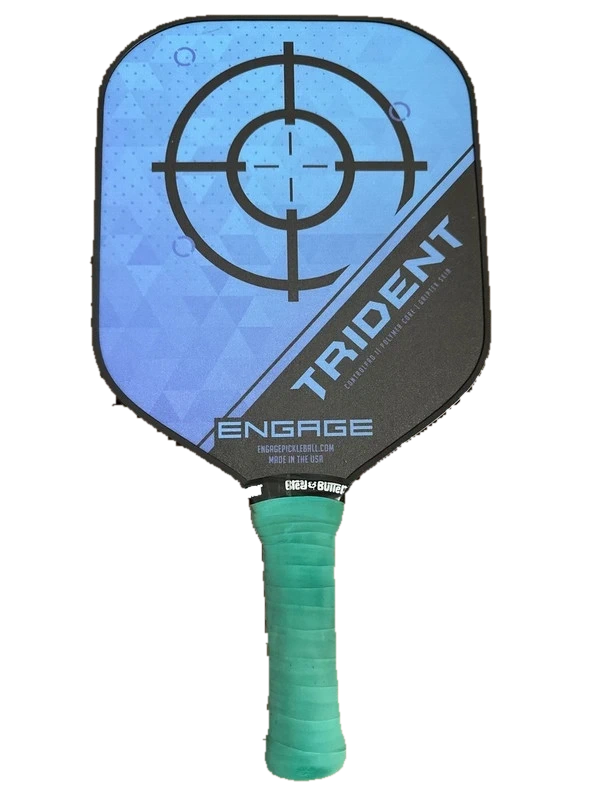
I also liked the turquoise-green grip visible on my real product photograph. It fitted my hand well and felt like the right thickness. But I have not provided who installed that wrap, so I cannot claim it is factory-original or that I personally installed it.
Editorial overall rating: 4.4/5. This number is an independent site calculation from the firsthand areas I actually described. It is not a rating I personally selected or an average of third-party reviews. It does not score power, third-shot drops, long-term wear or other things I left unanswered. See the seven supported areas and their 100%-weighted calculation below.
Affiliate disclosure: As an Amazon Associate I earn from qualifying purchases. The Amazon.com search links on this page contain the affiliate tag owlratings08-20. A qualifying purchase can earn the site a commission without an added cost to you. I bought the photographed Trident new with my own money at the normal price I paid and had no discount, gift or sponsorship. The links lead to Amazon US search results, not a verified exact-item ASIN, live offer or guaranteed listing for my particular blue version.
My verdict: better dinks after a few games and a soft, controlled feel
Dinks: after a few games, my dink placement improved over my previous paddle, which I did not name.
Touch: contact felt soft, and short shots felt damped rather than harsh.
Defense: I found the paddle absorbed hard returns well.
Serve spin: I could put good spin on my serves, but I did not measure RPM or report all other spin techniques.
Contact: the face made it easy for me to hit the ball cleanly and securely.
Weight feel: the Trident felt light and lighter than I expected; I did not weigh my particular sample.
Grip: the turquoise-green grip fitted my hand and had a suitable thickness, but I did not confirm who mounted it.
Scope: I gave no firsthand power, third-shot-drop or durability result, so these are not scored.
What I actually liked
- Improved dink accuracy after getting used to it
- Soft contact feel and damped short shots
- Absorbed hard returns effectively in my play
- Good spin on my serves
- Easy, secure ball contact
- Light-feeling paddle, lighter than I had expected
- Turquoise-green grip felt comfortable and appropriately sized
Trade-offs and what I cannot verify
- It took several games before I appreciated the benefit; the improvement was not immediate
- No reported power, hard-drive, serve-speed or finishing-putaway assessment
- No third-shot drops or defensive reset results in the owner answers
- No long-term edge, surface, grip or core durability evaluation
- Unknown who fitted the photographed turquoise-green grip
- No verified personal paddle weight or directly named comparison model
Bottom line: 4.4/5 editorial rating
Across my 6–15 hours of indoor doubles, I especially enjoyed how the blue Engage Trident helped me improve my dinks once I had adjusted. Soft touch, good serve spin and reliable-feeling absorption of hard returns were other positives. I liked the grip and the light feeling, but did not evaluate enough other areas to claim the Trident was the most powerful or longest-lasting paddle. The editorial rating reflects only the supported performance areas.
Which Engage Trident did I actually play with?
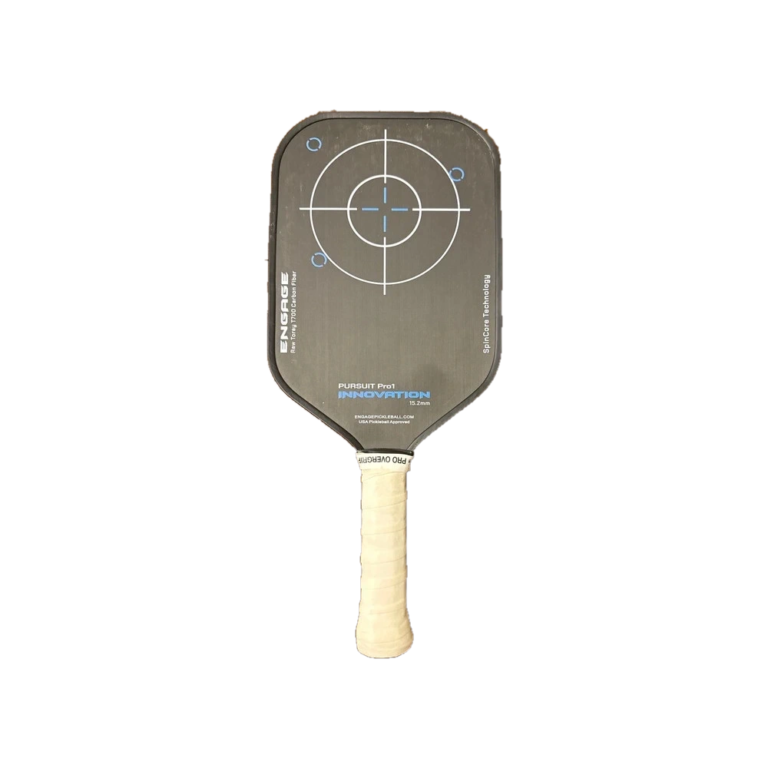
My own photograph identifies the original blue Engage Trident: a blue face with dark target/crosshair graphics, a black diagonal section with TRIDENT lettering, ENGAGE branding near the throat and a distinctive turquoise-green wrapped handle. The photo used on this page is a genuine image of my sample with the wooden background removed. The face design and physical grip have not been replaced by synthetic artwork.
This particular paddle is distinct from the Engage Raven Wide Body, Poach series, Encore models and newer Pursuit family. Retailer descriptions for the original Trident specify a widebody composite design, a five-layer GripTEK face and a polymer Control Pro 3 core. Those are published model descriptions; they do not prove the precise swingweight, condition or factory-grip status of my individual photographed paddle.
I confirmed that I bought the Trident brand new in September 2026 for $59.99 USD, self-funded at normal price without any discount or sponsorship. I played it for 6–15 hours, mostly in indoor doubles with indoor balls. That is the full supported test context: I did not supply my exact court sessions, ball model, additional tape configuration or the precise name of the paddle I compared it against.
My real test: improving dinks after getting used to the Trident
At first, the improvement was not obvious
I chose two answers about the adjustment process: the advantages became apparent only after a few games, and the difference from my older paddle was not immediately clear. These statements describe the same adaptation period, so I do not treat them as separate problems or separate strengths.
Once I had adjusted, I found my dinks were more accurate. I also reported that they were better than with my previous paddle. I did not identify that older bat or conduct a measured same-session trial with identical shot counts, so this is a personal improvement rather than a laboratory-controlled comparison.
The editorial dink category rewards this result while acknowledging that it took some time to notice. I did not report a verified increase in dink depth accuracy, a numerical success percentage or better third-shot drops, so those additional outcomes are not attributed to me.
Soft contact and a damped feeling in the short game
One thing I liked was the soft feel of the paddle on impact. I also found it soft and damped on short shots. These closely related responses support a single positive observation about touch; they are not separately scored as though I had tested multiple unrelated physical properties.
Engage’s historical descriptions associate the Control Pro 3 polymer core with touch and control. I cannot tell from my own answers exactly how much of the feeling came from the core, the GripTEK face, the ball or my technique. What I can describe is how the whole paddle felt during actual indoor play.
Hard returns: the Trident felt good at absorbing pace
I explicitly reported that the paddle absorbed hard returns well. This was a separate playing situation from placing a deliberate dink. It is why defensive absorption receives its own editorial score, rather than being silently folded into a claim that the Trident is good at every type of control shot.
My answer does not establish a measured shock-absorption percentage, vibration amplitude, twistweight or defensive reset success rate. I did not say whether the paddle remained equally stable on every edge hit or whether I could turn every hard return into a controlled kitchen ball.
Spin: I liked what I could do on serves
I could put good spin on my serves. That is the specific spin observation in my firsthand answers. I did not separately report topspin on drives, slice on backhands, a dipping-shot success rate, or measured revolutions per minute.
The original Trident is described as using a five-layer GripTEK composite surface, designed by Engage for ball feel and spin. That design claim makes the model interesting, but it does not justify converting my single serve-spin observation into a verified RPM figure or an assertion that the surface retains grip indefinitely.
Widebody contact and subjective weight
Easy, clean contact
I found it easy to hit the ball cleanly and securely. That experience gives this widebody a positive contact category in the scoring table.
However, I did not explicitly report the diameter of a large sweet spot, minimal twist on off-center hits or unusually good edge response. Those questions were left unanswered. The original model’s broad geometry offers helpful background, but I do not score forgiveness claims I did not personally make.
Lighter than expected
I described the Trident as light in my hand and lighter than I expected. This is one subjective handling impression expressed twice; it receives one weight, not two.
I did not weigh my bat or provide a swingweight value. The published weight ranges vary across retailers and historic stock configurations. I also did not select that I reacted faster in hands battles, so I cannot turn a light feeling into an unreported on-court speed advantage.
The turquoise-green grip: comfortable, but the fitting history is unknown
The bright turquoise-green grip is visually distinctive on my original photo. In use, I felt it fitted my hand well and had a comfortable thickness.
I have not stated whether I installed the wrap myself, it came already fitted, or it was a factory grip. The photograph alone cannot answer that. Therefore, the review scores the actual feel of the grip as used, not a manufacturer claim about the stock grip material or a personalized benefit of an owner-installed overgrip.
I did not report that it slipped, caused blisters or remained unchanged over months. Nor did I provide a separate evaluation of two-handed-backhand space or handle length; those are left unscored.
What I did not test or report
There were no firsthand selections on third-shot drops, power, serving speed, drives, high-ball putaways, core/edge durability, water exposure, current tournament approval or long-term spin retention. These omissions are not negative findings. I also did not provide a value-for-money verdict beyond my verified purchase price.
The normal purchase price I paid was $59.99 USD, but it would be wrong to score monetary value as good or bad without my own opinion about the price. Likewise, the fact that I did not report a crack, dead area or loose edge does not establish that every Trident remains defect-free over extended play.
That distinction is particularly important for a 6–15-hour test. It supports a thoughtful initial-owner review, but not a multi-season durability conclusion.
Original Engage Trident specifications – published data, not my measurements
| Specification | Historical retailer/manufacturer information |
|---|---|
| Model | Original Engage Trident – Blue / Midnight Blue widebody design |
| Face | Five-layer GripTEK composite surface |
| Core | Control Pro 3 polymer honeycomb |
| Published length | 15½ inches |
| Published width | 8⅛ inches |
| Published handle length | Approximately 5 inches |
| Published grip circumference | Approximately 4¼ inches, not a measurement of my turquoise wrap |
| Published weight ranges | Vary by retailer, approximately 7.3–8.1 ounces across listings; I did not weigh my sample |
| Visible sample color and grip | Blue/black face and turquoise-green wrapped grip, verified from genuine owner photo |
| Owner’s real payment | $59.99 USD for a new bat in September 2026, no discount or sponsorship; not a current advertised price |
Specifications are based on historical Engage Trident model information, Just Tennis’s Trident listing and Pickleball Nation’s Trident specifications. These published specs do not determine my exact sample’s weight or the source of its current turquoise grip. Historical retailer claims about competition approval do not substitute for checking current rules for a particular event.
What other Trident owners said – external context only
Randy in Kansas City, in a PickleballCentral Trident owner account, said that he initially saw little difference from his generic paddle. After a couple of games, he enjoyed better dinks, slightly more spin and a softer feel. That experience is relevant context for my own adjustment, but it is still another person’s anecdote.
Jim O’Connor noted good grip, light weight, spin on serves and an ability to absorb hard returns in his JustPaddles owner review. His negative observation was wishing for a paddle 2–3 inches longer. I did not myself report a length problem, so Jim’s criticism is not treated as my own.
An owner named Clare reviewed a separate blemished Trident and found it lighter than expected, but that is a distinct sample category and does not prove the weight of my blue paddle. No outside score or star average affects this review.
How the evidence-based editorial 4.4/5 was calculated
I did not enter a personal star rating. The editorial result applies subjective one-decimal category judgments only to seven separately supported aspects of my own experience. My repeated soft-feel and dink-improvement statements count once per category, while the real adaptation period moderately limits the dink score. The 100%-weighted calculation is fully disclosed:
| Evidence-supported criterion | Weight | Editorial subscore | Owner evidence and boundaries |
|---|---|---|---|
| Dink accuracy after getting used to it | 25% | 4.4/5 | Dinks improved after several games versus an unnamed previous paddle. The overlapping statements about better dinks and adaptation were grouped once. |
| Soft contact and short-shot feel | 15% | 4.4/5 | The paddle felt soft at impact and damped on short shots. Repeated soft-feel descriptions counted as one. |
| Hard-return absorption | 15% | 4.3/5 | The owner found it absorbed hard returns well, a distinct defensive playing situation from deliberate soft dinks. |
| Spin on serves | 15% | 4.3/5 | The owner could generate good serve spin. No measurement of RPM, and no separate evidence on slice, drives or long-term grit. |
| Light feeling in hand | 10% | 4.3/5 | It felt light and lighter than anticipated, which are one subjective weight/handling theme; no net reaction-time or scale weight was reported. |
| Ease of clean contact | 10% | 4.3/5 | Making clean, secure contact felt easy; this is not a measured sweet-spot map or a finding on off-center losses. |
| Grip fit as used | 10% | 4.4/5 | The turquoise-green grip felt comfortable and the thickness fitted the owner, but who installed it is not known. |
Total weight: 100%. The actual arithmetic is (4.4 × 25%) + (4.4 × 15%) + (4.3 × 15%) + (4.3 × 15%) + (4.3 × 10%) + (4.3 × 10%) + (4.4 × 10%) = 4.350/5. Conventional one-decimal rounding gives 4.4/5, so the product-card five-star display is filled to 88%.
The subscores represent editorial interpretation of qualitative firsthand reports, not lab precision, a manufacturer rating or another user’s results. No separate numeric value or durability subscore is invented. Observations about the feel and thickness of the turquoise-green grip apply only to the actual grip as used, whose installer is unknown.
Who might benefit from the Trident?
My positive experience is most helpful for people who value dink placement, softer contact and confidence on hard returns, especially if they are willing to spend a few games getting accustomed to a different paddle. I also liked the serve spin, light feel and comfortable grip.
I cannot conclude from my answers that it is a particularly powerful bat, the fastest bat at the net or a proven multi-year performer. Someone prioritizing those features would need additional direct evidence, ideally from longer testing of the same model. For me, the demonstrated strengths were in the soft game and controlled contact.
Related genuine-owner reviews
For other original, separately tested pickleball paddles, see my Engage Raven Wide Body Blue review and Engage Poach Extreme Purple and Red review. These articles do not establish a head-to-head Trident comparison, since I did not identify the older paddle against which my dinks improved.
Frequently asked questions
How long did I play with the Engage Trident Blue?
For 6–15 hours, mainly indoor doubles using indoor pickleballs. I did not supply a specific session count or ball brand.
Did my dinks improve?
Yes. I felt my dink accuracy improve after a few games, and I thought the resulting dinks were better than those with my previous unnamed paddle.
Did the Trident feel soft?
It did in my experience. Contact felt soft, and shorter shots had a damped feel. These closely related observations are grouped in the editorial scoring method.
How did the paddle handle hard returns?
I found that it absorbed hard returns well. I did not measure vibration or test whether that also improved every defensive reset.
Could I spin my serves?
I could put good spin on serves, but did not verify a numerical spin rate or report separate topspin/slice results on other strokes.
Was it lightweight?
It felt light and lighter than expected to me. I did not weigh my particular sample, and the retailer’s weight range does not establish its exact mass.
Did I install the turquoise-green grip?
I did not supply who installed it. I can confirm only that the grip fitted my hand well and had a suitable thickness when I played. The photo shows the wrap but cannot prove its history.
Did I test its durability?
No reliable long-term assessment was given. I used this paddle for 6–15 hours, so I do not assign a durability score or promise a lifespan.
How much did I pay?
$59.99 USD for a brand-new Engage Trident Blue in September 2026, self-funded at normal price without discount or sponsorship. This is a past personal purchase, not today’s online sale price.
Why is the editorial rating 4.4/5?
The site weighted seven independent evidence-backed areas to exactly 100%. The unrounded result was 4.350/5, displayed as 4.4/5. I did not select a numerical score, and other players’ ratings did not enter the calculation.
Firsthand methodology and limitations
This review uses the actual photo of my original blue Engage Trident, not a synthetic or replaced paddle image. Its firsthand statements are limited to what I explicitly selected: a self-purchased new paddle used for 6–15 hours in indoor doubles with indoor balls; easier clean contact; soft feel on contact and short shots; dink accuracy improving after several games compared with an unnamed older paddle; good serve spin; effective absorption of hard returns; light subjective weight; and a well-fitting turquoise-green grip of unknown fitting history. No unanswered category, retailer claim or outside reviewer comment has been converted into my own performance result or a hidden scoring assumption.

Jonathan Grøn created The Pickleball Wise. He coaches beginner pickleball players and captains a pickleball team in Series 2. He combines on-court experience with official rules and coaching resources to write practical guides on doubles strategy, skills, and training.