Engage Poach Infinity EX Blue Review: My 6–15 Hour Test (3.8/5)
My Engage Poach Infinity EX Blue review after 6–15 hours: I bought the original blue standard-shape Poach Infinity EX brand new in August 2026 for $89.99 USD, paying the normal price with my own money and without a discount or sponsorship. I mainly played indoor doubles using indoor pickleballs. This paddle offered my favorite kind of control on hard incoming balls: I could absorb their pace, redirect them accurately and play short defensive resets.
I also liked its dink accuracy after getting used to it. But the very soft, muted feel required adjustment, and I sometimes hit dinks too short initially. I preferred a different paddle’s more direct contact feel, produced less spin than with my Engage Elite Pro, and had to swing harder to generate ball speed. I could still hit hard and maintain control, but another paddle felt more powerful. At $89.99 USD, I personally thought the price was too high.
My overall editorial score is 3.8/5, calculated from eight distinct areas supported by my answers. I did not personally choose a number; outside owners’ product ratings, retailer marketing claims and untested categories have no role in the calculation. The full 100%-weighted breakdown, including the lower ratings for power, spin and price, appears below.
Amazon Associates affiliate disclosure: As an Amazon Associate I earn from qualifying purchases. This article contains Amazon US search links with tracking tag owlratings08-20. If you purchase a qualifying item, the site may receive a commission without an additional cost to you. I bought my reviewed paddle new at the normal price, with no sponsorship or discount. The affiliate links go to Amazon.com search results, not a verified exact product listing, live sale price or ASIN. Check that a result is the original blue Poach Infinity EX, not Poach Extreme, the older Infinity without EX, or a different MX/SX/LX version.
My verdict: impressive defensive control, but compromises at the price
Dinks: I could place them precisely and control short exchanges, although they sometimes came up short before I adapted.
Defense: I could take pace off hard returns, send them back in the intended direction, and produce short resets.
Impact feel: the contact was unusually muted and soft with very little felt vibration, but I preferred a different bat’s more immediate response.
Power: hard hits remained controllable, but I needed more swing effort for speed, and another bat felt more powerful.
Spin: I got less spin than with my Engage Elite Pro. This was one comparative negative, not two separate test findings.
Weight and styling: it felt light in my hand and I liked the distinctive blue target graphic.
Condition: there were ordinary scratches or edge scuffs, but I did not report a mechanical fault or sufficient evidence to rate long-term durability.
Value: I personally found my $89.99 full-price purchase expensive relative to my experience.
What I personally liked
- Accurate dinks and good control in the short game
- Effective absorption of hard incoming shots
- Precise redirection of hard returns near the kitchen
- Controlled short defensive resets
- Soft, muted contact with very little felt vibration
- Ability to hit hard while keeping direction under control
- Light-feeling handling and an attractive blue crosshair design
Trade-offs and limitations I actually identified
- The unusually muted feel took time to get used to; I preferred a more direct contact feel from another paddle
- Some dinks came up short at first
- Less spin than with my Engage Elite Pro
- Needed a harder swing for ball speed; another paddle felt more powerful
- My $89.99 purchase price felt too high
- Ordinary surface/edge scuffs; not enough evidence to determine long-term durability
- Weight class, spin RPM, handle fit, quick hands and sweet-spot size not independently assessed
Bottom line: 3.8/5 editorial rating
For me, the Poach Infinity EX Blue was very good at defending and redirecting hard balls and offered precise soft-game control after an adjustment period. However, the very muted contact was not my preferred feel, my Elite Pro delivered more spin, I had to swing harder for pace, and I thought $89.99 was expensive. My evidence-based 3.8/5 accounts for both the real strengths and the real drawbacks.
Which Engage Poach Infinity did I test?
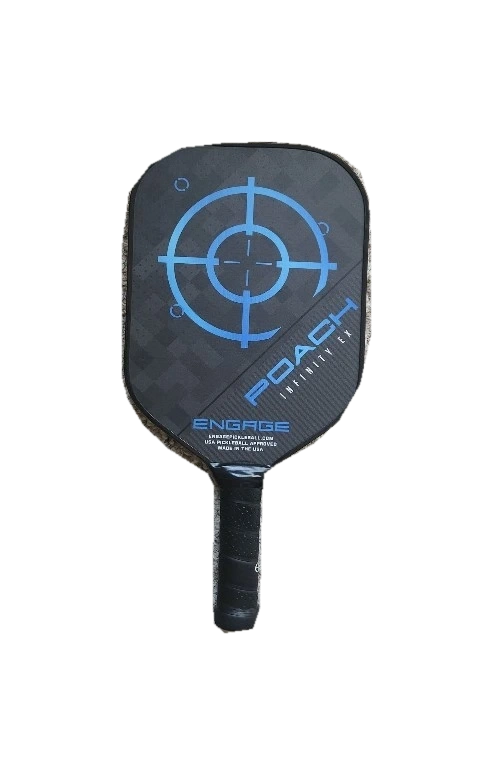
The genuine photo shows the standard blue-and-black Engage Poach Infinity EX with a large light-blue target/crosshair symbol, diagonal POACH INFINITY wordmark, smaller Engage branding near the throat and a black grip. The image is my actual photographed paddle with the carpet background removed; it is not an artist’s rendering or manufacturer stock picture.
The distinction between model names matters. This is Poach Infinity EX from the updated series, not Poach Extreme (a separate paddle I also reviewed) and not the earlier Poach Infinity that lacked an EX designation. It is the regular 16 × 8-inch EX shape, rather than the alternate MX, SX or LX geometries.
My actual owner test took place over 6–15 hours in primarily indoor doubles with indoor balls. I bought it new for $89.99 USD in August 2026 at normal price, out of my own money, without any discount or sponsorship. I did not tell the site whether my sample was specifically Lite or Standard weight or provide a scale measurement, grip modification history or precise number of sessions. Those facts remain unknown.
Soft and muted contact: a real strength, but not always my preference
One of the most noticeable characteristics during my playing time was the unusually soft and muted contact. I also noticed very little vibration. For players who enjoy a damped hit, that kind of feel can be appealing, and I could recognize its practical contribution to soft shots.
But there was a real trade-off for me. The soft feeling was unfamiliar at first, and I preferred another paddle’s more direct impact sensation. I also reported that the Infinity EX felt especially muted compared with a Pursuit paddle. My firsthand answer did not identify the exact Pursuit version, so I do not assign a precise model designation or claim a laboratory comparison.
These remarks belong to a single impact-feel dimension. The very soft sensation, little vibration, Pursuit comparison and preference for a more direct contact are related descriptions of the same quality, not four separate reasons to increase or decrease the overall rating. This category is therefore 3.5/5, recognizing comfort alongside the less preferred feedback.
Dinks: accurate once I had adjusted, too short initially
I could place dinks precisely and had good control over short dinks. That was one of the strongest positive elements of the paddle for my type of game.
At the start, however, some of my dinks were too short. I needed a few games to adjust to its unusually muted response. This is an important qualification, rather than an independent long-term defect. The correct takeaway is that the Infinity EX could deliver accurate placement for me, but there was a short learning curve.
I did not measure a dink-placement percentage, record exact depths at the kitchen line or confirm that every soft shot became easier than with another paddle. The editorial dink category is 4.0/5, with the precise placement balanced against my adjustment difficulty. The repeated positive and negative checkbox statements are each represented once.
Hard returns, short resets and control at the kitchen
Here I had especially useful firsthand experiences. I could absorb hard incoming shots, redirect hard returns accurately and found the paddle gave me good control at the kitchen line.
I also selected that I could take the pace off hard balls to make short resets. These are related but concrete defensive outcomes: rather than just surviving a fast return, I could soften it or direct it where I wanted. This is why the defensive-control category receives the strongest subscore of 4.6/5.
I did not, however, submit a separate conclusion on third-shot drops. A controlled reset following a hard ball is not the same as a successful third-shot drop from deeper in the court. I have not converted my defensive results into claims about an untested stroke.
Power: directional control was good, but getting speed required effort
I could hit hard while still maintaining control over the ball. That is a genuine positive, and it explains why the EX was not simply weak or unusable for attacking shots in my experience.
The drawback was that I had to swing harder to create good pace. I also found that another paddle felt more powerful. I did not name that other bat or provide radar-measured ball speed, and I did not specifically assess serves or high-ball putaways. The comparison is therefore a first-person relative impression, not a universal power ranking.
The power subscore is 3.6/5. The need for extra swing effort and the lesser power compared with another paddle are two descriptions of a connected performance limitation, not two independent penalties. The ability to keep hard swings controlled remains a positive part of the same category.
Spin: my Engage Elite Pro felt better
I specifically noticed that I got less spin than with my Engage Elite Pro. I also selected an equivalent answer that another bat gave me more spin. These are overlapping observations, so they contribute one negative comparative finding to the editorial spin score, not two.
I did not measure RPM, break down topspin versus slice, or compare exact ball brands in a controlled test. The appropriate statement is that my personally experienced spin was less satisfying than with the Elite Pro I had used, leading to a 3.0/5 spin category.
The EX series was marketed with a textured multilayer face intended to help spin. But design intentions are not a substitute for my actual result, and they do not overturn my comparison.
Light feel and the blue target graphic
I liked that the paddle felt light in my hand. This is a subjective but useful handling observation. I did not identify a Lite weight-class label, weigh my sample or report the speed of fast hands battles, so the review does not claim the paddle was objectively lightest in class or that I moved it faster than my other paddles.
Appearance also mattered a little: I liked the blue crosshair/target graphics. This is a straightforward personal preference, not evidence of coating durability or an improved ability to hit the ball. Because appearance is less important to overall performance, it receives only a 5% editorial weight, as does the separately supported light feel.
Ordinary scratches, but no established longevity result
In my own use, I reported ordinary scratches or edge scuffs. I did not report that they caused a performance failure, and I did not provide enough information to determine exactly when they appeared or how severe they were.
I did not select a measured decline in spin, cracked edge, loose grip or dead zone, but I also did not submit a reliable long-term durability assessment. It would be wrong to make up a durability score simply because the paddle was photographed and used for 6–15 hours. The cosmetic condition is mentioned for completeness, and mechanical longevity is left unscored.
Was the Poach Infinity EX worth the $89.99 I paid?
I paid $89.99 USD for my Poach Infinity EX Blue in August 2026. I bought it brand new at the normal price, with my own money, and received no discount or sponsorship.
I explicitly said the price felt too high. That is a legitimate negative value judgment, rather than a conclusion the site inferred from a different retailer’s list price. While I enjoyed the paddle’s excellent defensive control and dinks, the less-preferred contact feel, extra effort required for pace and lower spin compared with Elite Pro contributed to a less favorable overall experience at my purchase price.
Accordingly, the editorial value category is 2.8/5. That refers specifically to my own $89.99 purchase, not to what someone might pay for used stock or a different historical sale price. Amazon prices and stock availability may differ, and no verified exact ASIN is claimed here.
Historical model specifications: separate from my personal testing
| Feature | Published information for the original Poach Infinity EX |
|---|---|
| Model | Engage Poach Infinity EX, standard blue version |
| Shape | Standard 16 × 8 inches |
| Core | Proprietary ControlPro Black polymer core, approximately 13mm |
| Face | Six-layer textured composite surface |
| Handle length | About 5¼ inches |
| Grip circumference | About 4¼ inches, not measured on my individual paddle |
| Published weight variants | Lite approximately 7.5–7.8 oz; Standard approximately 7.9–8.3 oz; my exact variant not identified or weighed |
| Visible sample appearance | Blue target graphic, blue diagonal Poach Infinity lettering, black grip |
| My historical purchase | $89.99 USD in August 2026, brand new, self-funded, normal price without discount or sponsor |
Published dimensions and design terminology come from Engage’s 2022 model interview, the Poach Infinity EX Standard listing and the Lite model’s specifications. These are retailer/manufacturer sources, not independent measurements of my own sample. Claims about vibration-dampening technology do not establish a medical benefit or current tournament approval.
What other EX players reported – contextual research only
In a Reddit discussion involving the blue Infinity EX, an owner said the paddle offered better control but less spin than their Engage Elite Pro. That resembles one of my own trade-offs, but it remains independent testimony and does not strengthen or duplicate my rating.
Another Infinity EX owner described a very muted feel and little vibration, while personally preferring a Pursuit EX 6.0. That owner also described adding weight to an EX used by a family member to make it feel more powerful. I did not report modifying my paddle, and a separate person’s lead-tape result is not proof that a modification would help me.
Craig’s owner review of a blemished middleweight EX described excellent control and hard-return absorption but a soft-core adjustment period, short dinks initially and more swing effort for pace. That test was from a different sample and explicitly a blemished middleweight; my own weight variant is unknown. It offers context rather than verified evidence about the performance of every blue EX.
How the evidence-based 3.8/5 editorial score was calculated
I did not submit a star score. The site grouped my confirmed answers into eight different editorial categories, avoiding repeated treatment of soft impact, vibration, dink adaptation, hard-return control, comparative spin and swing effort as separate duplicate claims.
| Firsthand-supported criterion | Weight | Editorial subscore | Basis and limitations |
|---|---|---|---|
| Soft touch and vibration | 15% | 3.5/5 | Very soft, muted contact and little felt vibration, but it initially felt unfamiliar and the owner preferred another paddle’s more direct contact. Q4 and Q13 overlap, so this is one category. |
| Dinks after adaptation | 20% | 4.0/5 | Accurate controlled dinks after a few games, counterbalanced by dinks initially coming up short. Repeated Q5 descriptions count once. |
| Hard-return control and short resets | 20% | 4.6/5 | The owner absorbed pace, redirected hard returns precisely, maintained kitchen control and played short defensive resets. Closely related Q6/Q7 observations are grouped. |
| Power and swing demand | 15% | 3.6/5 | Hard hits could stay controlled, but obtaining speed required a harder swing, and another unnamed paddle felt more powerful. |
| Spin relative to Elite Pro | 10% | 3.0/5 | The owner experienced less spin than their Engage Elite Pro. Q8 D/F describe one comparative deficit, not two. |
| Value at actual purchase price | 10% | 2.8/5 | The owner self-purchased new at normal price $89.99 USD in August 2026 and expressly judged the price too high. |
| Light feel in hand | 5% | 4.3/5 | The paddle felt light; no measured sample weight and no claimed hands-battle speed. |
| Blue design preference | 5% | 4.5/5 | The owner liked the blue target/crosshair graphic; no claim of print durability. |
The weights total exactly 100%. The arithmetic is (3.5 × 15%) + (4.0 × 20%) + (4.6 × 20%) + (3.6 × 15%) + (3.0 × 10%) + (2.8 × 10%) + (4.3 × 5%) + (4.5 × 5%) = 3.805/5. Rounded to one decimal, the score is 3.8/5, which equals a 76% fill of a five-star display.
The category numbers represent editorial judgments based only on my qualitative answers, not measured equipment performance or star ratings that I entered. The site did not assign neutral or speculative scores to fast hands battles, sweetspot size, handle fit, third-shot drops, equipment legality or long-term durability, because those dimensions were not confirmed in my own test.
Who may appreciate the Poach Infinity EX Blue?
My experience suggests the Poach Infinity EX can be attractive to players who especially value absorbing hard shots, redirecting incoming pace and controlling dinks, particularly if they enjoy a softer, more muted contact sensation. It helped me create short defensive resets and accurately place dinks once I had adjusted.
However, players who want a crisper impact feel, stronger spin or easier access to hitting power should consider my genuine reservations. I personally favored another paddle’s more direct feel, obtained less spin than with my Elite Pro and needed a more forceful swing to create speed. I also judged my $89.99 purchase expensive.
Related authentic owner paddle reviews
The Engage Poach Extreme Purple and Red review covers a different model, not an alternate color of this Infinity EX. I have also separately reviewed the original Engage Trident Blue and Engage Raven Wide Body Blue. Their scores are individual owner-evidence judgments, not controlled head-to-head measurements against this EX. Another distinct review covers my Engage Pursuit Pro EX 15.2 Arctic Gold with a short handle; that is a different paddle from this Poach Infinity EX.
Frequently asked questions
How long did I actually use the Poach Infinity EX Blue?
I played 6–15 hours, mostly indoor doubles using indoor pickleballs, without a precise session count or measured shot data.
Was it good for dinks?
In my experience, yes. I could place and control short dinks precisely, but some initially landed too short until I adjusted to the soft contact.
How did it perform against hard returns?
That was a strong point for me: I absorbed hard shots, redirected them accurately and played controlled short defensive resets.
Was it soft or muted at contact?
Very much so. I noticed unusually muted contact and very little felt vibration. I also preferred the more direct feel of another paddle, so soft contact was not an unqualified advantage.
Was it powerful?
I could hit hard while maintaining control, but needed a stronger swing for speed, and another unnamed bat felt more powerful. I did not measure ball speed.
How much spin did it generate compared with Elite Pro?
I experienced less spin than with my Engage Elite Pro. I did not record RPM or describe individual spin types.
Which Poach Infinity EX weight did I own?
I did not specify whether my blue model was Lite or Standard, and I did not weigh it. The advertised weight ranges cannot be used as a substitute for a measurement of my own sample.
Did I encounter durability problems?
I reported normal scratches or edge scuffs, not a confirmed structural defect. I did not test long-term core and face life sufficiently to assign a durability score.
How much did I pay, and did I consider it good value?
I paid $89.99 USD in August 2026 for a new, self-funded paddle at normal price, without discount or sponsorship. I thought that price was too high, which is reflected in the editorial value score.
How was the editorial 3.8/5 calculated?
Eight independently supported owner-experience criteria were weighted to exactly 100%. The mathematical result was 3.805/5, displayed as 3.8/5. I did not choose a numeric rating, and other owners’ opinions did not change it.
Methodology and firsthand evidence limitations
The photo used in this article shows the actual original blue Poach Infinity EX provided by the owner, with its original product markings intact and a transparent background. The first-person findings are limited to the explicit owner answers: 6–15 indoor doubles hours, light feel, very soft/muted contact, low vibration, initially short dinks followed by accurate control, effective absorption and redirection of hard returns with short resets, lower spin than Elite Pro, control on hard swings but more effort required for power, preference for another bat’s more direct contact, regular scratches or scuffs, a blue graphic the owner liked, and the $89.99 self-funded purchase considered too expensive. No unanswered question was converted into an invented result; the owner did not report a precise Lite/Standard designation, grip modification, tournament approval, laboratory spin result or long-term durability assessment.

Jonathan Grøn created The Pickleball Wise. He coaches beginner pickleball players and captains a pickleball team in Series 2. He combines on-court experience with official rules and coaching resources to write practical guides on doubles strategy, skills, and training.