Pickleball Apes Pro Line Energy Review: My 30–100 Hour Test
My Pickleball Apes Pro Line Energy review after 30–100 hours: I used the original 17-inch elongated Pro Line Energy mainly for indoor doubles, with an overgrip fitted. The strengths I actually noticed were precise dinks, more manageable resets, powerful full-swing drives, good topspin, useful reach and a comfortable, balanced feel. The trade-offs were a small sweet spot, visible face wear and a surface that became smoother with use. In my separate playing experience, JOOLA Perseus Pro IV gave me more spin.
Another Pickleball Apes model in my own hands: My new Pulse S Hybrid Purple review covers 3–10 hours of real indoor doubles with precise dinks, easier drops and resets, and quick handling, but weaker put-away power. It is different from this original 17-inch Pro Line Energy; I have not made up a head-to-head winner between them.
Related Pickleball Apes model: I have now published a separate purple Pulse X elongated first-hand review based on approximately 3–10 hours of indoor doubles. It felt forgiving with precise dinks, drops and blocks, but direction changes were slow in quick exchanges. The Pulse X is not the original 17-inch Pro Line Energy reviewed here. I did not explicitly report a controlled head-to-head preference between the two.
I bought the paddle myself about one month before this review, around October 2026, without a discount, free product, sponsorship or paid promotion. My 30–100 hours are the playtime range I reported from firsthand use, not a visual guess based on the photograph. No receipt total, order date or exact Amazon.com price was supplied, so I will not invent a price I paid.
Affiliate disclosure: As an Amazon Associate I earn from qualifying purchases. The Amazon US search link in the product card uses my affiliate tag owlratings08-20. Purchases that qualify may earn the site a commission at no extra cost to you. This product was purchased independently, without a discount or sponsorship. The affiliate destination is a search-results page, not a verified exact-product Amazon listing.

My 3.9/5 verdict: excellent reach and touch, smaller sweet spot
What I liked: I could place dinks accurately and absorb pace on resets. Full-swing drives felt powerful without sacrificing my overall sense of control. Topspin, extended reach, grip comfort and a well-balanced, softer feel were all positives in my play.
What I did not like: the sweet spot felt small. After my reported use, the face had visible marks and a smoother texture. That is my observation, not proof of a specific loss of spin or a manufacturing defect.
My relevant alternative: my separately tested JOOLA Perseus Pro IV gave me more spin, even though I still found the Pro Line Energy good for topspin in its own right.
- Precise dinks and more controllable resets
- Powerful drives with a full swing and a strong power/control balance
- Good topspin on drives
- Useful extra reach from the elongated design
- Comfortable grip with my overgrip, balanced feel and soft impact sensation
- A small sweet spot that was not especially forgiving
- Less spin than my JOOLA Perseus Pro IV in my personal experience
- Visible face wear and a surface texture that became smoother during my use
My bottom line: 3.9/5
In my 30–100 hours of mostly indoor doubles, this was a rewarding paddle for reach, precise short-game shots, full-swing attacking power and comfortable handling. However, I would not recommend it primarily on forgiveness: my sweet spot felt small. The face also showed visible wear and felt smoother as I used it. If your priority is maximum spin compared with the JOOLA Pro IV, I personally got more spin from the JOOLA. These are subjective experiences, not instrument-measured performance claims.
Exactly which paddle I tested – and my setup
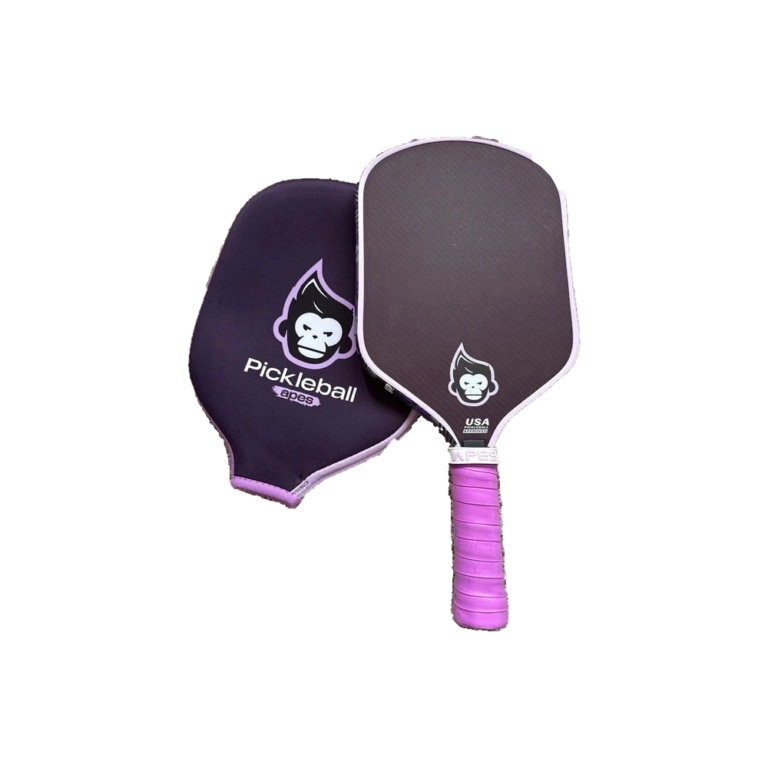
The pictured paddle is the original Pickleball Apes Pro Line Energy 17-inch elongated model, recognizable by the tall narrow red-and-black face, the vertical “PRO LINE energy” text, the small Pickleball Apes logo near the throat and a pink band at the grip. It is not the shorter Pro Line Energy S or one of the newer hybrid Energy-series colorways.
My testing was primarily indoor doubles. I had an overgrip fitted, which matters when interpreting comfort and weight in hand. I did not report exactly which indoor ball brand I used, whether I fitted lead tape, or a measured playing level. I will not assume any of those details. Also, because I did not specify a court-by-court control test, the observations below are real play impressions rather than laboratory benchmark results.
The photo is my original owner photograph with the background removed, keeping the photographed paddle pixels intact. You can still see the actual face marks and the pink grip band. A previous file called “product cutout” retained carpet behind the paddle; that unsuitable derivative was not published. No digitally recreated, AI-drawn replacement paddle was used.
Technical specifications – external product facts, not my measurements
Two independent exact-model reviews document this original version as approximately 17 inches long, 7 inches wide, 16.5 mm thick, with a 6.25-inch handle and a face mixing DuPont Kevlar with Toray T700 carbon fiber. Listed stock weight is around 8.0–8.2 oz; I did not weigh my individual paddle, and mine had an extra overgrip. These dimensions are independently described in Pickleheads’ original Pro Line Energy review and Dash Pickleball’s original model analysis. The model also appears in USA Pickleball’s equipment listing.
Do not mistake that 17-inch original configuration for the manufacturer’s current “Energy S” specification panel. The manufacturer’s Energy product family has multiple shape selections, and the price shown on its page is not a reliable receipt for my original paddle.
Dinks: precision without claiming a giant sweet spot
The most consistent positive I selected was precise dinks. I could place the ball where I wanted more confidently in my indoor doubles play. This is an example of the paddle’s useful soft-game control from my own experience; I did not report an exact target-hit percentage or claim it won a particular match point.
Importantly, good dink precision and a small sweet spot can exist at the same time. I did not report a huge forgiving face. For me, the paddle rewarded cleaner, centered hits and demanded more precise contact than a broad-sweet-spot bat might. I did not separately select third-shot-drop performance, so I am not presenting specific drop results as if I had measured or reported them.
Resets: taking pace off the ball
I also reported that the Pro Line Energy made it easier to absorb pace with resets. That is a clear, valuable observation for doubles play, where controlling a fast ball and getting it back softly can matter more than simply driving it hard. I did not separately document every type of block, counter or speed-up, so my verdict is about the resets I actually evaluated.
Combined with my positive dink experience and a softer impact feel, resets help explain why the paddle worked for my controlled play despite the narrow sweet spot.
Drives: strong when I took a full swing
I experienced strong power on full-swing drives and reported a good power/control balance. This does not mean I measured ball speed or proved that the paddle produces more raw power than a named rival. It means the paddle felt capable when I committed to the shot and that the extra power did not automatically overwhelm my placement.
I did not report that all short-swing counters were explosive, that my drives flew long, or that serves were faster than with my other paddles. I have kept those separate, unselected options out of my first-hand evaluation.
Spin: good topspin, but JOOLA gave me more
Two things are simultaneously true in my experience: I found the Pro Line Energy good at producing topspin on drives, and I reported that my JOOLA Perseus Pro IV 16mm produced more spin. There is no contradiction. “Good spin” is an absolute feel within one trial; “more spin with the JOOLA” is a comparison between my separate playing experiences.
I did not report measured RPM or a same-day head-to-head test with identical balls. External paddle-lab numbers, such as those published in the PPA Tour paddle lab, are independent testing rather than a measurement of my paddle, and I have not placed any of those numbers into my own rating or structured review data.
Extra reach, comfortable grip and balance
I appreciated the extra reach of the 17-inch elongated shape. I also felt that the paddle was balanced in my hand, and its grip was comfortable during longer play. I used an overgrip; that distinction matters because a bare factory grip might feel different to other buyers.
I did not specifically test two-handed backhand ergonomics, quantify swingweight or report superior hand speed in fast net exchanges. Those are common topics around long paddles, but not facts I personally confirmed in this review.
Soft impact feel
The paddle’s soft and comfortable feel on impact was another positive I selected. Together with my dink and reset results, that helps describe why its touch appealed to me. It should not be confused with saying I measured vibration reduction or that the paddle was silent or pain-free for everyone. Those specific experiences were not part of my recorded answers.
Face wear and a smoother texture after 30–100 hours
There is a genuine caution from my longer use window: I reported visible marks on the hitting surface and said that the face texture became smoother over time. My original photo also shows real scuff marks. The two observations support a limited firsthand point about surface condition, not a lab diagnosis of what caused the wear.
Crucially, although I got more spin with JOOLA Pro IV, I did not explicitly report a loss of spin on the Pro Line Energy as its face became smoother. I will not invent a before/after RPM drop, imply that the paddle is damaged internally, or declare that its warranty will fail. For buyers playing substantial hours, it is still useful to know that I observed these surface changes. See also my guide to pickleball paddle grit, friction and spin wear.
Who should consider this paddle – and who should look elsewhere?
Consider the original Pro Line Energy if: the combination I experienced sounds relevant: accurate dinks, controllable resets, strong full-swing drives, useful reach, good topspin and a softer-feeling paddle. Buyers who like long paddles and have consistent contact may be particularly interested, based on the verified 17-inch dimensions. That last point is a practical inference, not a claim that I personally tested every playing style.
Consider another paddle if: you need a big, forgiving sweet spot, because mine felt small. If relative spin is your deciding factor and you are considering a JOOLA Perseus Pro IV, I personally got more spin from the JOOLA. And if the appearance and roughness of the face over time are important, note the smoother texture and visible marks I observed.
My comparison with other personally reviewed paddles
| Owner-tested paddle | Reported playtime | Editorial score | What my documented experience supports |
|---|---|---|---|
| Pickleball Apes Pro Line Energy (this review) | 30–100 hours | 3.9/5 | Precise dinks, resets, full-swing drives, reach and spin; small sweet spot; face wear and smoother texture. |
| JOOLA Perseus Pro IV 16mm | ~8 hours in its separate review | 4.6/5 | My confirmed relative observation is more spin from JOOLA. I did not establish an overall winner here. |
| Selkirk AMPED Control Epic Midweight (green) | 10–30 hours in its separate review | 3.2/5 | My previous impressions included good soft-game control but insufficient power for my style. No direct Apes-vs-green head-to-head preference was provided. |
These are separate testing periods with different first-hand evidence and playing conditions. The scores should not be read as instrument-based same-day rankings. If you want to understand off-center forgiveness more generally, see paddle twist weight, sweet spot and stability. My best pickleball paddles guide is another starting point; this additional standalone review does not retroactively alter that guide’s original list count.
How I calculated my 3.9/5 first-hand rating
The following seven editorial sub-scores are my transparent interpretation of the owner-confirmed qualitative responses. They are not manufacturer specifications, external reviewer scores, instrument-measured RPM or measured ball velocities. The weights total 100%, and I do not award points for characteristics I did not evaluate.
| Criterion | Weight | Editorial score | Firsthand basis |
|---|---|---|---|
| Dinks and resets | 25% | 4.5/5 | Precise dinks and easier pace-absorbing resets in indoor doubles. |
| Full-swing drives and power/control balance | 15% | 4.4/5 | Strong drives on full swings and good overall power/control balance. |
| Topspin, including relative spin | 15% | 3.8/5 | Good topspin on drives, although I got more spin from JOOLA Perseus Pro IV. |
| Reach, grip and balance | 15% | 4.4/5 | Useful reach, comfortable grip and a balanced feel; I used an overgrip. |
| Impact feel | 10% | 4.3/5 | Comfortable, softer impact feel in my play. |
| Sweet spot forgiveness | 10% | 2.4/5 | A small sweet spot that required cleaner contact. |
| Face condition/texture retention | 10% | 2.5/5 | Visible face wear and a smoother surface after use; no measured RPM decline. |
Math: (4.5 × 25%) + (4.4 × 15%) + (3.8 × 15%) + (4.4 × 15%) + (4.3 × 10%) + (2.4 × 10%) + (2.5 × 10%) = 3.935/5, rounded to 3.9/5. The visual stars use 78% fill to match the rounded score. The face-texture sub-score does not allege an independently measured spin decline.
Pricing and Amazon.com availability in November 2026
I bought this paddle myself about a month ago, with no free product, discount or paid promotion. I did not supply the exact checkout total. I indicated that I paid the Amazon.com listed price, but that amount cannot be recovered reliably from a current public product page without my original invoice. Consequently, the price I personally paid remains unverified.
For market context, the manufacturer’s Energy-family product page has displayed a $74.99 promotional price compared with $120 for a selected Energy model; stock and the exact 17-inch original variant were not independently confirmed. Older Pickleheads and Dash Pickleball reports mentioned a historical launch-era price around $149.99. Neither historic nor family-level pricing proves a live Amazon.com offer for my exact original paddle.
For a current offer, use the Amazon.com search for Pickleball Apes Pro Line Energy 17-inch (affiliate link). It is intentionally a search, not a fabricated exact-product ASIN. Verify the original elongated model rather than the Pro Line Energy S or another revised Energy product, and check the seller’s actual checkout price.
FAQ
How long did I actually use the Pickleball Apes Pro Line Energy?
I reported 30–100 hours of use, mainly indoors in doubles, with an overgrip. This range came from my own test history.
Did the paddle have a forgiving sweet spot?
Not in my experience. I selected a small sweet spot requiring precise contact, even though the dinks themselves felt accurate.
Did it have strong power and spin?
Full-swing drives felt powerful, and the overall balance of power and control was good. Topspin on drives was also good, although my JOOLA Perseus Pro IV generated more spin in my separate play.
Did the Kevlar/carbon face lose spin after 30–100 hours?
I observed face marks and a smoother texture, but I did not confirm a measured or subjective decline in spin on this specific paddle during that period. Those are different claims and should not be conflated.
Did I pay $74.99 or $149.99?
I did not provide a receipt or exact amount. Those are public manufacturer or older review price references, not proven amounts I paid on Amazon.com. The review therefore does not claim either as my personal purchase price.

Jonathan Grøn created The Pickleball Wise. He coaches beginner pickleball players and captains a pickleball team in Series 2. He combines on-court experience with official rules and coaching resources to write practical guides on doubles strategy, skills, and training.