JOOLA Perseus 3S 16mm Review: 50 Hours vs Pro IV & V
JOOLA Ben Johns Perseus 3S 16mm review after 50 hours: my biggest reservation is not a lack of power—it is too much pop when I want to soften the ball. I bought the original 3S myself around October 2026 at regular retail, with no discount or sponsorship. I have played with it, and I know the Perseus Pro IV 16mm and Perseus Pro V 16mm from my own separate reviews. My takeaway: the older 3S feels surprisingly stable and forgiving, but I had an easier time with drops and resets using the newer paddles. I would only buy the 3S again if it were substantially discounted.
Testing disclosure: I personally played with this exact paddle for 50 hours, which I now confirm from my own experience. That is my actual playing time, not an estimate inferred from photos. My comparisons against the Pro IV and Pro V came from separate playing periods, not controlled simultaneous testing. My performance verdict is based on my own on-court experience, not numbers or ratings borrowed from other reviewers.
Affiliate disclosure: As an Amazon Associate, I earn from qualifying purchases. The paid Amazon link in this article may earn The Pickleball Wise a commission at no additional cost to you. I purchased this paddle myself at the regular price, with no discount, free product, sponsorship or paid promotion. Affiliate compensation does not determine my editorial opinion or rating.
JOOLA Ben Johns Perseus 3S 16mm: my firsthand verdict
Quick verdict: I found plenty of pop, perhaps more than I wanted for my softer game. My resets and drops were easier with my later Pro IV/Pro V paddles, but I was pleasantly surprised by how solid and forgiving this 3S felt.
Best for: Players who enjoy a lively, power-leaning response and find a genuinely appealing discount on this older model.
Skip if: Reliable, easy-to-manage drops and resets matter more to you than lively pop, or you need a USA Pickleball-approved model for a particular event.
The deciding trade-off: stability and forgiveness on one hand, too much pop for my touch game on the other. This is my experience, not a measured specification or a universal result.
- Surprisingly stable feel
- Forgiving response, in my use
- Plenty of lively pop for aggressive play
- More pop than I wanted for soft shots
- Drops and resets felt easier using my Pro IV/V
- I would only repurchase at a major discount
Bottom line
I would not pay a premium for the older 3S just because it is a Ben Johns JOOLA. It can be enjoyable if the price is right, but my own control preferences point me toward newer alternatives.
What it actually felt like on court
My clearest criticism is the lively, sometimes excessive pop. When I tried to play delicately, I felt less comfortable managing the ball than I did with my later Perseus paddles. This is especially relevant to my third-shot drops and transition-zone resets. Those shots were easier for me with the Pro IV and Pro V, although I did not run a blinded or simultaneous laboratory comparison with identical court conditions.
The positive surprise was stability and forgiveness. I expected the lively response to make the paddle feel less settled, but it felt reassuringly stable in my hands and more forgiving than I anticipated. That is a qualitative impression—not a measured sweet-spot dimension, twisting resistance, or claim that every off-center shot was saved.
I am not assigning the 3S an invented spin RPM, serve speed or precise head-weight difference. Nor do I have enough specific personal evidence to say how spin retention changes month by month. What readers can take from this review is a real decision trade-off: a paddle can feel forgiving at contact yet be too lively for the controlled shot outcomes I want.
My actual paddle and original photographs
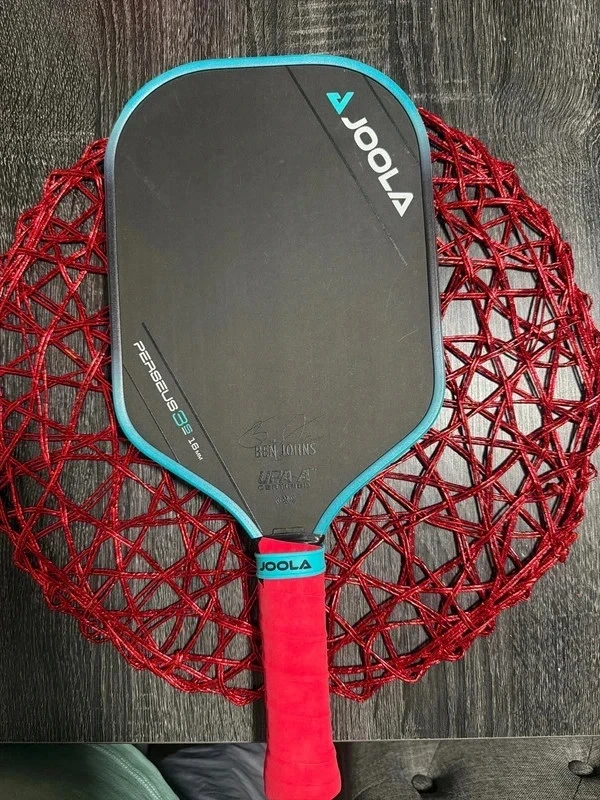
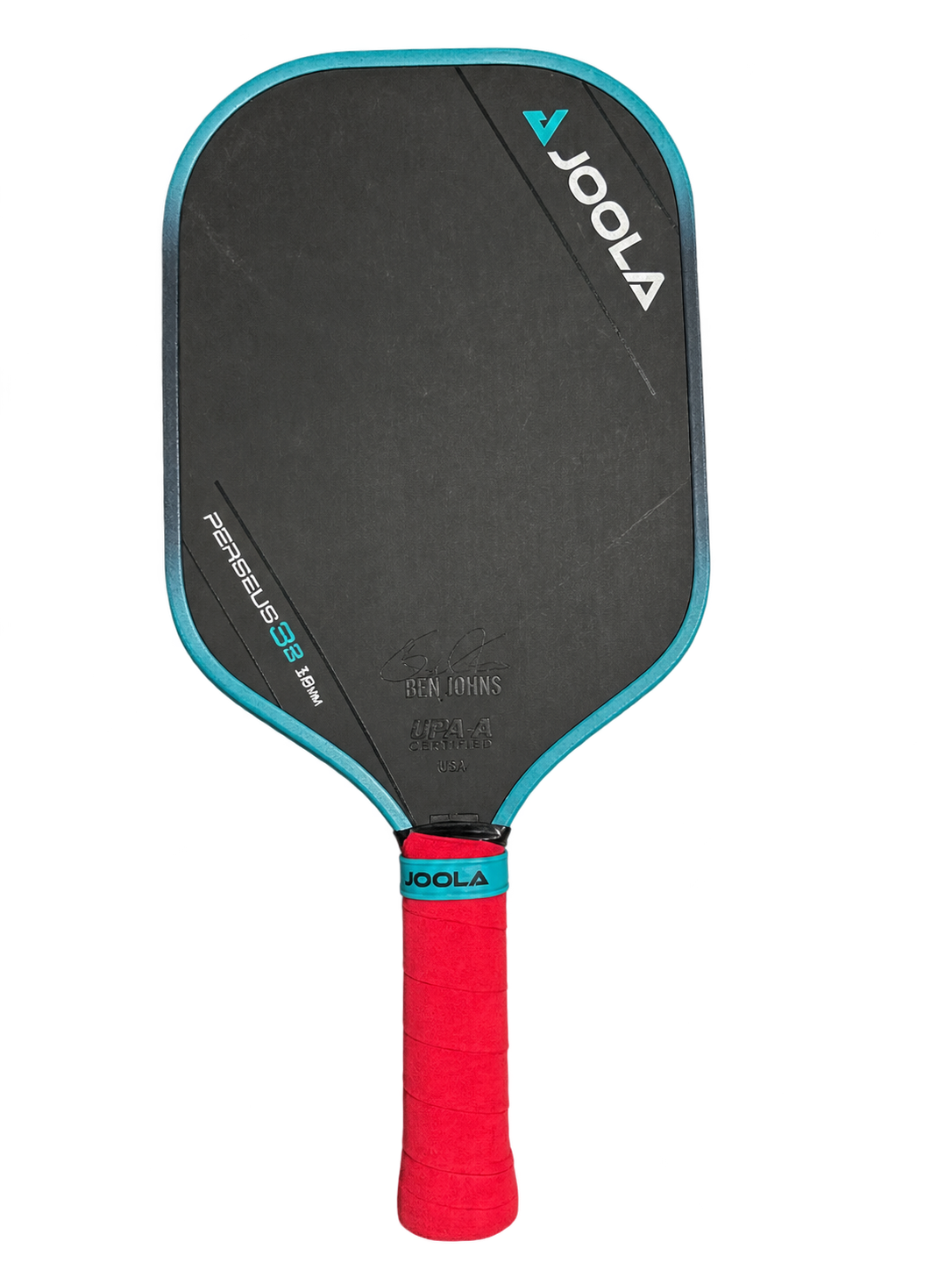
These photographs show the exact black-face, teal-edge 3S 16mm paddle I own. Some surface marks are visible. My 50-hour usage figure comes from my own confirmed playtime, not an attempt to estimate hours from the photos. These images do not establish internal core condition or long-term reliability.
The original 3S 16mm versus 3S Dual: check the version
This review is of the original Ben Johns Perseus 3S 16mm, not the newer Perseus 3S Dual. The two have related names but must not be treated as the same exact SKU or approval record. The original 3S was marketed with UPA-A certification; do not assume that makes it USA Pickleball-approved. JOOLA says the newer 3S Dual meets both UPA-A and USAP PBCoR.43 standards. Check the current equipment list required by your tournament before buying an older paddle. JOOLA’s 3S Dual page describes that newer, different paddle.
Key model specifications (published, not measured by me)
| Feature | Original Perseus 3S 16mm |
|---|---|
| Core thickness | 16mm |
| Shape | Elongated |
| Approximate manufacturer/retailer listed size | 16.5 in long × 7.5 in wide |
| Published average weight | About 8.0 oz (individual paddles vary) |
| Published handle length | 5.5 in |
| Face / core naming | Charged Carbon face / Propulsion Core |
| Photos in this review | Black face, teal edge, red overgrip on my own sample |
These are published product specifications, not my own lab measurements. Source for model-specific dimensions and materials: Pickleball Central’s exact-model listing. The red overgrip is the configuration in my photos, not proof of the stock grip color on every retail paddle.
Perseus 3S vs Pro IV vs Pro V: which would I choose?
Because I have personally reviewed all three, there is an unusually useful internal comparison here. These observations come from separate real-use periods, not a controlled same-day A/B test. Scores are the editorial ratings published in each original review; their evidence windows and criteria are not identical.
| My owned paddle review | Published rating | My documented experience | Main buying consideration |
|---|---|---|---|
| This 3S 16mm review | 3.3/5 | Surprisingly stable and forgiving, but too much pop for my soft game | Only attractive to me at a major discount |
| JOOLA Perseus Pro IV 16mm | 4.6/5 | In my separate indoor test, dependable third-shot drops and predictable drives were highlights | My stronger value-oriented premium preference |
| JOOLA Perseus Pro V 16mm | 4.1/5 | I liked the feel and control but questioned whether its higher price and apparent wear justified the upgrade | Enjoyable, with price and wear concerns |
| Vatic Pro V-Sol Tour Evergrit 16mm | 4.3/5 | My own separate test emphasized grip on the face, balanced handling and a few off-center inconsistencies | Budget-conscious alternative worth reading about |
| Selkirk LABS Boomstik Elongated 16mm | 4.1/5 | My separate early test also found very lively power and pop, with soft shots requiring care | Premium-price power-oriented alternative; only 4+ hours of first-hand evidence, no controlled head-to-head against 3S |
My practical recommendation is simple: if you prioritize relaxed, consistent drops and resets, read the Perseus Pro IV hands-on review first. If you are comparing premium feel with price, the Pro V firsthand review explains my trade-off. My broader best pickleball paddles guide puts those earlier tests into context; its historical test count is not silently increased by this newly published review.
Is the older 3S still worth buying in 2026?
For me, only with a substantial discount. I bought mine without any discount and would make a different purchase decision today. The latest Amazon checkout price for the exact B0DC71MJMX listing could not be independently verified at the time of updating this review, so I am not displaying a guessed live price or pretending that a price for 3S Dual is the same product. You can check the original Perseus 3S 16mm listing on Amazon (paid link) and compare the actual price with newer versions.
Also consider whether you are buying for casual recreational play or for a specifically sanctioned event. Model identity and the event’s current paddle-approval rules matter more than the marketing promise of “tournament ready.” See our guide to checking pickleball paddle legality.
How I calculated my 3.3/5 first-hand rating
These are my editorial subscores inferred from the specific qualitative impressions I confirmed. They are not borrowed from other testers, performance laboratories or Amazon customer reviews. I selected four criteria grounded in my 50 hours of play. I have not assigned a separate long-term durability score because I have not documented a specific pattern of wear or a failure over that period. Weights total 100%, and the combined result is rounded to one decimal.
| Criterion | Weight | Editorial score | My reason |
|---|---|---|---|
| Power and usable pop | 25% | 3.6/5 | Strong pop can help aggressive play, but I personally found it excessive on some shots |
| Touch, drops and resets | 30% | 2.6/5 | My Pro IV/V felt easier to control on these specific shots |
| Forgiveness and stability | 25% | 4.3/5 | The main positive surprise in my own use |
| Value and repurchase decision | 20% | 2.5/5 | I would only buy this older model again at a significantly reduced price |
Calculation: (3.6 × 0.25) + (2.6 × 0.30) + (4.3 × 0.25) + (2.5 × 0.20) = 3.255, rounded to 3.3/5. That is the score shown on this page and in its structured data. I intentionally did not score long-term durability or invent spin measurements. See our editorial policy.
Questions readers ask
Is the JOOLA Perseus 3S 16mm forgiving?
It surprised me positively with how stable and forgiving it felt, although the high pop could still make touch shots hard to manage. “Forgiving” in this review is my on-court feel, not a calculated sweet-spot size.
Is the 3S better than the Pro IV or Pro V?
Not for my touch-oriented play. I found drops and resets easier with the Pro IV and Pro V, though I enjoyed the 3S’s stable, forgiving feel. These were not simultaneous controlled trials.
Is the original Perseus 3S 16mm USA Pickleball approved?
Do not assume it is. The original 3S and the later 3S Dual have different approval histories. JOOLA explicitly markets the Dual variant as USAP/UPA-A certified. Check your event’s current approved-paddle list using the exact model name and production version before playing.
How many hours did I play with this paddle, and what do the photos prove?
I personally played with this paddle for 50 hours. The photos themselves cannot independently verify that duration, establish hidden core condition or predict long-term durability. Without a documented progression of wear or failures, I have not assigned a separate durability score.
Final verdict
I like the confidence of the 3S’s surprisingly stable feel; I do not like having to manage so much pop when I am trying to play softly. Given the choice, I would start with my Perseus Pro IV review, compare the Pro V if money is less of a concern, and buy the original 3S only if the discount is compelling and its tournament eligibility suits my needs. That is my owner-tested decision, not an affiliate-driven recommendation.

Jonathan Grøn created The Pickleball Wise. He coaches beginner pickleball players and captains a pickleball team in Series 2. He combines on-court experience with official rules and coaching resources to write practical guides on doubles strategy, skills, and training.