GAMMA Two-Tone Indoor Pickleballs Review: My 4–10 Hours (3.9/5)
My GAMMA Two-Tone Indoor Training Pickleballs review, after 4–10 hours of actual play: these pink-and-purple balls were most useful to me as a visual training aid. They made it easier to tell topspin from backspin, helped me read spin on an opponent’s serve, and showed me that my own drives had less topspin than I thought. They also flew evenly without visible wobble during my use.
I would not call them a flawless everyday indoor ball. On the basketball-hall floor where I used them, their bounce felt a little dead. That was a real drawback even though their travel through the air looked straight. I liked the bright pink/purple design, relatively quiet contact sound, convenient carrying net and usefulness for warmups. My small signs of surface scratching did not noticeably affect how they played during the limited test period.
I bought the six-ball set myself at ordinary retail price in September 2026 for $12.99 USD. I have described a 4–10-hour usage range, not an exact number of sessions or a months-long durability test.
Amazon Associates affiliate disclosure: As an Amazon Associate, this site earns from qualifying purchases. The Amazon.com link below includes owlratings08-20 and may earn a commission without an additional charge to you. It goes to Amazon search results, not a verified exact product/ASIN listing. Check that the product is the pink/purple indoor six-pack rather than a differently colored outdoor ball. My September 2026 purchase price is not a current Amazon price.
My verdict: useful spin feedback, but a rather dead bounce on my hall floor
Spin reading: the two colors made topspin and backspin easier to distinguish, including on opponents’ serves.
Technique insight: my own drives showed less topspin than I had assumed. That is a visible observation, not a measured RPM test.
Flight: I saw even, straight flight without obvious wobble in my ordinary play.
Bounce: the balls felt slightly dead on the basketball-hall floor. Straight flight and a disappointing bounce can both be true.
Warmups and noise: I liked them for warming up, and found them quieter than my normal pickleballs, without decibel measurements.
Short-term condition: minor surface scratches developed, but I did not notice an accompanying loss of function in the 4–10-hour window.
What I personally liked
- Clearer visual distinction between topspin and backspin
- Easier for me to read spin on an opponent’s serve
- A useful reality check on how much topspin my drives actually carried
- Straight, even ball flight without visible wobble
- Good for warmups and quieter than my usual balls
- Attractive pink/purple finish and a practical mesh carrying bag
Drawbacks and evidence limits
- Somewhat dead-feeling bounce on the basketball-hall floor used in my test
- Some surface scratching, although without a noticed loss of playability yet
- Only 4–10 hours of use; no claim of monthslong durability or controlled ball-speed testing
- The exact Amazon.com product ASIN and a live matching price remain unverified
Bottom line: 3.9/5 editorial rating
I found this a worthwhile spin-training and warmup ball for my own indoor recreational play, particularly because the changing colors made spin easier to interpret. Its slightly dead bounce on my basketball-hall floor prevents an unqualified recommendation as an all-round everyday ball. At my real purchase price of $12.99 for six, I considered the specialized training benefit reasonably priced. The 3.9/5 is a calculated site editorial rating, not a star number I personally selected.
Exactly which GAMMA indoor balls did I test?
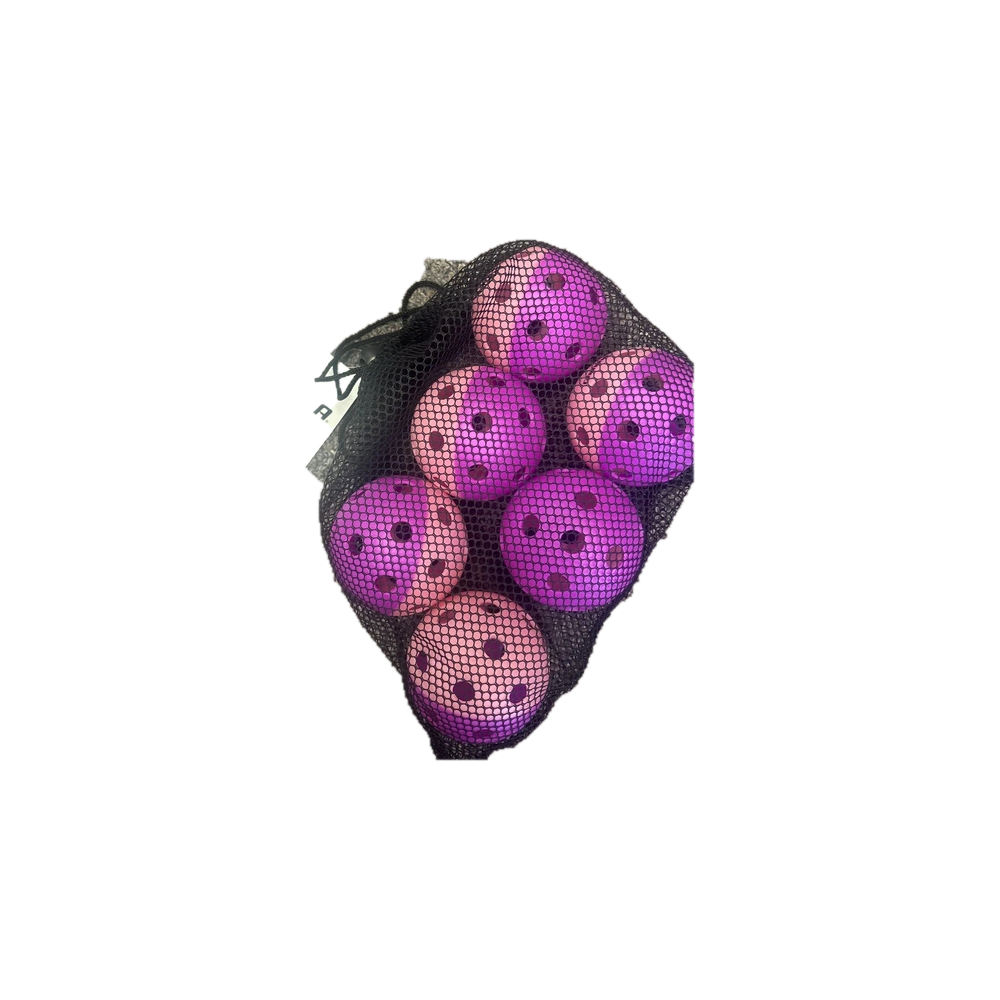
The actual photographed set is the GAMMA Two-Tone Indoor Training Pickleballs, pink/purple, six-ball pack. My original photo shows the six two-color balls together in a black mesh bag with GAMMA-branded labeling. The featured image on this page is the same authentic owner photograph with the background removed; it is not a manufacturer render or a different product.
GAMMA describes this indoor training design as having 26 precision-molded holes and contrasting pink/purple colors to help players visualize rotation. Academy and other retailers list the corresponding six-pack under CIPT610. Those are manufacturer and catalog details, not measurements I made personally. Some sellers also stock outdoor Two-Tone designs with a different hole arrangement; their results should not be confused with my indoor sample. See the official GAMMA product description and Academy’s indoor six-pack listing.
How I actually used them: 4–10 hours of indoor recreational play
My test record covers 4–10 hours of actual playing time in recreational indoor games, including play on basketball-hall flooring. I have not supplied an exact session count, ball-by-ball rotation schedule, court-floor material, recorded temperatures, or comparative timing data. The time range is my reported use, not a guess from a photograph.
I also used the balls in a context where I found them good for warmups. I have not claimed a controlled training experiment, formal lesson curriculum, ball-machine test, tournament approval test or scientific measurement of spin. The firsthand findings below are simply what I experienced in normal play.
Two colors made spin easier to understand
This was the clearest advantage in my experience. With a normal single-color ball, I can see the ball’s path but do not always find it easy to judge exactly how it is rotating. With this pink/purple GAMMA design, I found it easier to distinguish topspin from underspin. I also found it easier to recognize the spin an opponent had put on a serve.
An especially useful observation came from my own drives: the two-color design showed me that they had less topspin than I thought. That was a practical visual learning moment. It does not mean the ball reduced my topspin, that I had measured RPM, or that one drill had permanently improved my technique. The useful result was greater awareness of the spin I was actually producing.
Because the two observations about spin recognition and serve reading are related, I treat them as one training/visibility theme in my score rather than manufacturing separate rating categories from closely related experiences. For general guidance about how court backgrounds and lighting affect colored balls, see our pickleball ball color and visibility guide.
Ball flight was even; the bounce felt a little dead
I selected two observations that may sound contradictory until you separate flight through the air from response off the floor. I saw an even flight path without visible wobble in my play. At the same time, I found the bounce on the basketball-hall floor slightly dead or muted.
That limitation matters. A training ball can be excellent at showing spin without reproducing every aspect of the playing feel you expect from your regular ball. In my sessions, the balls helped me observe rotation, yet the bounce response was not one of their strengths. I cannot say whether the same dead feeling would appear on every wood, vinyl or other indoor court surface, because I did not document tests on multiple floor types.
I did not report that the balls wobbled, were out of round, had inconsistent individual trajectories, or lost speed in flight. I also did not measure bounce height or pace. The product’s straight-looking flight and my less satisfying bounce experience should both appear in an accurate review.
Quieter contact and useful warmups
In ordinary play I found the GAMMA Two-Tone indoor balls quieter than my normal pickleballs. This is a subjective comparison, not a laboratory decibel reading or a claim that the balls are quiet enough for noise-restricted spaces.
They also worked well for my warmups. That combination makes sense for the role I personally liked: they gave me visible feedback about rotation while I was getting into the rhythm of a session. I cannot extrapolate from that to guarantees about advanced drills, match suitability or what every other player will prefer.
Appearance, carrying bag, and short-term wear
I liked the pink/purple appearance of this particular set, and found the black mesh bag practical to transport. The photo shows six balls together in that bag. Those are modest conveniences, but they are real parts of the experience, so I include them without making the colors a claim about universal visibility in every sports hall.
With use I noticed minor scratches on the balls. I did not notice that those small marks made them perform worse during my reported 4–10 hours. This supports a limited short-term observation, not a prediction of how many months they will last. I have no basis to claim I tested cracking resistance, long-term shape retention, repeated ball-machine use or color fading.
How different were they from Franklin X-40?
I have also personally used the Franklin X-40, and these GAMMA indoor Two-Tone balls felt noticeably different in play. That is the extent of the specific comparison I confirmed. I did not provide a head-to-head measurement, a claim that GAMMA was faster, a statement that Franklin bounced higher, or a ranking between the two.
They also serve somewhat different roles in product design: the GAMMA is a colored indoor spin-visualization training ball, whereas the Franklin X-40 is commonly sold as an outdoor ball. It would be misleading to turn my broad “played differently” observation into a definitive better/worse judgment. If you want separate owner experiences with other indoor options, see the GAMMA Photon Indoor review and our JUGS Indoor pickleball review; I am not claiming I ran a controlled three-way test of these exact sets.
Was $12.99 worth it?
I paid $12.99 USD in September 2026 for my set of six, purchased myself at the ordinary price. At that purchase price I thought they represented reasonable value as a specialized spin-training tool. That is a judgment about my purchase and usefulness, not a live price quote or a promise about today’s stock.
The Amazon button on this page is explicitly a search link. I have not verified an exact Amazon.com ASIN for the particular pink/purple indoor six-pack, so I am not pretending to know the current Amazon price or linking to a potentially incorrect outdoor variant. Always confirm both the indoor designation and six-pack count if you decide to buy.
How my 3.9/5 editorial rating was calculated
Editorial overall rating calculated from the owner’s documented firsthand answers. I did not give a personal overall star rating. The site’s six nonduplicated scoring themes below use only the observations recorded from my actual 4–10 hours of play. The weight of each category reflects its relevance to this spin-training product; no untested performance category was assigned a neutral score.
| Independent owner-evidence theme | Score | Weight | Contribution | Confirmed reason |
|---|---|---|---|---|
| Spin visibility & useful technique feedback | 4.4/5 | 30% | 1.320 | Easier topspin/backspin and serve-spin recognition; drives had less topspin than expected. Combined as one theme. |
| Bounce & flight response | 3.1/5 | 30% | 0.930 | Even, wobble-free visible flight, offset by a dead-feeling bounce on the hall floor. |
| Warmup suitability & contact noise | 4.2/5 | 15% | 0.630 | Worked well in warmups and sounded quieter than my ordinary balls. |
| Short-term surface condition | 3.8/5 | 10% | 0.380 | Minor scratches developed without a noticed functional decline; limited to 4–10 hours. |
| Transport & visual design | 4.2/5 | 5% | 0.210 | I liked the colors, and the mesh bag was convenient to carry. |
| Value at my paid price | 4.1/5 | 10% | 0.410 | I judged the specialist training purpose fairly priced at $12.99. |
| Total | 100% | 3.880 | Rounded editorial result: 3.9/5 | |
The six weighted contributions total 3.880/5, rounded to 3.9/5. That maps to a 78% fill of the five-star graphic in the product card and the same 3.9 in the Review schema. The slight dead-bounce weakness is reflected rather than hidden, even though the spin benefit was strong. The ratings are editorial judgments from the owner’s actual selected experiences, not manufacturer grades or other buyers’ scores.
Important evidence limits: I did not document exact session counts, numerical RPM, ball speed, bounce measurements, multi-floor controlled testing, long-term cracking or a direct head-to-head performance ranking against the Franklin X-40. Unanswered questions were not scored as average or negative.
What other players have reported, separately from my experience
Third-party perspective, not my test data: Pickleball Nation displays a named customer report from Michele Mennett praising the lightweight feel and colors, while another, anonymous customer says the colors did not provide the hoped-for extra visibility. Those are different people’s experiences and do not affect my editorial rating.
A Reddit commenter reporting use of the pink/purple indoor balls similarly describes them as somewhat dead or heavy on some basketball-court floors. That resembles my own floor-specific impression, but it is not proof that every court or player will experience the same bounce.
Braydon Unsicker’s hands-on GAMMA Two-Tone family discussion explains how contrasting halves can reveal unexpected amounts of spin on different strokes. His article includes a broader product-family context, so I have not treated every observation there as verified testing of my exact six-ball indoor version or borrowed his findings as my own.
Who might enjoy these balls – and who might not?
Based on my own experience, the clearest use case is a player who wants visible feedback during recreational indoor play or warmups. I found them helpful when distinguishing topspin from underspin and when reading an opponent’s serve. I also liked the quieter sound and the included mesh bag.
On the other hand, someone who prioritizes a familiar-feeling indoor bounce above spin visualization should pay attention to my floor-specific caveat. These felt a little dead on my basketball-hall floor. That is not a universal verdict for every court, but it is an important real-world limitation. For a broader category view, see our best pickleball balls guide, which separately explains other balls we have reviewed.
Frequently asked questions
Are GAMMA Two-Tone indoor balls good for learning spin?
In my 4–10-hour experience, yes, as a visual aid: I found topspin and backspin easier to tell apart and learned that my drives had less topspin than I expected. I did not measure my spin or quantify improvement.
Are the pink/purple GAMMA balls the same as the outdoor Two-Tone version?
No. The reviewed six-pack is specifically labeled Indoor. GAMMA describes the indoor ball with 26 precision-molded holes, while outdoor Two-Tone versions are separately marketed. Verify the correct variant before purchasing.
Did the balls bounce consistently?
I saw steady, straight flight without wobble, but the bounce felt a little dead on the basketball-hall floor I played on. I did not measure bounce height or test every indoor surface.
How durable were they?
Minor surface scratches appeared during my 4–10 hours of use without a noticeable loss of function. I cannot offer conclusions about months of use, cracks, shape deformation or color fading.
What did you actually pay and is the Amazon price current?
I paid $12.99 USD in September 2026 at ordinary retail price. That is my personal historical purchase price, not an up-to-date Amazon.com price. The Amazon CTA goes to a search page because an exact matching ASIN was not independently verified.
Final verdict
My GAMMA Two-Tone Indoor Training Pickleballs review ends at a 3.9/5 editorial score. The dual-color spin information was genuinely useful to me, the balls flew straight, they were pleasant for warmups and quieter than my regular balls. The less lively bounce on my basketball-hall floor is the principal reason I would not describe them as a perfect replacement for any standard indoor pickleball. At my real $12.99 paid price, I considered the specialist training benefit worthwhile while recognizing the limitations of a 4–10-hour test.

Jonathan Grøn created The Pickleball Wise. He coaches beginner pickleball players and captains a pickleball team in Series 2. He combines on-court experience with official rules and coaching resources to write practical guides on doubles strategy, skills, and training.