Engage Poach Extreme Review: My Purple & Red 16–30 Hour Test (4.1/5)
My Engage Poach Extreme review after 16–30 hours: I purchased two original Engage Poach Extreme paddles—a purple one and a red one—in July 2026 for a combined total of $79.99 USD, paying my normal purchase price with no discount or sponsorship. I mainly played outdoor doubles with outdoor pickleballs. Both paddles felt broadly alike in play, although the purple paddle felt lighter than the red one. I did not weigh either unit.
What I liked most was the long, narrow, aerodynamic-feeling shape. It suited my playing style and let me hit familiar tennis-like forehands. I could place volleys, short punch volleys, dinks and third-shot drops with good control, and I had useful power when I needed it.
One important drawback did emerge: after some period of use, I noticed a dead area. I did not report where on the face it was, which of the two paddles it affected, when it first appeared, or a measured change from the original performance. That finding is recorded honestly as my observation—not automatically diagnosed as a defect common to both colors, or proof of an internal core failure.
Editorial overall rating: 4.1/5. This number is an original, weighted interpretation of my documented firsthand answers, not a score I personally entered or an average of third-party reviews. It gives substantial credit for soft-game placement, volley direction and play-style fit, while explicitly reducing the consistency score for the dead-area observation. The full calculation appears below.
Affiliate disclosure: As an Amazon Associate I earn from qualifying purchases. The Amazon US links on this page contain owlratings08-20; a qualifying purchase may earn this site a commission at no extra cost to you. I paid for both paddles myself at the normal price I paid, without a discount, free sample or sponsorship. These links open Amazon.com search results, not an independently verified listing or ASIN for either exact original red or purple Poach Extreme. Confirm the original model, variant and seller before placing an order.
My verdict: precise soft-game placement and tennis-like swing, with one important consistency concern
Dinks and drops: I could control dink depth and direction and place third-shot drops close to the kitchen line.
Volleys: I could direct regular volleys, control short punch volleys and redirect balls accurately.
Long, narrow shape: it felt aerodynamic, fitted my style and made tennis-like forehands feel natural.
Power: I had enough power when I needed it. I did not separately report measured serve or drive speeds.
Stability: lighter mishits felt stable, but I noticed a dead area after some use. The affected unit, location and cause are unverified.
Grip and touch: the handle fitted my hand and short shots felt soft and damped.
Differences between units: despite generally similar play, the purple one felt lighter to me than the red one.
What I actually liked
- Consistent control of dink depth, direction and third-shot drops
- Accurate volleys, punch volleys and redirection
- Long, narrow, aerodynamic feel that suited my tennis-like forehand
- Useful power when I wanted to hit harder
- Stable feeling on lighter off-center hits
- Comfortable grip and soft, damped feel on short shots
Real drawback and evidence limits
- I noticed a dead area after some period of use. This lowers the consistency score
- It is not known whether that observation applied to the purple unit, red unit or both
- The exact location, timing and cause of the dead area were not supplied
- The two paddles felt similar overall, but the purple felt lighter; neither was weighed
- I did not provide measured speed, spin, vibration, sweet-spot dimensions or long-term failure analysis
Bottom line: editorial 4.1/5
Across my 16–30 hours of outdoor doubles with these two Poach Extremes, I especially liked the soft-game control, volley accuracy and natural tennis-style swing. I also had useful power and a comfortable, damped contact feel. The editorial rating includes a meaningful deduction for the dead area I noticed after using the paddle, without claiming to know which unit or what caused it.
Which Engage Poach Extreme paddles did I actually use?
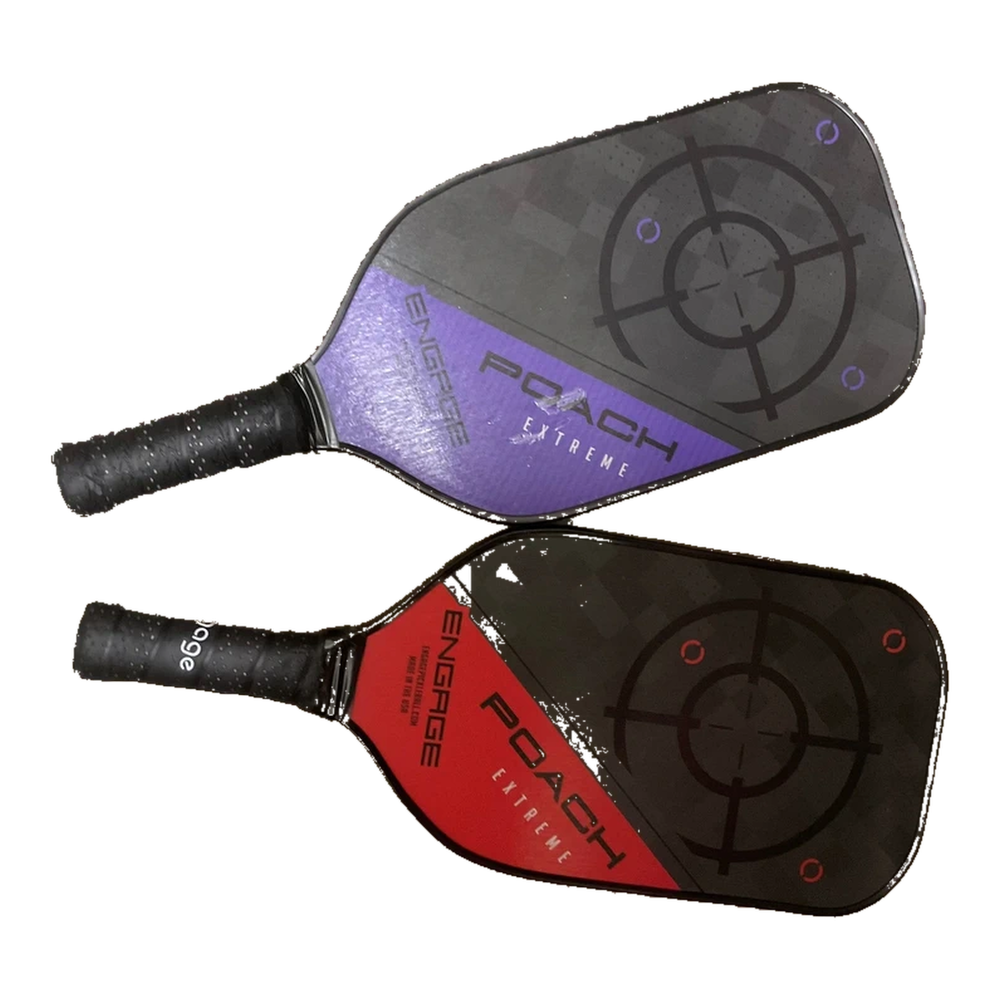
My authentic photo shows two original Engage Poach Extreme paddles lying together: a purple/black version above a red/black one, each with the distinctive targeting-reticle graphic and a black grip. These are separate physical paddles, not two color filters applied to the same product. A cleaned, transparent-background copy of my original photograph is used for the featured image and card; both actual paddles and their printed graphics remain visible.
I confirmed that I bought and played with both paddles. My overall use period was 16–30 hours, but I did not allocate a separate number of hours to each one. I also reported that they felt broadly similar while playing, even though the purple one felt lighter. Those statements are compatible: two paddles can play similarly while differing in perceived weight or balance. I did not provide actual scale measurements, factory weight-class labels or batch numbers, so I will not pretend to know their exact weights.
These original Poach Extremes should not be confused with the Poach Advantage (a wider paddle), Poach Icon, Poach Infinity, newer Engage Pursuit paddles or models with similar targeting graphics. The original elongated Poach Extreme is the exact version identified on both of my photographed faces.
My real test: outdoor doubles with outdoor balls
I used the Poach Extreme models for 16–30 hours in total, primarily in outdoor doubles with outdoor pickleballs. I did not specify my exact session count, which color received more playing time, the surface or the ball manufacturer. That context matters because the anecdotes below describe what I actually experienced, not standardized bench testing.
Why the long and narrow shape worked for me
One of my clearest impressions was that the long, slim paddle shape felt aerodynamic. It also suited the way I like to play. I could use tennis-like forehand strokes, which made the design feel familiar and practical for my personal stroke mechanics.
This is a preference grounded in how I swing. I did not separately measure swing speed, air resistance or extra inches of defensive court coverage. I also did not say I could reach more balls than with a standard paddle, or that every player with a tennis background would prefer this shape. The editorial handling score reflects these linked owner observations as one theme, not three independent technical tests.
Dinks: control over depth and direction
For the short game, I found the Poach Extreme easy to control on dinks. I could manage their depth and direction rather than simply hoping the ball landed somewhere in the kitchen.
These are related descriptions of the same useful skill, so they do not receive separate subratings. I did not report any particular topspin dink technique, dink RPM or instrumented landing-pattern data.
Third-shot drops close to the kitchen line
I also reported controlled third-shot drops and could place them near the kitchen line. This is a distinct practical shot situation from a stationary dink, although both belong to the larger soft-game placement category in the rating method.
I have not provided a drop success percentage, an exact number of attempts or a side-by-side drop comparison against another paddle. The supported finding is that I liked my real ability to place third shots with this one.
Volleys and punch volleys: strong directional control
At the net I could place regular volleys accurately and had good control over short punch volleys. I separately selected that I could redirect volleys precisely, which is the same underlying control theme expressed during a particular type of exchange. I group these observations in one volley placement and redirection category rather than awarding three independent high scores.
I did not report an actual measured reaction-time advantage or claim that the Poach Extreme was faster in every hands battle. Those questions were not answered in my firsthand report.
Power when I needed it
I found the paddle supplied good power when I wanted to hit harder. That is an overall firsthand power impression, not a claim that I independently measured harder drives, faster serves and more powerful overheads. I did not select separate examples for those shots, so the offensive-power rating remains positive but moderate in weight and confidence.
A stable feel on lighter mishits—then a dead area
My playing impressions were mixed here. I initially described the paddle as stable on lighter off-center hits. I also reported that after some time using the paddle, I noticed a dead area.
These are not mutually exclusive. A paddle may remain stable or forgiving at some off-center positions but produce a duller, weaker response in another area or in a different session. However, my questionnaire response did not specify whether the dead area was on the purple paddle, the red paddle or both. I also did not supply the exact hitting location or a before-and-after measurement. It would be irresponsible to label this a proven manufacturing flaw, a core breakdown or a defect that develops in every Poach Extreme.
What I can report faithfully is that the later dead-area observation reduced my confidence in the consistency of my experience. The editorial category covering forgiveness and consistency therefore receives the lowest score in the rating. This is the main negative factor, not a fabricated complaint about spin, grip or head speed.
Grip comfort and softer contact on short shots
The grip fitted my hand well. I also noticed a soft, damped feel on shorter shots. These observations help explain why I enjoyed the controlled part of the game.
They do not establish a tested medical benefit, reduced elbow pain or a measured vibration level. I did not confirm that either grip was replaced or customized; the photo’s visible small marks on the black grip material do not tell us the history of any modification.
Purple versus red: how similar were my two bats?
I chose that the two Poach Extremes felt about the same overall. I also chose that the purple one felt lighter than the red one. There is no need to erase one of these experiences to make the review sound simpler: the overall playing character could be similar, with a perceivable difference in weight or swing balance.
The historic Poach Extreme was sold in different weight ranges, but color does not establish the actual weight class of my units. Without weighing them, checking factory labels or giving more individual comparisons, I cannot claim that one was definitely the “LITE” edition, that either had a specific weight in ounces, or that the purple one delivered better power or control. I did not even state which color developed the dead area.
Both were purchased together, and the $79.99 USD price is for the pair. It is not the price I paid for each paddle separately, nor a verified present-day market price for one Poach Extreme.
Original Poach Extreme specifications (external information)
| Feature | Historically published model information |
|---|---|
| Model | Engage Poach Extreme, original elongated/blade version |
| Length and width | About 17 inches long × 7 inches wide |
| Handle length | Approximately 5 inches |
| Grip circumference | Approximately 4¼ inches |
| Advertised weight ranges | LITE approximately 7.5–7.8 oz; standard approximately 7.9–8.3 oz |
| Face | Six-layer fiberglass/polymer composite, marketed as Variable Release construction |
| Core | Proprietary polymer composite marketed as Control Pro Black |
| USA Pickleball listing | Original Poach Extreme listed as Pass, added April 6, 2018 |
| My exact red/purple samples | Not weighed or independently measured; color and graphics verified by original owner photograph |
Sources: historical purple Poach Extreme listing, PickleballCentral’s original 2018 model introduction, and USA Pickleball’s approved-model record. These are specification and historical approval sources, not scale measurements or current tournament certification of either used paddle. Approval status and restrictions should be rechecked for any particular competition.
External owner experiences—kept separate from my test
Professional player Ty Petty described switching to the Poach Extreme and liking its long, slim, aerodynamic character, as well as its power and control on dinks, volleys and drops. He disclosed that Engage sponsored him, so that account is useful firsthand context with an important commercial relationship. Read the interview with Ty Petty.
A separate Reddit participant said they played with Engage Poach Extreme and could carry over tennis-style strokes. That is a relevant individual account, although it does not prove the color or weight class of their sample: original discussion.
Another player’s account of a cracked edge after colliding with a partner’s paddle concerns the broader Engage Poach name, but the exact model was not established and the damage followed an external impact. It is not evidence that I experienced the same problem or that all Poach Extremes are intrinsically defective: that individual report.
Price: what I paid versus historical retail
In July 2026, I paid $79.99 USD combined for both the purple and red Poach Extreme paddles. They were self-purchased at the normal price I paid, with no discount or sponsorship. I did not submit an overall value-for-money judgment or say that either unit was bought used, so I do not describe them as discounted, refurbished or secondhand without evidence.
Older retail listings for individual Poach Extreme paddles show varying asking prices, including a historical $179.95 purple listing. That is not proof of a currently available sale or what I personally paid for one bat. The editorial score deliberately does not invent a value-for-money subscore from a price alone.
The Amazon.com affiliate link is a labeled model search, not a confirmed exact-product listing. Because this is an older model with multiple colors, I recommend checking the original Poach Extreme name, face design, physical condition and the seller’s actual photos instead of buying an unrelated Poach model with a similar name.
How the editorial rating was calculated: 4.1/5
The following score is an editorial interpretation of my own documented experiences, not a star rating I submitted and not an average of other players. The scoring areas are distinct enough to discuss separately: soft touch and drops, volleys, swing/playing style, power, forgiveness/consistency and grip/contact feel. Within each area, repeated examples are counted once.
| Evidence-backed criterion | Weight | Editorial subscore | Confirmed evidence and limits |
|---|---|---|---|
| Dink and third-shot drop control | 25% | 4.5/5 | Owner-reported control of dink depth/direction and third-shot drops placed near the kitchen; related touch observations grouped once. |
| Volley placement and redirection | 20% | 4.4/5 | Accurate volleys, controlled short punch volleys and purposeful redirection; repeated volley answers counted as one theme. |
| Swing handling and tennis-style suitability | 20% | 4.4/5 | Aerodynamic long, narrow shape, suited owner’s playing style and tennis-like forehands; both paddles felt broadly similar, although purple felt lighter. |
| Power when required | 10% | 4.0/5 | Owner confirmed reliable power as needed, without separate shot-speed readings or specific drive/serve tests. |
| Forgiveness and consistency over use | 15% | 2.8/5 | Stable on lighter mishits, but an owner-noticed dead area after some period of use; location and which individual paddle were not specified. |
| Grip fit and soft contact feel | 10% | 4.0/5 | Grip fit the owner’s hand and contact felt soft/damped on short shots; no injury or vibration measurements. |
Weights total exactly 100%. The calculation is (4.5 × 25%) + (4.4 × 20%) + (4.4 × 20%) + (4.0 × 10%) + (2.8 × 15%) + (4.0 × 10%) = 4.105/5. Rounded to one decimal, the displayed rating is 4.1/5, and the five-star display uses 82% fill.
These category values are qualitative editorial judgments, not precision measurements of shot speed, reaction time or equipment failure rate. Soft-game accuracy and volley placement are different shot situations, while the repeated dink/drop statements or volley-redirection statements within each group do not acquire extra weight. A noticeable dead area is a genuine negative observation, hence the lower consistency subscore, but I do not know which paddle or the location. No score is assigned to unreported spin tests, future durability, medical comfort, exact weight or value for money.
Who might prefer this paddle?
Based only on my actual experience, I especially liked these Poach Extreme paddles for tennis-influenced forehands, precise third-shot drops, controlled dinks and accurate net volleys. The long, narrow design felt well suited to my stroke style, and there was useful power for attacking opportunities.
The caveat is consistency. If a buyer wants a paddle with clearly verified, uniform response across the entire face over a long period, my experience cannot establish that, and I did notice a dead area later in use. The model’s age and the fact that sellers may offer different colors or conditions make checking the individual unit sensible.
Related firsthand paddle reviews
For separate owner-tested paddles rather than imagined head-to-head tests, see my Engage Pursuit Pro1 Innovation 15.2mm review and my original ProKennex Kinetic Ovation Speed review. I did not provide an actual Poach Extreme versus Pursuit Pro1 Innovation comparison, so no performance ranking between the two is asserted here.
Frequently asked questions
Did I test the purple and the red Engage Poach Extreme?
Yes. I personally purchased and played with both paddles. They felt broadly similar, but the purple felt lighter than the red. I did not weigh either sample.
How many hours and what kind of pickleball?
I reported 16–30 hours in total, mainly outdoor doubles with outdoor balls. The separate usage time for each color was not provided.
How did the Poach Extreme perform on dinks and third-shot drops?
I felt I could control my dinks well, including depth and direction, and place third-shot drops near the kitchen line. These are my firsthand playing impressions, not quantified shot-success statistics.
Was it suitable for tennis-style swings?
For me, yes: the long, narrow design felt aerodynamic and suited my style, and I could use tennis-like forehands. I did not test whether every tennis player would have the same preference.
Did the paddle develop a dead spot?
I noticed a dead area after using the paddle for some time. I did not identify whether it was the purple or red unit, where it was, or what caused it. The review takes that negative experience seriously without inventing a diagnosis.
Did I pay $79.99 for each paddle?
No. $79.99 USD was my combined total for both paddles, purchased in July 2026 at the normal price I paid, without any discount or sponsorship.
How was the editorial 4.1/5 calculated?
Six separate categories supported by my actual answers were weighted to 100%. They include accurate dinks/drops, controlled volleys, swing-style suitability, available power, grip/contact feel and a significantly lower forgiveness/consistency category for the reported dead area. The exact table and math are shown above. I did not choose the overall number myself.
Can I buy this exact purple or red paddle on Amazon?
The affiliate button links to Amazon US search results for Engage Poach Extreme. I could not verify a current exact-item ASIN or availability for either photographed original color. Check the seller’s paddle photographs and model description before buying.
Firsthand methods and evidence limits
This review was written after my explicit personal selections for both original Poach Extreme paddles, including usage, purchase and two-color ownership history. No other player’s opinions have been converted into my personal experiences. Overlapping answers were grouped in the editorial rating rather than counted repeatedly, and the observed dead area was preserved as a genuine drawback without assigning it to an unidentified unit. I did not invent a measured weight, spin figure, durability failure mode, health benefit, value-for-money judgment or verified Amazon ASIN. The same one genuine background-removed owner photo appears in the product card, featured image and Product/Review structured data.

Jonathan Grøn created The Pickleball Wise. He coaches beginner pickleball players and captains a pickleball team in Series 2. He combines on-court experience with official rules and coaching resources to write practical guides on doubles strategy, skills, and training.