GAMMA Compass NeuCore Review: My 6–15 Hour Test (4.0/5)
My GAMMA Compass NeuCore review after 6–15 hours of real play: I bought the original white-and-red GAMMA Compass NeuCore (standard RGCPP10 model) new at its normal price in July 2026 for $59.99 USD. I used it as a lower-intermediate/intermediate player, both in technical practice and matches. I really liked the extra reach of its elongated face, the generally forgiving sweet spot, the directional control and the comfortable feel on softer shots.
It was not a perfect paddle. I also noticed a dead-feeling area in the lower portion of the hitting face, even though I found the sweet spot generous and forgiving elsewhere. The standard, relatively short handle was comfortable to hold, but for two-handed strokes I preferred the longer handle on GAMMA Compass LH, a different version I had used. I also found that the paddle cover supplied with my purchase did not fit properly. Those reservations are important parts of my firsthand experience, not hypothetical negatives copied from retailer reviews.
My overall experience was positive, with good reach, control, touch, power and spin, but those concrete trade-offs put the site-calculated editorial rating at 4.0/5. This number is calculated from seven nonduplicated categories of my selected experiences. I did not choose an overall personal star number, and the 6–15-hour test does not establish a months-long durability verdict.
Amazon Associates affiliate disclosure: As an Amazon Associate, this site earns from qualifying purchases. The linked product photo and orange CTA below use affiliate tag owlratings08-20 and may earn a commission at no extra cost to you. They lead to Amazon.com search results, not a verified direct listing or current price for this exact version. Confirm standard GAMMA Compass NeuCore RGCPP10, not Compass LH with the longer handle, before buying. My $59.99 July 2026 purchase amount is historical and does not represent today’s Amazon price.
My verdict: excellent extra reach and feel, with a localized dead spot
Reach: The elongated head helped me reach balls I struggled to get to before, including at the net.
Sweet spot: Generally generous and forgiving on off-center shots, but the lower portion of my hitting face felt dead.
Control: I could direct the ball confidently, and the response felt responsive and easy to manage.
Touch: Short balls felt good, my dinks improved and I could control my volleys.
Power and spin: I got satisfactory power without over-swinging and noticeable spin, including more serve spin than with a previous Z-series paddle.
Handling: Well balanced, comfortable grip and a pleasant, relatively soft impact sensation.
Fit and accessories: I preferred Compass LH’s longer handle for two-handed shots, and my included cover fitted poorly.
What I personally liked
- Extra elongated reach, particularly useful around the net
- Generally large and forgiving sweet spot despite a narrow head
- Good directional control and responsive handling
- Confident shorter shots, better dinks and controlled volleys
- Satisfactory power without having to force the swing
- Noticeable spin; personally more spin on serves than with an earlier Z paddle
- Good balance, comfortable grip and pleasant soft-feeling ball contact
- Distinctive compass artwork and good personal value at $59.99
Trade-offs and tested limits
- The lower portion of the face felt dead in my own test; don’t assume the whole hitting surface behaved like its sweet spot
- I preferred Compass LH’s longer grip for two-handed strokes, although the standard grip was comfortable to hold
- The included paddle cover did not fit properly
- Only 6–15 hours: no justified claims about long-term face, core, edge guard or grip durability
- No calibrated spin, speed or exact paddle-weight measurement; previous Z paddle was not identified precisely
- Current matching Amazon price and an exact live listing/ASIN not independently verified
Bottom line: 4.0/5 editorial rating
For the $59.99 I paid, my standard GAMMA Compass NeuCore delivered the reach, control, touch, spin and power I wanted during 6–15 hours of practice and matches. It was generally forgiving and comfortable, but one lower part of the face felt dead, the short handle was less attractive than Compass LH for two-handed strokes, and the supplied cover was a poor fit. My evidence-weighted 4.0/5 is a qualified positive verdict, not a claim that the entire surface is equally lively.
Which GAMMA Compass did I actually use?
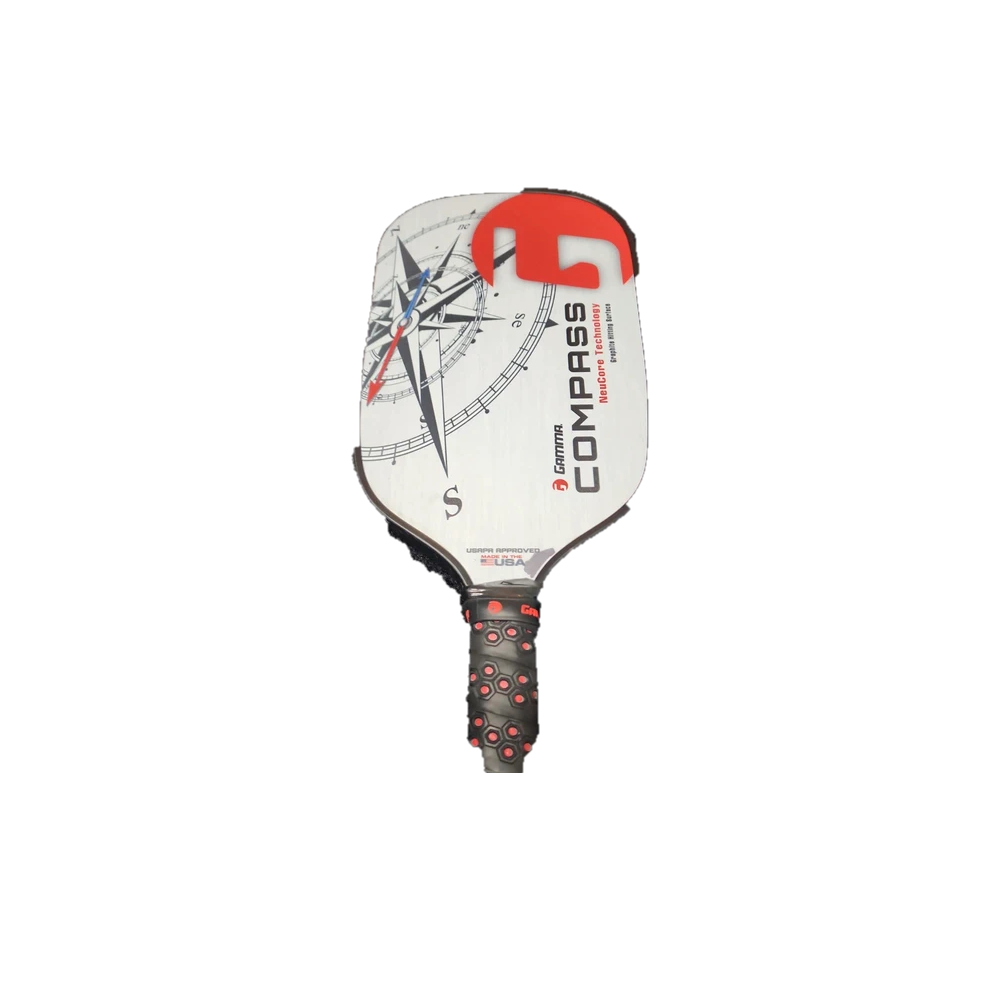
This review covers the standard GAMMA Compass NeuCore RGCPP10, not the GAMMA Compass LH. The original owner photograph shows the white/light-grey paddle face with black compass illustration, large red G, COMPASS lettering, red NeuCore Technology text and short black GAMMA grip with red honeycomb-shaped highlights. It is the actual photographed product; the background was removed from the owner’s original image, not recreated with AI or substituted from a stock catalog photo.
The manufacturer and USA Pickleball’s original Compass equipment record describe the standard graphite-faced paddle, with NeuCore polymer honeycomb core around 16 mm and an elongated, comparatively narrow face. Catalog dimensions are commonly listed as approximately 16⅝ inches long by 7⅛ inches wide, with an advertised weight near 7.75 oz and 4⅛-inch grip circumference. The original model’s equipment listing dates to May 20, 2019. Those are external design and registry specifications, not measurements I made of this individual paddle. Published handle lengths vary slightly between vendors; I did not measure mine, and I won’t imply an exact personally verified value.
The standard Compass has the shorter grip, while Compass LH is a distinct long-handle variant. That matters to my actual review: I have tried the LH and prefer its longer grip for two-handed shots. I am not importing its potentially different sweet spot, power, balance or face feel into my findings about this standard version.
My real 6–15-hour test conditions
I used the Compass for 6–15 hours of actual playing time, both for technical drills and in matches, at a lower-intermediate/intermediate stage in my pickleball experience. I did not supply the exact number of sessions, court surface, location, indoor/outdoor split or specific ball model, so those are deliberately not reported as facts.
The photo alone is not enough to infer hours, damage or grip modifications. I also did not confirm whether the grip was original or had been altered. My first-person handling and grip remarks apply to the actual paddle as I held it, not necessarily to every factory-unmodified Compass in the marketplace.
Despite the limitations described below, I was generally satisfied with the experience. My aim here is not to claim a controlled comparative study but to explain what this specific elongated paddle did well—and where it fell short—in my own use.
Extra reach was a genuinely useful advantage
Compared with my earlier practical reach, I could get to balls that were previously difficult to reach. The extended head was especially helpful at the net, where having a little extra paddle length can matter in a fast rally. I also thought the Compass felt well balanced during regular swings.
Those are separate but related observations: I valued both the additional physical reach and the swing balance. I did not record centimeters of added reach, aerodynamic measurements or a formal volley reaction-time test. The rating therefore combines these as one reach-and-handling category rather than awarding multiple unearned extra points for different descriptions of essentially the same benefit.
Sweet spot: forgiving overall, but an important dead area
I liked the generally large and forgiving sweet spot for such an elongated, narrow paddle. Many of my hits away from the exact center still worked well, and I did not find the head universally unforgiving.
However, I also experienced a dead area in the lower portion of the paddle face. That observation should not be removed merely because I liked the rest of its hitting area. A paddle can have forgiving contact around much of its upper and central face while feeling distinctly less lively near the throat or lower hitting zone.
I did not measure the dimensions of the dead area, establish whether it was a manufacturing defect, test several other Compass units, or document when the behavior started. I also did not claim it gradually developed over time. It is simply a real localized issue on the paddle I used. The rating includes both a positive overall-control category and a separate negatively scored lower-face dead-area category so buyers can see the trade-off clearly rather than having one finding overwrite the other.
Directional control and improved dinking
For normal shots, I had good control over where the ball went, with a responsive feel that made it easier to guide the paddle. I could play shorter, softer shots with good touch, and I felt my dinks improved with the Compass.
I also reported good control on volleys. This made the paddle enjoyable around the net in the matches and exercises I actually played. I did not report an instrumented dink success percentage, specific third-shot-drop results or a measured accuracy improvement, so I won’t make those claims. My account is qualitative but direct.
These positive experiences do not contradict the dead zone. They describe what happened on my normal controlled hits; the lower-face issue was a spatial exception. In the score, good dinking and volley behavior are grouped together as one touch/net theme, while general directional control belongs to the separate control/forgiveness theme.
Power and spin were both satisfying
I found the Compass had satisfactory power on harder hits and could strike firmly without having to overextend my swing. I also generated noticeable spin.
In one specific personal comparison, I felt that my serves had more spin than with a previous Z paddle I had used. I did not provide its full brand/model identification, and I did not measure spin RPM. Therefore I am not claiming that the Compass has a quantified advantage over a particular ONIX Z-series model or any modern carbon paddle. I am reporting only the comparative serve feel I actually experienced.
Because power and spin reflect two related but distinguishable capabilities and my observations are brief, they share one 15% performance category. I did not infer backhand drive speed, topspin RPM on every stroke or pro-level power merely because the paddle has a graphite face.
Grip fit, softer contact and the Compass LH trade-off
Another plus was that the grip was comfortable in my hand. I also liked the pleasant, relatively soft contact sensation on the ball. The paddle felt well balanced and not awkward during my normal swing.
Yet I also personally preferred the longer Compass LH handle for two-handed shots. That is a real preference after trying the different LH version, not merely a speculation that long grips are always better. Comfortable one-handed grip fit and wanting additional handle room for two-handed strokes can easily coexist.
These observations support a positive but qualified grip/feel category. I did not give a personal grip circumference measurement, describe hand sweat, claim an overgrip helped or say that I measured vibration or decibel output. The source photo shows GAMMA’s black-and-red honeycomb wrap, but does not confirm the complete modification history of the used example.
The cover included with my purchase did not fit correctly
There was also a small but concrete accessory problem. My Compass purchase came with a paddle cover that did not fit the paddle properly. I did not specify whether that cover was a retailer bundle or a standard manufacturer-included accessory for every Compass. Therefore I cannot honestly promise other buyers will get the same cover, nor conclude that every available Compass case fits badly.
Still, it affected what I personally received for my money. A protective cover is useful only when it actually accommodates the long paddle shape, and this one did not. When buying an older elongated model, I would check whether a bundle includes a fitted case and whether the seller confirms compatibility. Our separately researched paddle-cover guide covers accessories, without suggesting I tested every cover there against Compass.
What did I pay, and was it good value?
I purchased the standard white/red Compass NeuCore new for $59.99 USD in July 2026, at the normal price for my own transaction. I considered it good value for my style of play because the reach, control, dink feel, power and spin were enjoyable and useful. The dead lower-face area and awkward cover fit keep the overall recommendation qualified.
Retailers have advertised this model at various higher and discounted prices over time. Those advertisements are not evidence of what I actually paid, and my $59.99 is not a live Amazon price. Because the exact current Amazon.com listing and ASIN have not been independently verified, the product card intentionally links only to a clearly labeled Amazon.com search for GAMMA Compass NeuCore RGCPP10 (affiliate). Buyers should check the model name, short standard grip, seller and any included cover before ordering.
My transparent editorial rating methodology: 4.0/5
Site editorial rating calculated from the owner’s documented firsthand answers, not a rating supplied by the owner. The score is based on seven independently described themes. I grouped overlapping positives—extra reach at the net, for example, or the combination of predictable response and overall direction—rather than rewarding each repeated sentence as another independent achievement. I explicitly retained the dead spot as a performance drawback and included the less desirable LH handle comparison and ill-fitting cover in their appropriate categories.
| Distinct firsthand theme | Category score | Weight | Contribution | What supports the score |
|---|---|---|---|---|
| Added reach and balanced handling | 4.5/5 | 15% | 0.675 | Could reach previously difficult balls, especially at the net; standard Compass felt well balanced (3A/3C/10A counted together). |
| Control and overall sweet-spot forgiveness | 4.3/5 | 20% | 0.860 | Generally large forgiving sweet spot and responsive directional control (4A/4B/5A/5B); the localized low-face dead spot is penalized separately, not ignored. |
| Soft shots and net volleys | 4.4/5 | 15% | 0.660 | Good touch on short shots, personally improved dinks and controlled volleys (6A/6B/9A grouped). |
| Hard-shot power and spin | 4.3/5 | 15% | 0.645 | Satisfactory force without over-swinging; noticeable spin and more serve spin than previous unnamed Z-series paddle (7A/7C/8A/15C). |
| Grip and impact ergonomics | 3.9/5 | 10% | 0.390 | Comfortable grip, soft impact feel (11A/13A), but preferred the long Compass LH handle for two-handed strokes (12E). |
| Localized dead area at lower face | 2.5/5 | 15% | 0.375 | A genuine drawback: owner experienced dead response in the lower portion of the hitting surface (14B); does not invalidate all other contact areas. |
| Price value and supplied cover | 3.8/5 | 10% | 0.380 | Owner viewed the paddle as good value at $59.99 and liked the design, but the included cover did not fit properly (16A/17A/17B). |
| Weighted result | 100% | 3.985/5 | Rounded to 4.0/5 | |
The exact calculation is 0.675 + 0.860 + 0.660 + 0.645 + 0.390 + 0.375 + 0.380 = 3.985. That rounds to 4.0/5, equivalent to 80% star fill. The product review schema also uses the identical 4.0 rating. No category is filled in from unselected questionnaire choices, borrowed reviewer praise or manufacturer marketing.
The lower-face dead-area category has a meaningful 15% weight, so the issue is not buried beneath broad positive control remarks. The grip category reflects the genuine LH preference without incorrectly saying the standard grip hurt or slipped. The accessory affects the value category. No unsupported durability, factory defect causation or objective spin-speed subscore is added.
How other Compass owners’ experience compares
Other people’s reviews are not the evidence behind my firsthand score. Braydon Unsicker at Pickleball Effect tested the standard Compass and the separate Compass LH. He described the standard’s reach and control while distinguishing the LH’s longer grip and different playing behavior. I am not attributing his 30-plus reported games, measurements or comparative conclusions to my own test.
In Pickleball Galaxy’s owner feedback, players such as Bruce L and Cathy Blood enjoyed added reach, while Thom Dougherty reported a dead lower area and a less comfortable grip shape. The experiences vary; no single opinion proves that all standard Compass paddles have the same fault. Separate testimonials of Compass Blemished factory seconds and Compass LH are not presented as exact-model tests. In my own review, the lower-face drawback is present because I personally reported it, not because it appeared in an outside review.
Who should consider the standard GAMMA Compass NeuCore?
Another related, separately owner-tested GAMMA NeuCore paddle is our original GAMMA Typhoon RPTPP pink/white review. Its owner used it for 6–15 hours in drills and matches after photographing it before play, and reported a forgiving sweet spot, added reach, steady blocks and controllable short dinks. The original Typhoon is distinct from Compass: these are separate firsthand tests, not a measured head-to-head comparison.
For a different genuine-owner-tested GAMMA NeuCore paddle, see the GAMMA Havoc Lindsey Newman Signature (RPHAP10) review. Over 6–15 hours mainly in indoor doubles, the owner reported a generous sweet spot, comfortable soft touch and useful pop, with the limitations of a short test clearly disclosed. This is related reading, not a controlled head-to-head comparison with the standard Compass.
From my 6–15 hours, a player who appreciates extra reach, soft-game touch, a forgiving main hitting area and usable power/spin may find the standard Compass appealing. I used it at a lower-intermediate/intermediate stage and was generally pleased with it. I would not claim it is automatically right for every beginner, since I did not test it as an absolute beginner during this period.
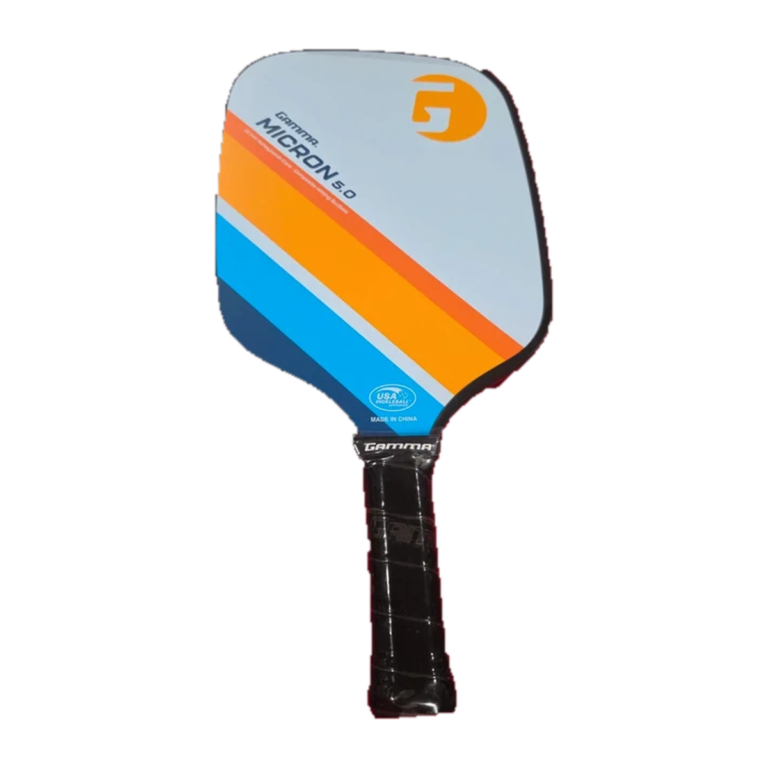
If you use a two-handed backhand, the separate Compass LH’s longer handle may be worth examining; I personally preferred that feature on the LH. If you are sensitive to occasional weak response near the grip or expect a properly fitting bundled cover, note that my own unit had a dead lower-face area and the included case fitted poorly. A player choosing among newer equipment may also read our independent owner experiences with the GAMMA Fusion Pro, GAMMA Fusion 2.0 Plus and GAMMA Micron 5.0, plus the best pickleball paddles guide. These are separate reviews, not claims of a standardized head-to-head test.
Frequently asked questions
Is GAMMA Compass NeuCore a good paddle?
I was generally satisfied after 6–15 hours of lower-intermediate/intermediate practice and matches. The extra reach, control, dink feel, power and spin were strengths; the lower-face dead zone and cover fit were real limitations.
What is the difference between Compass and Compass LH?
The standard Compass NeuCore RGCPP10 has a shorter grip. Compass LH is a distinct long-handle version. I personally preferred LH’s extra handle space for two-handed shots, but this review’s first-person performance findings otherwise belong to the standard model pictured.
Does the Compass have a big sweet spot?
I found it generally large and forgiving, but also identified a dead area near the lower portion of my face. Both details are necessary for an accurate description of my experience.
How did it perform on dinks?
I enjoyed good short-shot touch and felt that my dinks improved. I did not count successful drops or record an exact accuracy percentage.
Does Compass NeuCore generate spin?
I generated noticeable spin and felt I got more spin on serves than with a previous Z paddle. I did not specify the exact earlier model or measure RPM.
Is the paddle powerful?
In my play, I got satisfactory power without having to force the swing. There are no ball-speed measurements or a controlled comparison here.
Does the Compass come with a cover?
My purchase included one, but it did not fit properly. That does not establish the contents or fit of every retailer’s package; check the specific listing.
How long did you test it and what did you pay?
I actually played for 6–15 hours and paid $59.99 USD in July 2026 for a new unit at my normal purchase price. Neither figure represents a long-term test or live Amazon price.
Why 4.0/5 rather than a perfect score?
The 4.0/5 is a transparent weighted site editorial score. A dead-feeling lower-face area, a personal preference for the longer LH handle on two-handed shots, and a badly fitting cover reduce it, even though I liked most of its play characteristics. I did not personally select the numerical score.
Final verdict
My firsthand GAMMA Compass NeuCore standard RGCPP10 review ends with an evidence-weighted editorial 4.0/5. I liked its reach, forgiving overall sweet spot, directional control, improved dinks, satisfying power and spin, balanced swing and comfortable grip at the $59.99 I paid in July 2026. Crucially, I also experienced a dead area on the lower hitting face, preferred Compass LH for two-handed shots and found the supplied cover ill-fitting. This is an honestly qualified positive verdict drawn from my actual 6–15-hour test, not a claim of flawless face performance or extensive durability evidence.

Jonathan Grøn created The Pickleball Wise. He coaches beginner pickleball players and captains a pickleball team in Series 2. He combines on-court experience with official rules and coaching resources to write practical guides on doubles strategy, skills, and training.