Selkirk AMPED Epic X5 FiberFlex Lightweight Review: My 30–100 Hours
My Selkirk AMPED Epic X5 FiberFlex Lightweight review after 30–100 hours: I found dinks and resets easier with this original blue paddle, enjoyed its forgiving sweet spot, and got more power than expected from serves and drives. The negatives were significant too: drives initially went long until I adjusted, spin was difficult to generate, I noticed contact vibration or a hollow sound, and I saw visible wear. I personally prefer my JOOLA Perseus Pro IV and felt this Selkirk was too expensive for the experience.
Another original Selkirk model I tested (November 11, 2026): See my SLK Helix Max / Helix Pro Camo Glitch firsthand review. I reported 10–30 hours with that blue Max-shaped paddle and found precise dinks/drops but insufficient spin for my game. This is a different SLK paddle from the original AMPED Epic X5 FiberFlex Lightweight reviewed here; I have not reported a direct head-to-head winner between the two.
Related firsthand test (November 10, 2026): I also reviewed the separate green Selkirk AMPED Control Epic Midweight after 10–30 hours. The green Control version made dinks and resets easier and had a forgiving sweet spot, but I experienced too-soft feedback, too little power for my style, and a heavy or slow net feel. My original blue X5 FiberFlex Lightweight and the newer green AMPED Control are different paddle generations; I did not report a direct green-versus-blue winner.
This is a genuine firsthand review based on my own 30–100 hours of play, not an article that turns other people’s opinions into my test results. I do not have a purchase date, receipt amount, or details of sponsorship or discounts confirmed for this particular paddle. My use duration was supplied from memory, not estimated from its photograph.
Affiliate disclosure: As an Amazon Associate I earn from qualifying purchases. The Amazon link below contains an affiliate tag, so the site may receive a commission if you buy a qualifying item at no additional cost to you. The linked ASIN is a third-party-identified candidate for the original blue Lightweight model; its live Amazon price, availability and destination variant could not be confirmed. Please verify the product is the exact older X5 FiberFlex version, not the newer AMPED Control.
Original blue AMPED Epic X5 FiberFlex Lightweight · 3.1/5
My court verdict: The paddle’s greatest strengths in my play were touch on dinks and resets, a forgiving sweet spot and unexpected serve/drive power.
Where it fell short: I needed to adapt after early drives went long, had difficulty getting enough spin, noticed vibration or hollow sound at contact and saw visible wear. My selected answers do not distinguish whether it was vibration, a hollow sound, or both; nor do they identify the exact worn component.
Best fit for: Someone who values the touch and forgiveness I experienced and can demo the older paddle at a price they consider worthwhile. Less suitable for: My own spin-dependent expectations, contact-feel preferences and value priorities.
- Easier control of dinks and resets
- Large, forgiving sweet spot
- More power on serves and drives than I expected
- Drives initially went long until I adapted
- I found it difficult to produce enough spin
- Some vibration and/or hollow-sounding contact feedback; precise sensation not recorded
- Visible wear after my period of play, but location and cause not precisely documented
- I prefer JOOLA Perseus Pro IV and felt the Selkirk was too expensive for the experience
Bottom line: useful short-game control, but not my preferred value
3.1/5 from 30–100 hours of first-hand use. I liked the easier soft game and more-than-expected power, but struggled with spin, adjustment on drives, contact feedback and visible wear. Since I also prefer my JOOLA Perseus Pro IV, I would not recommend paying a premium for this older model based on my own experience.
Which Selkirk AMPED Epic did I actually use?
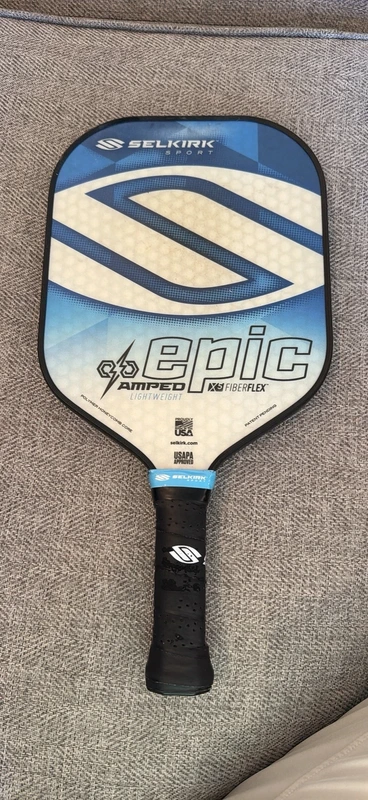
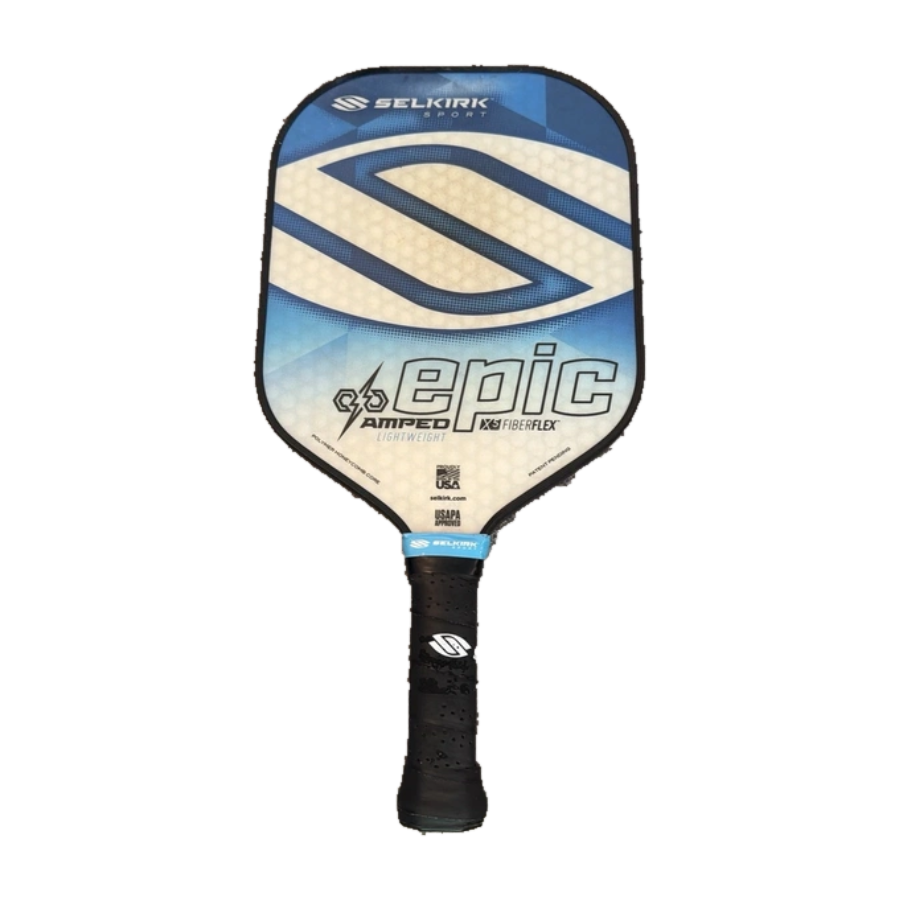
The writing on the genuine original photo reads SELKIRK SPORT, epic, AMPED, X5 FiberFlex and LIGHTWEIGHT. The color is blue and the grip is black. That lets me distinguish this older model from today’s similarly named AMPED Control or FiberFlex+ paddles, which should not be substituted in a comparison or buying link.
- Actual first-hand usage: approximately 30–100 hours, as reported by me, without a precise court-session log
- What I confirmed: easier dinks and resets, a large sweet spot, unexpected serve/drive power, early drives going long until I adjusted, insufficient spin, unwanted contact sensation/sound, visible wear, preference for JOOLA Pro IV and dissatisfaction with the relative price
- Purchase details not established: exact price paid, retailer, purchase date, discount/sponsorship status
- Not measured: spin RPM, exact power or ball speed, weight of my individual paddle, controlled failure rate, measured sweet-spot dimensions or side-by-side same-session performance numbers
- Photos: the original blue-paddle front view and a derived front-view close-up of that same photo, not evidence of two separate court tests
A specialist retailer’s historical listing identifies the older AMPED Epic Lightweight with X5 polypropylene honeycomb, FiberFlex fiberglass, an advertised 7.3–7.7 oz weight range, 15¾-inch length, 8-inch width and 5¼-inch handle. These are published product specifications, not measurements I performed. The retailer marks this design discontinued.
Control: easier dinks and resets, a generous sweet spot
In my own games, the main positive was how easy dinks and resets were to control. I also experienced a large and forgiving sweet spot. These are my firsthand qualitative impressions, not a measurement of how many square inches are forgiving or how often I mishit the ball.
This is the reason I can see genuine appeal in the original Epic. If I had to focus on softer shots, I would find that feel valuable. But that does not make the paddle my overall favorite, because I care about spin, confidence on stronger shots and the amount of value I get.
Serves and drives had power, but I needed an adjustment period
I found more power than expected on serves and drives. At first, some drives went too long before I adjusted my swing. This is not a claim that drives remained impossible to control for the entire 30–100 hours; the original observation specifically includes adapting to the paddle.
What surprised me was how the two impressions coexisted. There was enough power to exceed my expectations, while learning to keep that power inside the lines was not automatic for me. It is a practical learning-curve issue, not a stopwatch-measured performance difference.
Spin: the weakest part of my court experience
The spin response did not match what I wanted. I struggled to create enough spin on this paddle. I am not claiming that it cannot produce spin, or that every player will share my experience. I also did not perform a measured RPM comparison against newer textured carbon paddles.
It is worth keeping a separate research perspective: Pickleball Kitchen’s original Lightweight AMPED review reported a more positive spin experience. That is another reviewer’s opinion, not evidence that my own difficulties did not happen, and none of their claimed performance numbers entered my score.
Vibration, hollow-sounding contact and wear: what I can actually confirm
I also indicated vibration or a hollow sound at impact. This response came from one combined option rather than a detailed written diagnosis. It does not establish that both occurred, nor does it prove a loose core, defective bonding or a failed face.
I noted visible wear, but the same response option covered wear on the face, grip or edge, so I cannot honestly pin it to one specific component. After a reported 30–100 hours, that is worth mentioning — not enough to label a particular part as broken or to promise a fixed paddle lifespan.
Why I prefer JOOLA Perseus Pro IV
My direct buying preference is the JOOLA Perseus Pro IV 16mm. I had separately reported about eight hours in its earlier first-hand review and gave it a 4.6/5 editorial rating. I also have more extensive 30–100-hour experience with this older blue Selkirk. I have not described an identical-court side-by-side experiment, and I will not invent such a test or a precise numeric performance gap.
| Personally reviewed paddle | Documented playing time | Published site-owned rating | Supported takeaway |
|---|---|---|---|
| Selkirk AMPED Epic X5 FiberFlex Lightweight, blue (this review) | 30–100 hours | 3.1/5 | Easier dinks/resets, large sweet spot and unexpected power, but disappointing spin, contact feedback, wear and perceived price. |
| JOOLA Perseus Pro IV 16mm | Approximately 8 hours in the original review | 4.6/5 | My separately reviewed alternative and the one I expressly prefer. The ratings are not controlled head-to-head measurements. |
For broader context across paddles I have actually played with, see my best pickleball paddles guide. I have not changed that guide’s historical ranked count just by publishing another review.
How I calculated my first-hand 3.1/5 rating
I chose seven criteria that my actual answers allowed me to judge and weighted them to 100%. The scores are original, transparent editorial judgments derived from my own observations, not borrowed laboratory readings, Amazon customer ratings or measurements. I did not invent an exact dollar-based value metric without a confirmed amount paid.
| Criterion | Weight | Editorial score | My supporting observation |
|---|---|---|---|
| Dinks, resets and forgiving sweet spot | 25% | 4.5/5 | Easier dinks/resets and a large sweet spot in my play |
| Serve and drive power | 15% | 4.0/5 | More power than I expected on serves and drives |
| Drive control and adjustment | 15% | 2.5/5 | Drives originally went too long until I adjusted |
| Spin generation | 15% | 2.0/5 | I struggled to generate sufficient spin |
| Contact feedback | 10% | 2.5/5 | I reported vibration or a hollow sound, without specifying which |
| Visible condition after use | 10% | 2.5/5 | Observed wear on face, grip or edge; exact location unspecified |
| Personal value and preference | 10% | 2.0/5 | I prefer JOOLA Perseus Pro IV and found this Selkirk too expensive for my experience |
Calculation: (4.5 × 25%) + (4.0 × 15%) + (2.5 × 15%) + (2.0 × 15%) + (2.5 × 10%) + (2.5 × 10%) + (2.0 × 10%) = 3.100/5, rounded to 3.1/5. The review card’s five-star fill is 62%, matching the numeric rating. The visible wear category does not imply a measured failure rate, and the perceived value category is not a claim about my receipt amount.
Amazon.com price and availability for the older blue version
The original AMPED Epic X5 FiberFlex Lightweight is an older product. A third-party listing identifies blue model 1525_AMP21-Light-Epic-Blue and ASIN B0866SSLD2. However, I could not independently verify the live Amazon.com listing (paid link), its stock, or a current checkout price. The exact paddle shown in my photograph may no longer be available new.
A retail reference of around $149.99 for an older Epic model is not proof of what I paid or what Amazon charges today. I am not presenting that number as my purchase price, a live Amazon offer, or a discount. Check the listing’s model year, X5 FiberFlex marking, Lightweight option and blue variant carefully before purchasing — the newer AMPED Control is a different design.
Frequently asked questions
Is this a genuine firsthand Selkirk AMPED Epic review?
Yes. I reported about 30–100 hours with the original blue X5 FiberFlex Lightweight shown in my own photos. Other reviewers’ statements were not used as my results.
Did the paddle make dinks and resets easier?
Yes, in my own experience. The forgiving sweet spot was also a genuine positive.
Was it powerful?
It was more powerful on serves and drives than I expected, though my drives initially went long until I adjusted. I did not measure serve speed or hitting power in a laboratory.
Did the paddle fail?
I noticed visible wear and reported vibration or a hollow sound at contact. I did not document a confirmed structural failure, the exact worn component, or whether both sound and vibration occurred.
Would I choose this Selkirk over JOOLA Perseus Pro IV?
No. My confirmed personal preference is JOOLA Perseus Pro IV. That is my verdict from separate use, not a simultaneous controlled test.

Jonathan Grøn created The Pickleball Wise. He coaches beginner pickleball players and captains a pickleball team in Series 2. He combines on-court experience with official rules and coaching resources to write practical guides on doubles strategy, skills, and training.