Pickleball Apes Pulse S Hybrid Review: My 3–10 Hour Test (Purple)
My Pickleball Apes Pulse S Hybrid Purple review after 3–10 hours: I paid $99.99 for this paddle in September 2026 and have played mainly indoor doubles with an overgrip. Its biggest strength for me is soft-game control: precise dinks, easier third-shot drops and easier resets. I also liked its forgiving contact, fast handling at the kitchen, good topspin and comfortable, balanced feel. My biggest complaint was not enough power to put easy balls away. Even though I found it good value, I personally prefer the JOOLA Perseus Pro IV overall.
Related self-purchased control-oriented widebody: My new 11SIX24 Pegasus All Court 16mm review covers 3–10 hours of indoor doubles. I liked forgiveness and net stability, but found some dinks popped high and finishing power limited relative to stronger power paddles. This is different from the Pulse S Hybrid reviewed here; I did not report a direct Pegasus-vs-Pulse S overall winner.
Test independence: I bought the Pulse S myself, without a discount, free product, sponsorship or paid promotion. The $99.99 is my reported purchase amount, not a guessed current Amazon price. My 3–10 hours are the owner-reported playtime, not a visual estimate from the photo. I did not keep numerical shot-success logs or measure ball speed, RPM or long-term durability, so none of those appear as my test results.
Affiliate disclosure: As an Amazon Associate I earn from qualifying purchases. The Amazon US search link below includes my affiliate tag owlratings08-20, and qualifying purchases may earn this website a commission without additional cost to you. This review is independent: I paid for the paddle myself. The link is a search-results page, not a verified exact-product Amazon checkout page.
My 4.1/5 verdict: a strong control paddle, short on finishing power
Best part: dinks and third-shot drops were precise and easier to manage; resets were also easier. Soft-game control was my single biggest positive.
Other positives: contact felt forgiving on slight mishits, the paddle was quick at the net, topspin on drives was good and the grip was comfortable with my overgrip. I liked the balance and soft impact feel.
Biggest limitation: I lacked power when trying to finish easy balls. I did not separately report poor drive power, weak serves or bad counters, so I will not extend that complaint to every attacking shot.
Personal preference: at my $99.99 purchase price, I considered it good value; JOOLA Perseus Pro IV is still my overall preferred paddle from separate play.
- Precise dinks and easier third-shot drops
- Easier pace-absorbing resets, with soft-game control my biggest strength
- Forgiving feel on slightly off-center contact
- Quick, easy movement at the kitchen
- Good topspin on drives
- Comfortable purple grip with overgrip, good balance and soft touch
- Good value at the $99.99 I personally paid
- Not enough power for put-away shots in my own game
- I personally prefer JOOLA Perseus Pro IV overall
- 3–10 hours is not enough evidence for a long-term durability verdict
Bottom line — 4.1/5 from my first 3–10 hours
I found the Pulse S an appealing control-oriented hybrid. My dinks, drops and resets were all positives, alongside forgiving contact, good spin and fast net handling. But finishing easy balls required more power than I felt I could get from this paddle. I would describe it as good value at my own $99.99 price, while keeping the short test window and preference for JOOLA Pro IV transparent.
Which Pulse paddle did I actually test?
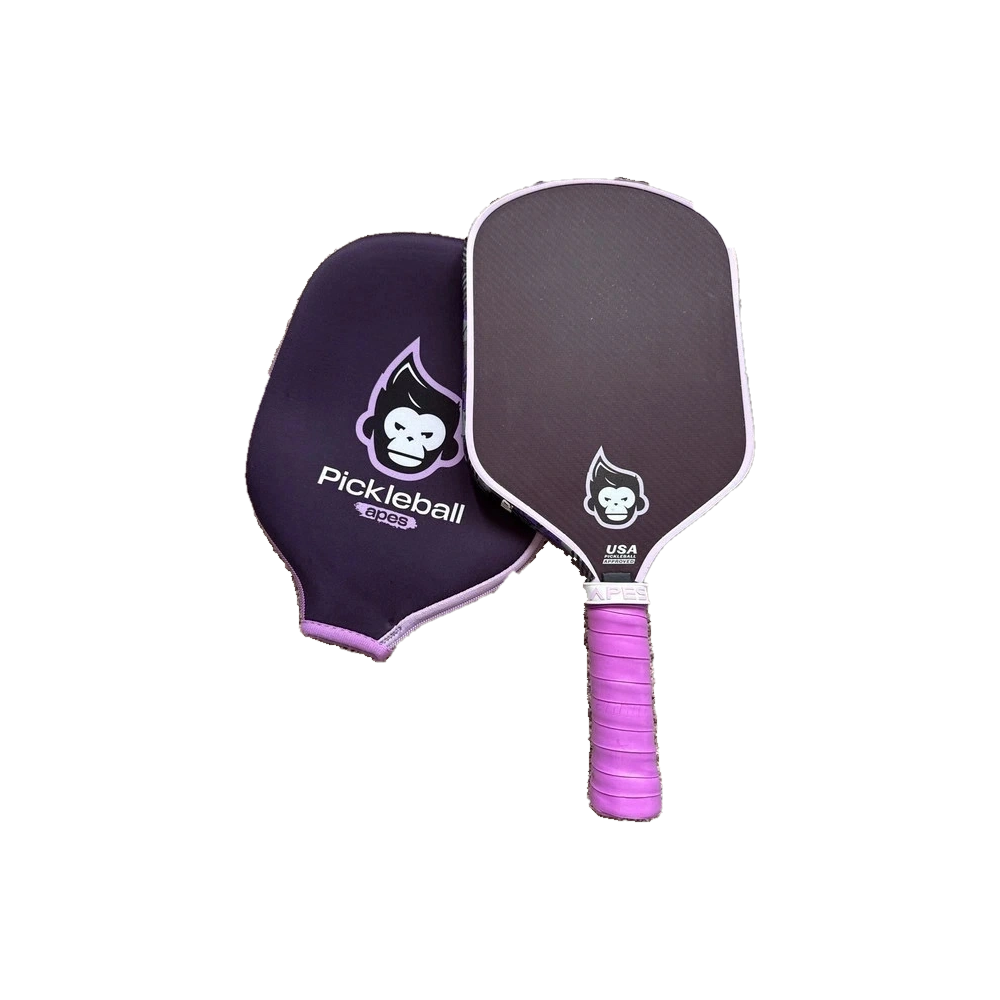
My pictured paddle is the Pickleball Apes Pulse S Hybrid in purple, with a lavender-edged dark face, a purple overgripped handle and the matching Pickleball Apes cover. It is not the longer Pulse X elongated, the wider Pulse V or the extra-elongated Pulse E. The single photo on this page is my own genuine product photo with its background removed, not a digitally reconstructed paddle or a stock advertising image. The original photo is preserved privately with the archived photos.
For context, Pickleheads and Pickleball Effect describe the Pulse S as a hybrid around 16.4 × 7.6 inches, with a 16.5 mm core, 5.5-inch handle and an aramid/nylon face. Published stock weight typically sits around 8–8.4 oz. Those are external product specifications, not measurements of my sample; my fitted overgrip also changes its real-world setup. A separate PPA Tour/John Kew laboratory listing contains exact-instance test data that I did not personally measure.
My test conditions and how much they limit the verdict
I tested this paddle over approximately 3–10 hours, primarily playing doubles indoors, and I used an overgrip. I bought it independently in September 2026. I did not provide a specific ball brand, player-rating level, court name or exact match-by-match testing log. As a result, this is an account of real use rather than a standardized lab comparison.
I also did not give a specific match story or numerical before-and-after measurements. I have not added an imagined rally to make the article sound more detailed. It is perfectly possible to learn useful things from 3–10 hours, but claims about durability and changes after months of play would need longer follow-up.
Dinks and third-shot drops: my strongest area
Precise, easy-to-place dinks were one of my clear positives. I also found third-shot drops easier to control. These are distinct observations: a paddle can feel good on short kitchen exchanges yet difficult when dropping a ball from farther back, but I was positive about both with the Pulse S.
The soft-game performance was the single biggest strength I selected. I cannot quantify the percentage of successful drops or claim that I performed the shots perfectly every time. What I can say is that this part of the game felt easier and more dependable to me during my indoor doubles sessions.
Resets: I could absorb pace more comfortably
When dealing with faster incoming balls, I found it easier to absorb pace with resets. This directly supports my control-oriented verdict. I did not provide separate answers on all blocks, defense under pressure or off-the-bounce counters, so the conclusion here stays specific to the resets I actually evaluated.
Independent reviewers such as Pickleheads also describe Pulse S as control-oriented, but that is external context, not the source of the claim about my own resets.
Sweet spot: forgiving on slightly off-center contact
I reported that the Pulse S felt forgiving when I hit slightly off center. That is positive, though not an assertion that the paddle has the largest measured sweet spot on the market. I did not use impact mapping, measure twistweight or compare the same off-center shot across multiple paddles under controlled conditions.
It’s worth distinguishing my own experience from mixed published views: Pickleheads described a medium-sized sweet spot and some unexpected mishits, while Pickleball Effect reported good forgiveness for a hybrid. My firsthand conclusion is narrower: slightly off-center contact was forgiving for me during this short trial.
Put-away power: the clearest weakness
My most important negative observation was not enough power to finish easy balls. I did not say that every drive, serve or punch volley lacked speed; the chosen answer was specifically about put-away shots, where I wanted to end the rally decisively.
This trade-off matters to players who regularly capitalize on high balls at the kitchen. I liked how I could soften the game, but I did not find the same easy finishing power I wanted. The score therefore penalizes put-away power more strongly than the otherwise positive soft-game attributes.
Net speed and handling: quick for my game
One benefit that coexisted with my put-away limitation was quick and easy movement at the net. I liked how readily I could handle the hybrid paddle in kitchen exchanges. That is not the same as saying my counters were objectively faster than with Pulse X or JOOLA: I did not select a direct speed comparison for this review.
My positive net-handling experience is also distinct from the paddle’s ability to finish a point. A paddle can be agile in the hand without having enough pop on a particular attacking shot.
Spin: good topspin on drives
I experienced good topspin on drives with Pulse S. I did not separately document my serve topspin, slice, exact RPM or how its spin compares with my JOOLA or Pulse X. I cannot responsibly turn this one positive into a comprehensive test of all spin shots.
External tests provide technical context: John Kew’s Pulse S laboratory listing reports approximately 2,183 RPM on a separate measured sample, while Pickleball Effect reported high spin from its own test. Neither number is mine or used as a measurement supporting my first-hand review score.
Soft contact, comfortable overgrip and balance
I experienced a soft, comfortable feel on dinks and drops. I also liked the grip comfort and found the paddle well balanced. Because I used an additional overgrip, I am not claiming that someone with only the stock grip will experience identical hand comfort or grip circumference.
I did not report arm pain, a hollow impact sound, a measured vibration level or successful two-handed backhand use. Those unselected observations do not belong in my personal assessment.
Early break-in: the contact felt softer with use
I noticed that the paddle became softer in its impact feel as I played. That is a genuine first-hand observation during a 3–10-hour period. I did not record exactly when the change happened or whether power, pop, spin or sound changed at the same time.
Some external reports describe Pulse-series changes over time, whereas Pickleheads reported relatively little change after its initial sessions. There is not a single universal trajectory. My observation is limited to feel becoming softer; it is not a diagnosed core failure or evidence that this particular paddle will grow more powerful later.
How it compares with my JOOLA and other Pickleball Apes paddles
I explicitly selected that I prefer the JOOLA Perseus Pro IV overall. That was a personal choice from my own separate playing experiences. I did not select a direct Pulse S-versus-JOOLA spin winner, or a head-to-head Pulse S-versus-Pulse X preference, so I will not invent either.
| First-hand review | Reported use | Editorial score | Relevant supported experience |
|---|---|---|---|
| Pickleball Apes Pulse S Hybrid Purple (this review) | 3–10 hours | 4.1/5 | Precise dinks, easier drops and resets, forgiving feel, quick net handling and good topspin; weaker put-away power; I prefer JOOLA Pro IV. |
| JOOLA Perseus Pro IV 16mm | Approximately 8 hours in its original review | 4.6/5 | My independently reviewed premium paddle and overall preference over Pulse S. |
| Pickleball Apes Pulse X Purple (elongated) | 3–10 hours | 4.2/5 | Separately tested: soft-game control and sweet spot were positive, with slower hand-direction changes. No direct Pulse S-vs-X preference given. |
| Pickleball Apes Pro Line Energy (original 17-inch) | 30–100 hours | 3.9/5 | Separately tested: strong full-swing drives and reach, but a small sweet spot and face wear. Not a controlled comparison with Pulse S. |
These are separate reviews with different exposure windows; editorial ratings across the site are not standardized head-to-head lab measurements. See my Best Pickleball Paddles guide for the original ranked shortlist. This Pulse S review is an additional standalone review, not an unannounced eighth entry in that guide.
Value: worth my actual $99.99 price
Unlike reviews with unknown purchase totals, I can state my own paid price here: $99.99 in September 2026, with no discount, sponsorship or free product. I specifically reported that I considered it worth the money. The combination of short-game control, spin, forgiving feel and speed at the net made that price feel worthwhile to me, even though put-away power was lacking and JOOLA remains my personal preference.
For shopping context, Pickleball Nation showed a $139.99 Pulse S listing with $199.99 crossed out when checked. That is a retailer snapshot, not what I paid, and not a verified current Amazon.com price. The manufacturer’s Pulse page includes multiple shapes, so shoppers should select S Hybrid rather than the X, V or E variants. I have not verified an exact Amazon.com ASIN; the product card’s Amazon US search link is transparently labeled as a paid search.
How I calculated my 4.1/5 firsthand editorial score
These are seven transparent editorial sub-scores based only on my own selected observations. They are subjective judgments, not lab measurements or other reviewers’ ratings. The criteria total 100%, with extra weight on touch shots and put-away power because both were decisive parts of my recorded experience.
| Criterion | Weight | Editorial score | Basis from my test |
|---|---|---|---|
| Dinks, drops and resets | 25% | 4.7/5 | Precise dinks; easier third-shot drops; easier resets; soft-game control was my biggest strength. |
| Forgiveness on slight mishits | 10% | 4.4/5 | The paddle felt forgiving on slightly off-center contacts. |
| Put-away power | 25% | 2.7/5 | I lacked power to finish easy balls; no claim about measured serve or drive speed. |
| Net maneuverability | 10% | 4.5/5 | Quick and easy to maneuver at the net. |
| Topspin on drives | 10% | 4.4/5 | Good topspin in my own drives, with no personal RPM measurements. |
| Feel, grip and balance | 10% | 4.5/5 | Soft touch; comfortable purple grip with my overgrip; balanced feel; softer with early use. |
| Value at my paid price | 10% | 4.5/5 | I bought it myself for $99.99 and felt it offered good value. |
Calculation: (4.7 × 25%) + (4.4 × 10%) + (2.7 × 25%) + (4.5 × 10%) + (4.4 × 10%) + (4.5 × 10%) + (4.5 × 10%) = 4.080/5, rounded to 4.1/5. Star graphics use 82% fill. I have not assigned an unearned long-term durability score from only 3–10 hours.
Frequently asked questions
Did I actually test the purple Pulse S Hybrid?
Yes. I bought the photographed purple Pulse S Hybrid myself in September 2026 for $99.99, with no discount or sponsorship, and used it for approximately 3–10 hours in predominantly indoor doubles with an overgrip.
Is it good for dinks, drops and resets?
In my experience, yes: dinks were precise, third-shot drops and resets felt easier, and I rated soft-game control as my biggest strength.
Does it have a forgiving sweet spot?
It felt forgiving on slightly off-center contacts. I did not measure a sweet-spot diameter or rank it under controlled conditions.
Is it powerful enough to put balls away?
Not consistently enough for me. I specifically reported insufficient finishing power on easy balls, without separately claiming weak drive or serve speeds.
Did the Pulse S change after break-in?
I felt the contact become softer during my short 3–10-hour test. I did not quantify a change in power, spin or core condition.
Is it worth $99.99?
I personally thought so, having paid that amount myself in September 2026. Today’s Amazon.com price and availability may differ.

Jonathan Grøn created The Pickleball Wise. He coaches beginner pickleball players and captains a pickleball team in Series 2. He combines on-court experience with official rules and coaching resources to write practical guides on doubles strategy, skills, and training.