ONIX Z Junior Composite Orange Review: My 1–5 Hour Test (3/5)
My ONIX Z Junior Composite Orange review after 1–5 hours: I bought the orange junior-size paddle myself in August 2026 for $29.99, without sponsorship, a gift or a discount. I personally played with it indoors using indoor pickleballs. I found it very light and easy to maneuver, noticeably quicker to react with than my larger adult paddles, and surprisingly lively on drives and short punch volleys. But there was a meaningful trade-off: I experienced many edge hits. My own overall rating is 3.0/5.
I tested the paddle myself; I did not observe or report a child using it. That distinction matters because ONIX sells the Z Junior as a smaller paddle for younger players. My experiences can describe how this particular orange paddle felt in my adult hands, but they cannot stand in for a child’s grip fit, development or enjoyment. Nor did I test the paddle for months: the period I submitted was only 1–5 hours.
Affiliate disclosure: As an Amazon Associate I earn from qualifying purchases. The Amazon US search link below uses affiliate tag owlratings08-20; a qualifying purchase may generate a commission at no additional cost to you. I purchased this paddle using my own money with no sponsorship, gifted sample or discount. The link goes to Amazon search results, not a verified exact-SKU checkout page. The original and newer Z Junior listings can be confused, so please check the orange graphic, version and seller.
My verdict: remarkably quick, with a small-paddle trade-off
Light and easy to move: I found the junior paddle noticeably lighter than my usual adult paddles, which made it easy to handle during my indoor test.
Fast at the net: I could reposition it quickly, react faster than with a larger paddle, and play effective short punch volleys.
More pop than expected: despite the smaller format, the face felt direct and lively. I could hit powerful drives.
Main issue: I experienced many edge hits. Quick hands were useful, but they did not mean every ball found the center of the shorter face.
Direct comparison: it felt lighter and more maneuverable than my ONIX Z3 Composite, a different adult-size paddle I have also played with.
Overall: this is my personal 3/5 rating after a brief firsthand test, not an automatically calculated editorial score.
What worked for me
- Very light-feeling and easy to maneuver
- Noticeably lighter than my regular adult paddles
- Quick repositioning and reactions at the net
- Faster reactions than with a larger paddle
- Easy handling even during the longer portions of my short test sessions
- More pop than I expected
- Powerful drives in my own play
- Effective short punch volleys
- Direct, lively contact response
What held it back
- Frequent edge hits during my 1–5 hours of play
- The quick junior format did not automatically translate to consistently centered contact for me
- No personal child-fit or junior skill-development test
- No reported findings on dinks, drops, serves, topspin or off-center stability beyond the edge-hit observation
- Limited test length; no long-term grip or durability assessment
Bottom line: my owner-selected 3.0/5
I enjoyed the lightweight, nimble handling, punch-volley responsiveness and unexpected drive power of the ONIX Z Junior Orange. However, I also caught the edge of the paddle frequently. The positives and that drawback can coexist: net speed and reliable clean contact are different aspects of play. I gave this paddle 3 out of 5. This is a short adult player’s test of a junior product, not a claim that kids will encounter the same strengths or problems.
Exactly which ONIX Z Junior paddle was in my test?
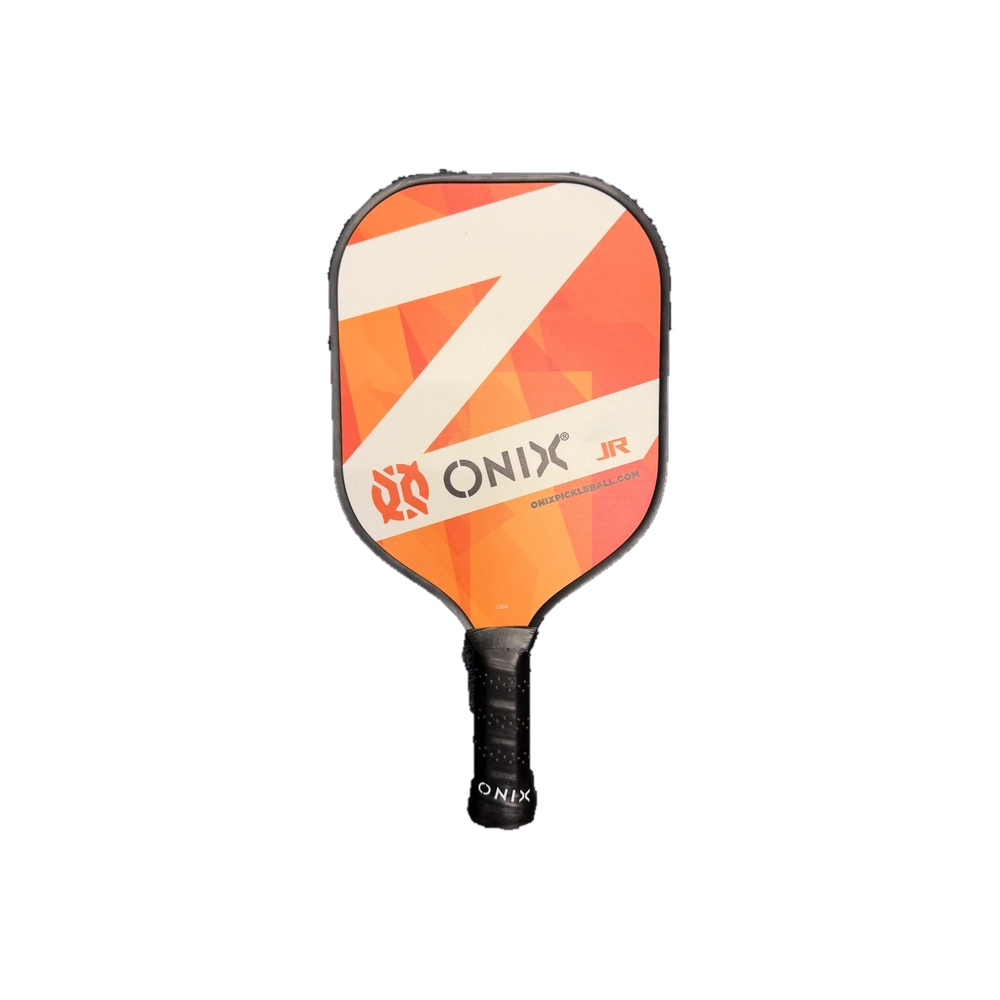
My original photograph shows a compact orange ONIX Z Junior Composite paddle with a large white diagonal Z, orange geometric graphics, ONIX JR lettering and a black wrapped handle. The featured photograph is a genuine cutout of that original image taken against gray fabric. Only the background was removed; the paddle design, letters and grip were not recreated.
I did not submit independent proof of the exact version or product SKU on my receipt or paddle label. ONIX has marketed an original Z Junior and a later variant. Its original Z Junior product listing and newer Z Junior listing describe the same general reduced-size junior category, but they give different grip circumferences. I therefore identify my sample by the photo and the submitted model name, without claiming a verified original or V2 SKU.
As published ONIX model specifications, the Z Junior family is approximately 14.5 inches long, 7.625 inches wide, with a 4.5-inch handle, 12 mm polypropylene core, composite face and a listed 6.2–6.8 oz weight range. The original listing specifies a 4-inch grip circumference; the newer variant lists 3.875 inches. Those are manufacturer figures, not measurements of my actual orange paddle. ONIX’s separate educational article has used a slightly different total-length figure; I have not treated that discrepancy as a personal measurement.
Importantly, ONIX lists the Z Junior as not meeting USAPA requirements on its product pages. It should not be described as a tournament-approved junior paddle merely because some other ONIX models are approved. If sanctioned-tournament eligibility matters, consult the current event and equipment rules before buying.
How I tested it: personally played indoors for 1–5 hours
I used the ONIX Z Junior myself during a total period of 1–5 hours, playing indoors with indoor pickleballs. I did not give an exact number of sessions, indoor venue or ball brand, and I did not identify a specific singles/doubles format for this paddle. I will not quietly substitute the doubles conditions from my separate ONIX Z3 review.
I bought this paddle independently in August 2026 for $29.99, without a promotion, sponsorship or a gifted sample. That was my actual payment. ONIX’s public catalog has listed the Z Junior at a higher price, but catalog prices are not what I personally paid, and I do not present an unavailable or unverified Amazon offer as a live buying opportunity.
Although this is marketed toward younger players, I did not provide an age, height, child grip-size observation or junior-game result. My test is specifically an adult’s first-person feel and contact assessment of the small paddle.
Weight and handling: exceptionally easy to maneuver
The strongest repeated impression I had was how light the Z Junior felt. I described it as very light and easy to handle, clearly lighter than the adult paddles I typically use. That is a comparison of physical sensation, not a scale measurement. I did not weigh this particular example or measure its swingweight.
At the kitchen, I could move it quickly and react faster than when using a larger paddle. I also felt that the lower weight made handling easier through the longer portions of my sessions. This applies only to my reported 1–5 hours total; it does not establish what would happen over a full season of training.
The smaller shape gave me a specific benefit in quick hand movements. I did not need to describe a swingweight number to recognize that the paddle felt responsive when I tried to move it into place. But I also found an important difference between getting there quickly and actually making clean contact: I experienced frequent edge hits, which I discuss separately below.
Net play: faster reactions and effective punch volleys
During quick net exchanges, the Z Junior felt fast in my hands. I could move it around the kitchen and make rapid reactions to incoming balls. I also found that I could play short punch volleys effectively.
These are two compatible observations, but they mean slightly different things. The speed is about how readily I moved the paddle; the punch-volley result is about getting a direct response on a compact stroke. I did not claim that all blocks were perfectly controlled or that defensive resets were easy. Those would require separate findings I did not submit.
For an adult testing a junior paddle, the easy handling was immediately noticeable. However, my experience cannot tell us whether the smaller grip would suit a particular child or whether the short handle would be comfortable for two-handed play. Those were not part of my test.
Pop and drive power: better than I expected
The Z Junior surprised me with its pop. Its contact felt direct and lively, and I could hit powerful drives. A small, lightweight paddle does not necessarily feel weak on every swing, and I did not experience the muted response I might have expected from its reduced size.
That is an important distinction from claiming the junior paddle has more maximum power than a full-size modern power paddle. I did not select a direct ranking of peak power against my ONIX Z3 or any other adult model. I only confirmed that the junior paddle offered more pop than I expected and that I could generate strong drives during my own indoor play.
I also did not measure ball speed, record video-based exit velocity or claim the manufacturer’s composite face delivered a particular energy-return percentage. My power conclusion is grounded in the limited play impressions I actually submitted.
The main weakness I reported: frequent edge hits
My clearest negative observation was straightforward: I experienced many edge hits. This is a real part of my first-hand assessment, not a criticism borrowed from other reviews.
It is entirely possible to move a paddle quickly and still catch the outer part of it. In my case, the junior-size format felt nimble, but I did not strike the center consistently. That combination helps explain why I can appreciate its handling and pop while still assigning a 3/5 overall score.
I have not claimed to know the precise cause of every edge hit. A smaller face may make placement less forgiving for a particular adult player, but I did not independently measure the paddle’s sweet-spot area, demonstrate that its internal core has dead spots, or prove that all juniors would experience the same contact difficulty. I also did not report how far the ball traveled on those edge hits. The confirmed finding is narrower: the edge was involved in many of my contacts.
Likewise, frequent edge contact does not necessarily mean the physical edge guard loosened or broke. I did not report a structural fault. For general background on how a paddle resists twisting on off-center hits, see the pickleball paddle twistweight guide. That guide does not provide a measured twistweight for my Z Junior.
How it compared with my full-size ONIX Z3
I selected a specific comparison with the ONIX Z3 Composite paddle that I reviewed separately: this Z Junior felt lighter and more maneuverable than the Z3. That comparison is supported by my own answers and fits the impression I repeatedly reported about the junior paddle’s ease of movement.
However, I did not state that Z Junior was more powerful, produced more spin, served deeper or offered more control than Z3. My ONIX Z3 review describes its own separate experiences, including good pop and drives, but those should not be turned into a full head-to-head ranking beyond the lighter and quicker feel I actually selected here.
| Comparison point | My confirmed conclusion | What I cannot claim |
|---|---|---|
| Perceived weight | Z Junior felt lighter than ONIX Z3 | No personally measured weight difference |
| Maneuverability | Z Junior felt easier to move | No instrumented swingweight result |
| Maximum power | Not directly compared in this test | No ranking of peak Z3 vs Junior pace |
| Sweet spot or spin | Not evaluated as a side-by-side comparison | No universal claim that either is more forgiving or spin-friendly |
| My Z Junior rating | 3/5 personally selected | Not a prediction of a child’s rating |
Soft game, spin, serves and grip: deliberately not rated
I did not select first-hand observations about dinks, third-shot drops, defensive resets, serves, returns, top- or backspin, grip comfort or how the handle worked for children. Even though ONIX describes the composite face and polypropylene core as balancing touch and power, manufacturer descriptions are not substitutes for my own testing.
In particular, I will not claim that the paddle makes learning dinks easier for juniors, produces high RPM or is excellent for slice based on someone else’s review. Those topics were outside the performance evidence I submitted. If you want to understand what a true spin test requires, my guide to paddle spin, surface friction and RPM explains the difference between surface claims and measured playing results.
The pictured grip is black, but I provided no record of whether an overgrip or replacement was used. I therefore do not claim to have customized the paddle or to have kept every component in its original condition.
Durability, construction and tournament use
My test covered only 1–5 hours. I did not report long-term wear, a cracked face, a failing edge guard, a loose grip or changes in performance after months. A few hours is enough to describe my handling and edge-hit experiences; it is not a lifespan study.
ONIX advertises a composite face, polypropylene core and edge guard. Those are identifiable product attributes, rather than proof from my personal tests of structural strength. I cannot fairly conclude the paddle is extremely durable or fragile on the strength of unreported construction experiences.
The manufacturer also explicitly lists “Meets USAPA requirements: No” for this model family. This is a meaningful purchasing distinction if sanctioned competitive play is your goal. It does not prevent informal use, but you should not assume that the ONIX Z Junior is approved simply because the ONIX name appears on other approved paddles.
Who is this paddle for, given what I actually tested?
ONIX designs the Z Junior as a reduced-size junior paddle. Its published weight class, shorter overall length and smaller grip options are relevant to adults shopping for a younger player, but I have not personally validated fit for any child. This review should therefore be used as one short hands-on account of the paddle’s handling, not as proof it will help a specific child learn faster.
What I can confirm is that an adult player found it extremely light, agile at the net and livelier than expected, with effective punch volleys and drives. I also encountered frequent edge hits. If you’re deciding between a junior paddle and a conventional adult size, it is worth allowing the intended player to handle the actual shape and grip rather than relying solely on advertising language or my adult test.
For my own experience, the junior format was fun to move but not without a meaningful contact drawback. I did not compare it against a second junior paddle or receive feedback from a child, so I make no “best junior paddle” ranking based on this test alone.
My price, my rating and the limits of the verdict
I paid $29.99 in August 2026, with no discount or sponsorship. The producer may currently advertise a different price. I did not select a specific personal value-for-money verdict, so I am not automatically calling it a bargain or bad value solely because my payment was below a listed manufacturer price.
My overall score, 3 out of 5, was personally selected. It is not an editorial estimate, a composite of invented sub-scores or an average of online customer ratings. The positive parts of my playing experience were quick reactions, easier handling, punch volleys, a direct response and powerful drives. The clear negative was how often I caught the paddle’s edge.
This is why my conclusion is more moderate than a list of positive features alone might suggest. I do not need to manufacture complaints about spin, grip quality or build durability to justify a three-star verdict. The edge-hit observation and the overall score stand as the first-hand information I actually provided.
External reports and manufacturer claims – separate from my experiences
Manufacturer information: The original ONIX Z Junior listing and later Z Junior listing describe the lightweight, reduced-size composite paddle and its 12 mm polypropylene core. Both list the model as not meeting USAPA requirements. ONIX markets the smaller grip and face as suited to developing younger players; that is the brand’s positioning, not an outcome I verified with a child.
Other buyer accounts: Published retailer feedback includes parents who describe their children’s enjoyment and the manageable size, and another customer who was less satisfied with accuracy and repeated edge hits. Such reviews sometimes span different colors or variants, and parent observations are not the same as firsthand play. I have not adopted any of those purchasers’ experiences as my own, even where they resemble something I personally reported.
Frequently asked questions
Did I personally play with the ONIX Z Junior?
Yes. I used it myself for an estimated 1–5 hours indoors with indoor pickleballs. I did not claim to observe a child’s match or training session with it.
Is the ONIX Z Junior easy to maneuver?
It certainly was for me. I found it very light, quick to reposition at the net, and easier to move than my ONIX Z3. Those are personal feel and comparison results, not a measured swingweight.
Does it have any power?
In my test, yes: it produced more pop than I expected and let me hit powerful drives and effective short punch volleys. I did not give it a measured power score or establish that it beats larger adult paddles in maximum pace.
Why did I rate it only 3/5?
I personally rated it 3/5. Despite enjoying its light feel, speed and lively response, I experienced many edge hits during my brief test.
Does the paddle fit a particular child’s hands?
I did not test it with a child, so I cannot confirm that personally. ONIX markets the Z Junior with shorter dimensions and a reduced grip size for juniors; check the intended player’s actual grip fit.
Is my paddle the original Z Junior or Z Junior V2?
My photo shows the orange face with the large white Z and ONIX JR logo. I did not independently verify an original-versus-V2 SKU from a purchase document, so I do not claim certainty beyond the visible photographed design.
Is the ONIX Z Junior USA Pickleball tournament approved?
The manufacturer’s product listings explicitly say it does not meet USAPA requirements. Do not assume it is eligible for sanctioned play without confirming the rules and current approval requirements for the relevant event.
How much did I pay?
I paid $29.99 in August 2026, bought it myself, and received neither a discount nor sponsorship. That is my historical purchase price, not a verified live retail offer.
Evidence boundary: Every claim written as my own playing experience comes from the selections I personally confirmed. Product measurements and USAPA status are manufacturer statements, not my tests. My original photographed paddle is used for the product image; no new paddle graphics were generated. I have not invented youth-test outcomes, exact session counts, precise SKU, measured paddle weight, spin RPM, dinks, serve performance, grip modifications, durability or head-to-head power tests.

Jonathan Grøn created The Pickleball Wise. He coaches beginner pickleball players and captains a pickleball team in Series 2. He combines on-court experience with official rules and coaching resources to write practical guides on doubles strategy, skills, and training.