JOOLA Perseus Pro V 16mm Review: 30 Hours, Worth $300?
JOOLA Perseus Pro V 16mm review after about 30 hours: this is the best paddle I have enjoyed playing with, but it is not the one I would choose to buy at its current price without hesitation. My Ben Johns Blaze Red 16mm feels a little softer and slightly more controlled than my Perseus Pro IV 16mm, while serves, drives and pop feel almost identical. At JOOLA’s current US prices, the newer paddle costs twice as much. And after about 30 hours, I am already concerned about visible face and grip-area wear, and whether a portion of the edge is starting to loosen.
Those are my own observations and worries, not proof of widespread defects or a failed core. This review separates what I played and saw from independently measured specifications and anecdotes about other paddles.
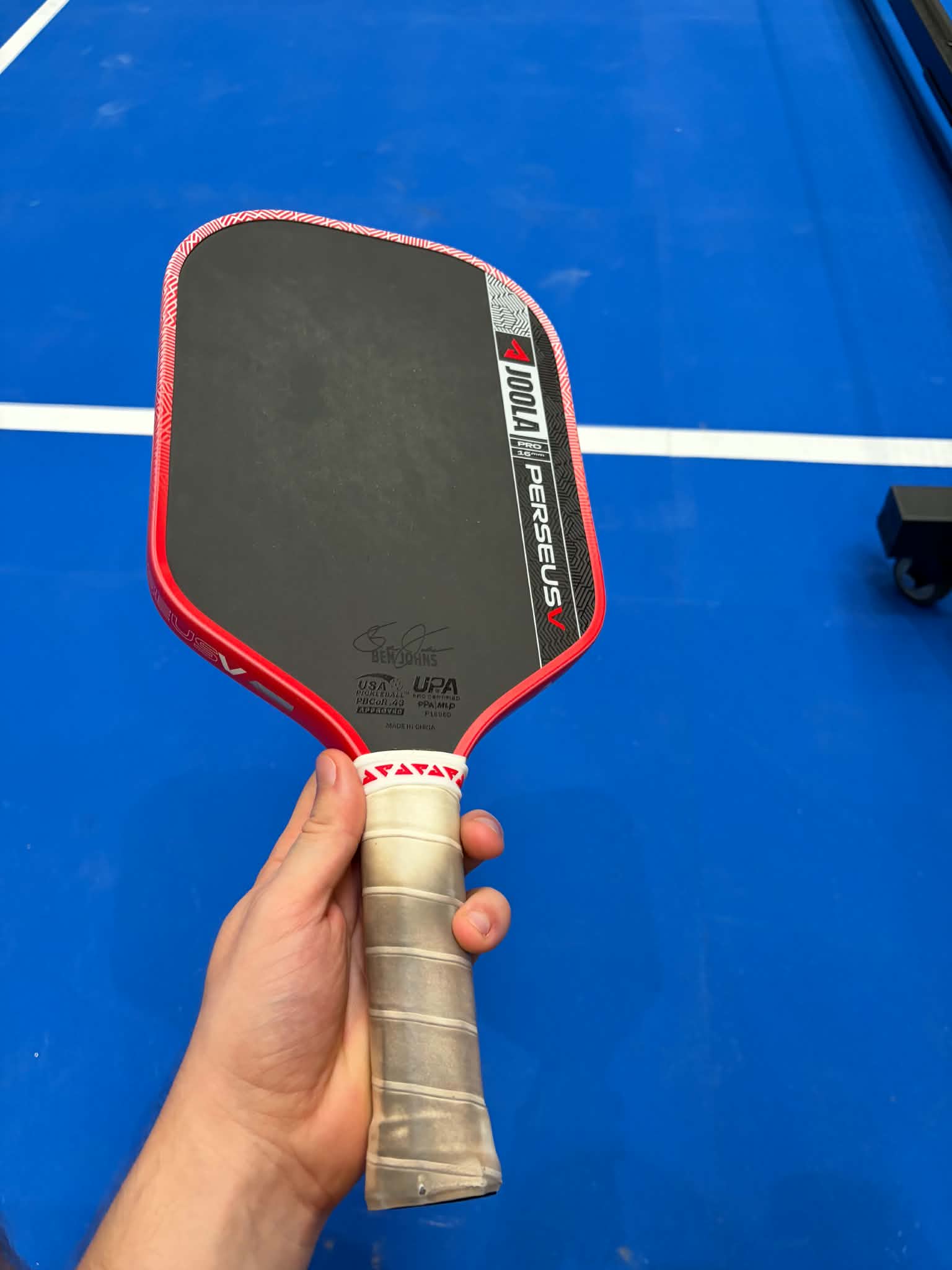
JOOLA Ben Johns Perseus Pro V 16mm: my 30-hour review
My court verdict: The best-feeling paddle I have personally played. Versus my Perseus Pro IV 16mm, the Pro V has a slightly softer response and just a little more touch on drops, dinks and resets, without losing meaningful power or pop.
The reason I would hesitate to buy it again: At around 30 hours I can already see face and handle-area wear and am worried the edge may be starting to lift. I have not confirmed an edge bond failure or core crush, but a $300 paddle should inspire more confidence.
My money choice: My Vatic Pro V-Sol Tour Evergrit. The JOOLA plays a little better; the Vatic makes more sense to me for value, and it has seemed more reassuring in my use so far.
- Outstanding soft-game control — a little better than the Pro IV
- Slightly softer, increasingly plush contact feel
- Strong power and pop, roughly equal to Pro IV
- Excellent spin and forgiving sweet spot in my play
- Quick, reliable volleys and counters in fast exchanges
- Only a modest performance gain over a much cheaper Pro IV
- Visible surface and grip-area wear after approximately 30 hours
- I am concerned about the edges, but cannot confirm an actual structural failure
- Long-term lifespan and spin retention remain unresolved
- Vatic Pro is my stronger overall value choice
Bottom line: brilliant to play, difficult to justify
4.1/5 overall, around 4.8/5 for the four on-court criteria alone. I genuinely prefer the Pro V’s touch to my Pro IV’s, but I would not pay roughly double for that small gain when the visible wear and unproven longevity worry me. If price and durability matter more than having the absolute best feel I have personally tried, I would consider the discounted Pro IV or my Vatic Pro first.
2026 buying-guide update: I include this exact paddle in my Best Pickleball Paddles 2026: seven paddles I actually tested as my best premium playing-feel pick, but not my overall value winner. The guide compares my real playing hours, observed strengths and caveats and keeps this original review score unchanged.
How I reviewed the exact Ben Johns 16mm model
- Reviewed paddle: JOOLA Ben Johns Perseus Pro V, Blaze Red, 16mm, identified by the original paddle markings and photographs.
- Playing time: about 30 hours, as estimated by the owner.
- Setting: paddle photographed on an indoor pickleball court; not every session, ball or court surface was formally logged.
- Tested comparisons: I have played the Perseus Pro IV 16mm, Vatic Pro V-Sol Tour Evergrit 16mm, and JOJOLEMON Shark 100.
- Evidence: six original on-court photos of face, grip, red edge and printed certification markings.
- Not documented: exact purchase date, my own purchase price, quantified spin RPM, ball speed, force readings, current face roughness or a structural inspection of the internal core.
- Scoring: six weighted criteria explained below; observed cosmetic condition is rated, long-term durability itself is not.
I’m writing about the one paddle shown in the original images. The JOOLA Pro V family includes different shapes, thicknesses and grip sizes. A result for a 14mm Perseus or a Scorpeus is not automatically a result for this 16mm Ben Johns model. My playing observations are subjective; I did not run a controlled laboratory comparison.
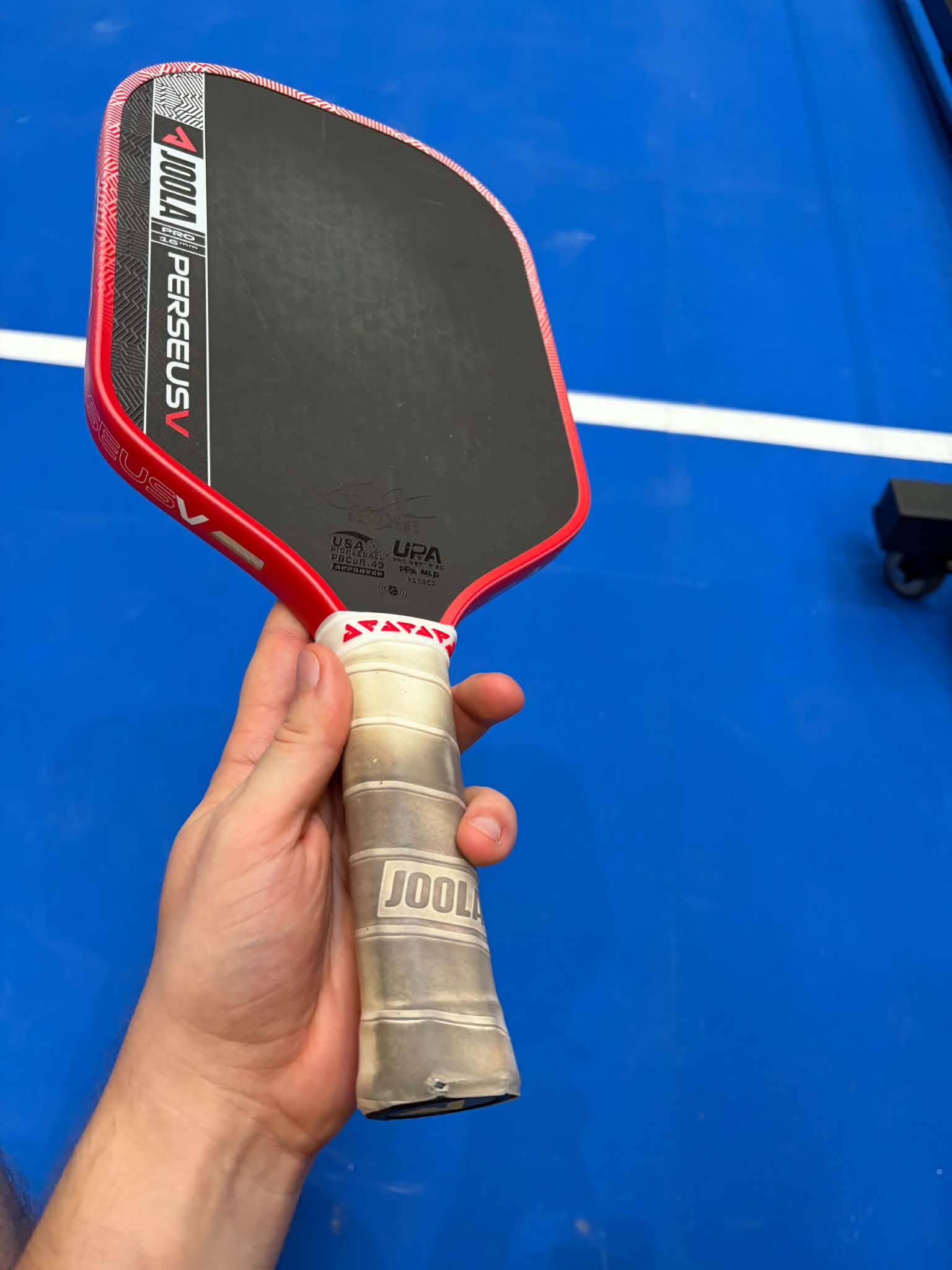
Pro V vs Pro IV: a small improvement I really can feel
I have used both generations. The Pro IV is already an excellent paddle, and the Pro V is only a little better in my hands. Contact feels a little softer and more cushioned. It helps me place the ball a touch more confidently on slower shots, but I would never describe the change as revolutionary.
This is the key buying distinction: if the two paddles were the same price, I would choose my Pro V for its feel. With the Pro V listed at $299.95 and the Pro IV at $149.95 on JOOLA’s US store during this November 2026 check, the extra 100% in price is hard to justify from my playing improvement alone. These are manufacturer listing prices, not prices I paid; local offers and stock can differ.
Dinks, third-shot drops and resets: my biggest reason to like it
The best part of the Perseus Pro V is its short-game control. Dinks and third-shot drops feel excellent to me, with a little more comfort in the ball contact than my Pro IV. Resets are also reassuring: I feel able to absorb pace instead of having the ball launch off the face too abruptly.
I did not record a controlled percentage of successful drops, so I cannot claim a numerical accuracy improvement. The difference is modest, yet noticeable to me in real rallies. If your main frustration with a Pro IV is wanting slightly softer contact, this is the clearest reason to try Pro V.
Power, pop and drives: practically the same as Pro IV
I do not feel that the Pro V gives me a major extra gear on serves or full drives. Power is roughly the same as my Pro IV, and pop on quicker attacking shots is similarly good. That is not a criticism of the performance: I like both. It is a criticism of the upgrade value if somebody expects a huge performance jump for the price.
Independent testing offers context, not a substitute for my own test. Pickleball Studio similarly described only a small power difference, while Pickleball Effect found the Pro V more controlled but somewhat less dependent on assisted pop. Their testing methods and samples are not interchangeable with my observations.
Spin, sweet spot and fast volleys
My answer on both spin and forgiveness is strongly positive. The Pro V lets me shape the ball with what feels like excellent spin, and the sweet spot is forgiving enough that I trust it on less-than-perfect contact. Quick volleys and counters also feel responsive and stable. I rated these experiences highly, but I have not measured spin in revolutions per minute or calculated twist weight for my own unit.
Published lab data put the independent spin reading for the 16mm at 2,170 RPM in Pickleball Studio’s test versus about 2,060 RPM from Pickleball Effect. Those figures describe their own samples and machines, not the spin remaining on my paddle after 30 hours.
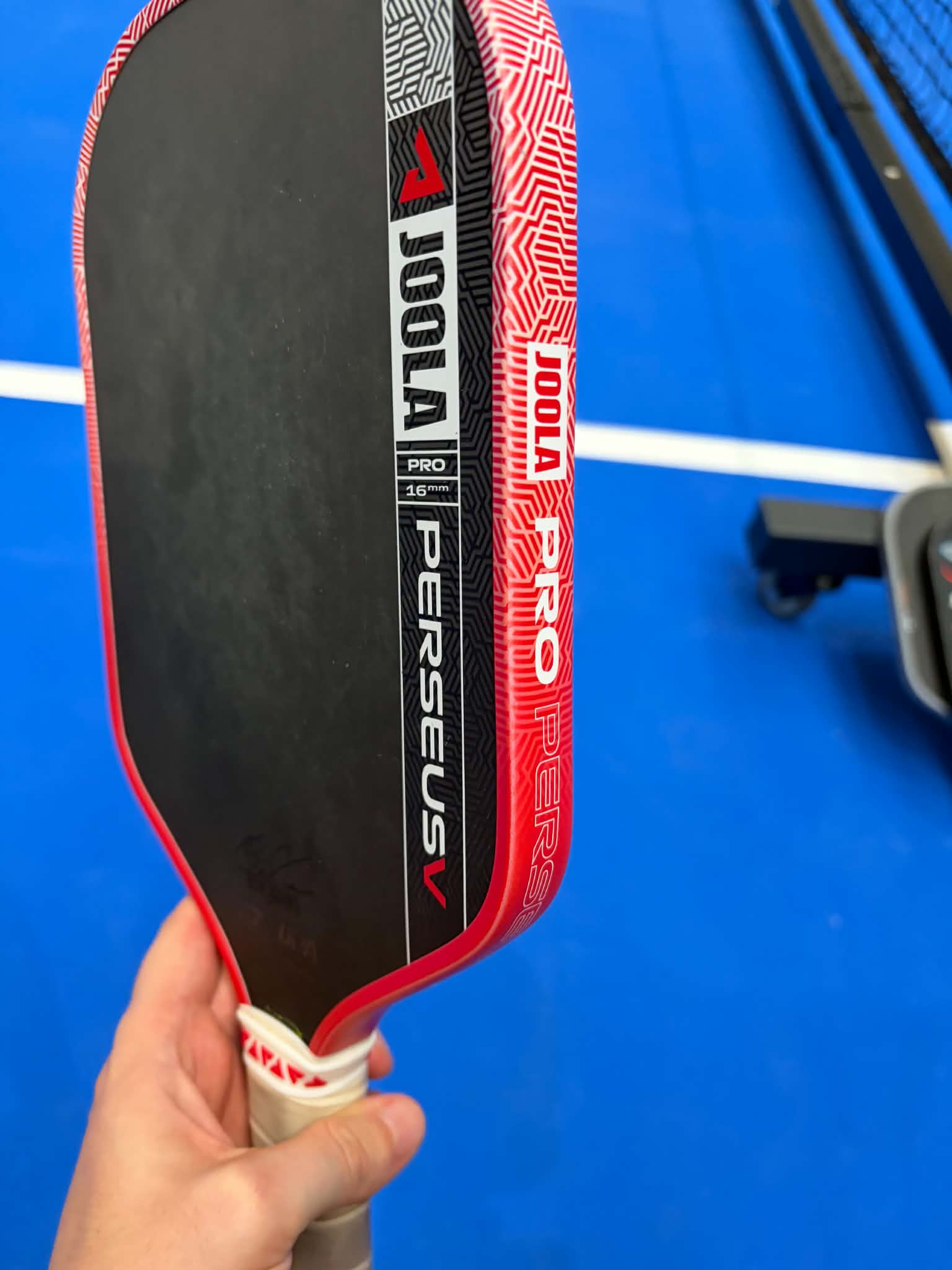
Break-in after 30 hours: slightly softer, not visibly more powerful
After playing for a longer period, the paddle has started to feel a little softer to me. I have not noticed a meaningful power or pop advantage appearing over the Pro IV, and I did not log a controlled before-and-after test. Some owners and reviewers describe a break-in effect, but my finding is simply a gradual change in perceived touch. A change in feel does not, on its own, diagnose damage.
Surface wear and edge concerns after about 30 hours
This is the part of the review that matters most to my recommendation. At approximately 30 hours I can see surface wear and wear around the handle/grip area. I am also worried that part of the edge may be starting to loosen. That concern is real, but I have not confirmed that the edge guard is separating, and I have not demonstrated core crush, delamination or a loss of certified performance.
My photos below document the appearance of the textured face, grip area and red frame. Marks, reflection and ordinary contact wear are not enough to determine adhesive failure. If a clear gap develops, the rebound changes unusually or JOOLA confirms a defect, that would justify a more definitive update. For now, this is a 30-hour condition warning, not a lifetime estimate or product-failure diagnosis.
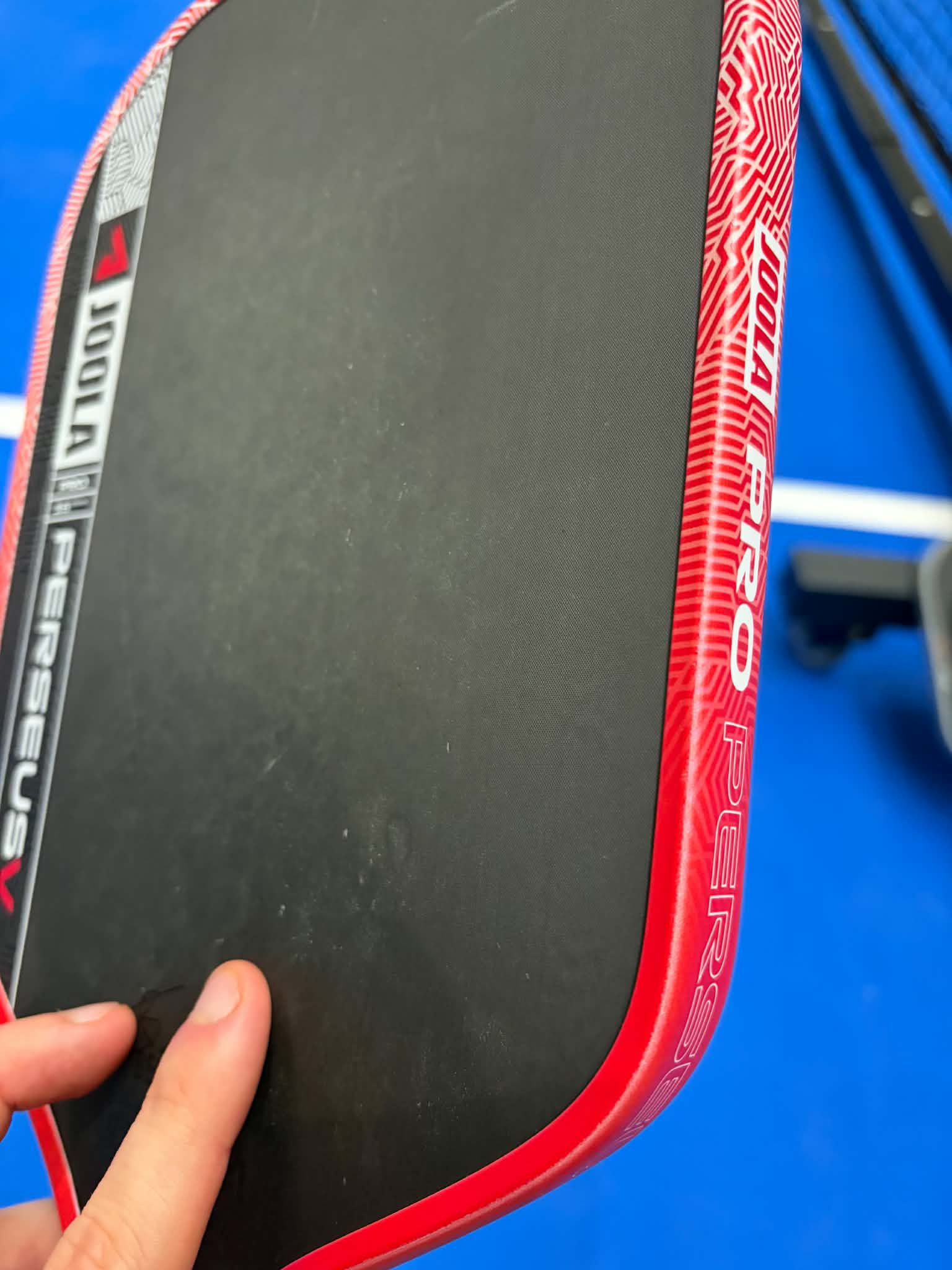
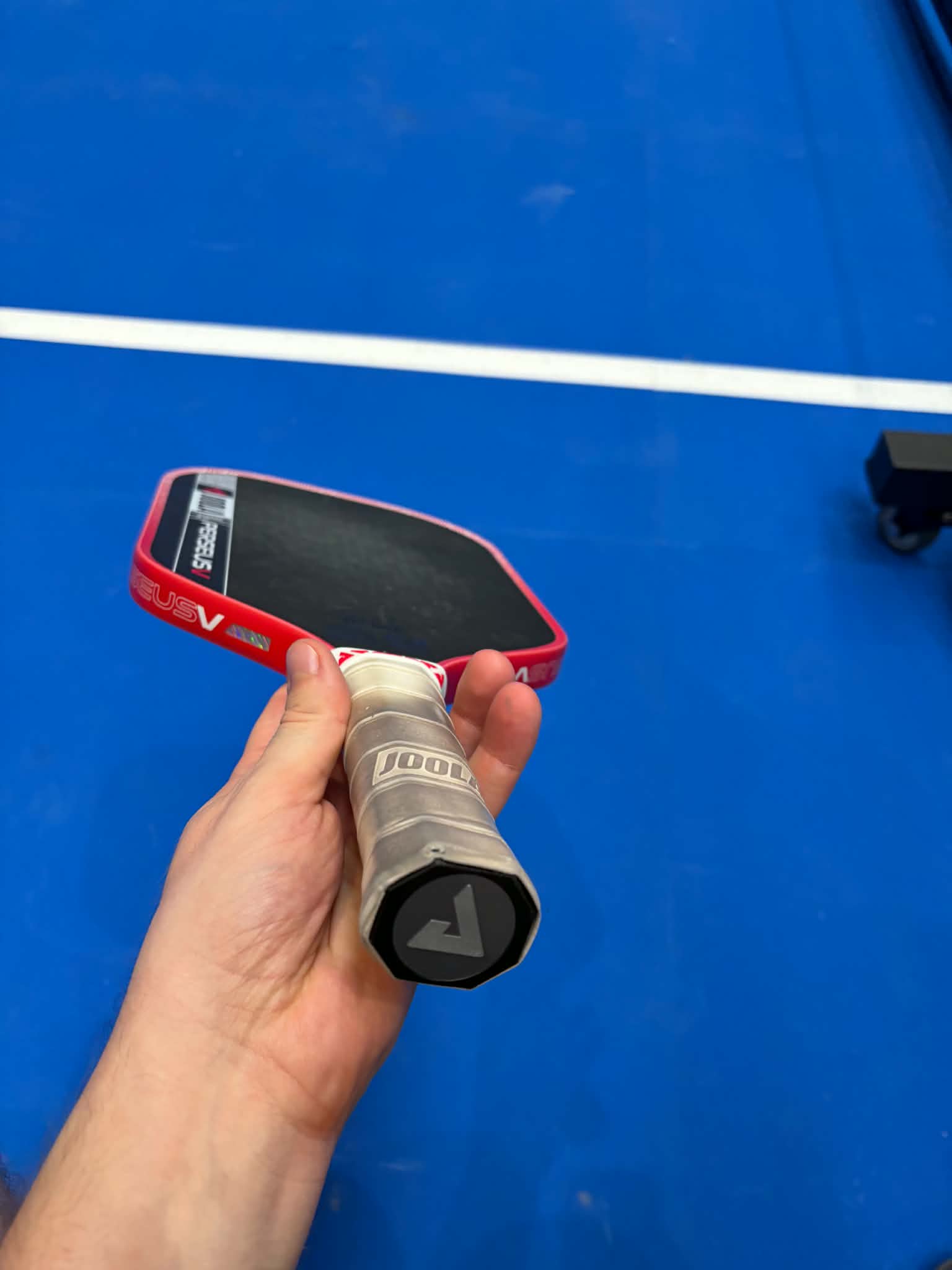
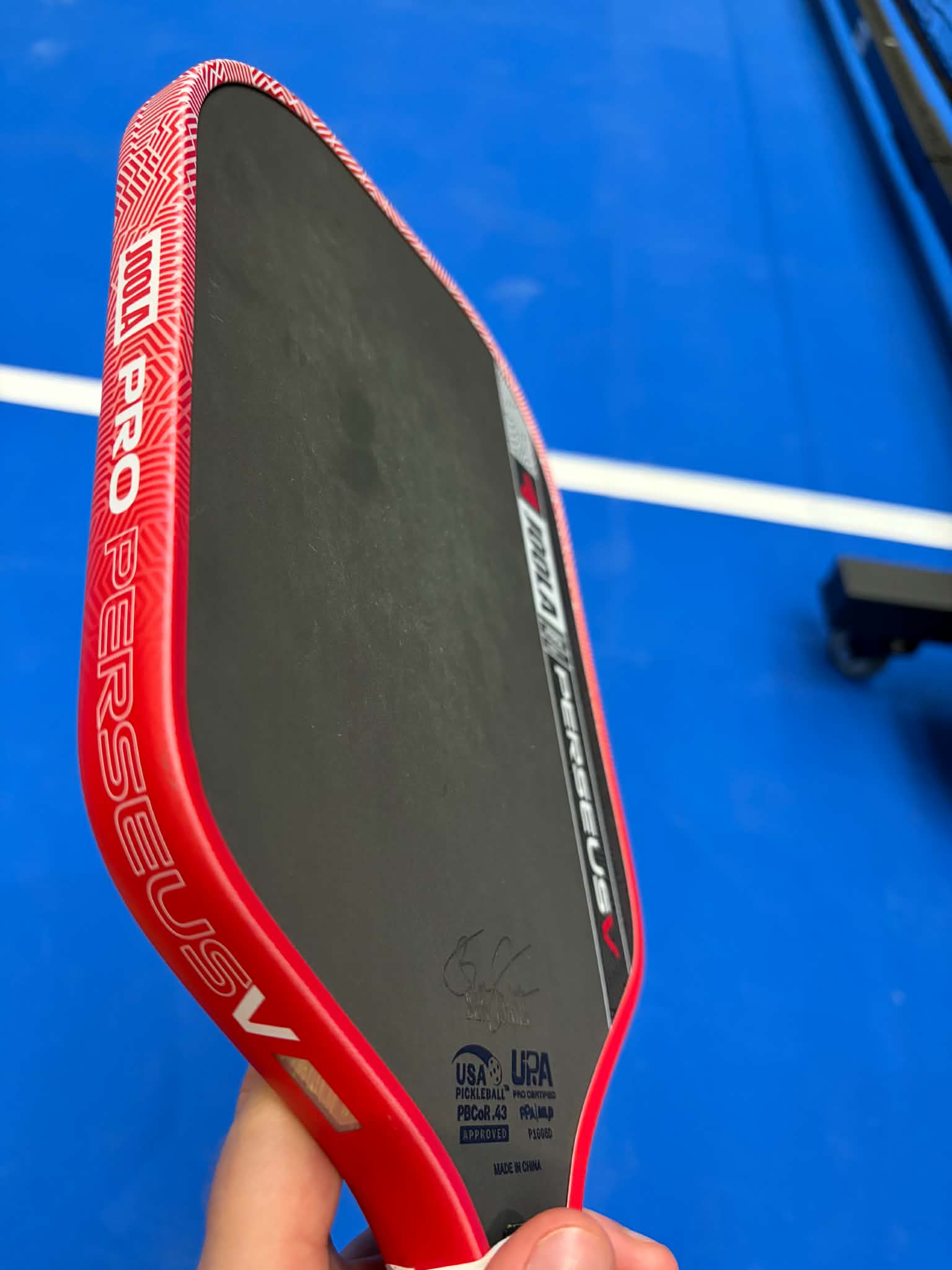
In my use so far, the Vatic Pro seems to be holding up in a way that gives me more confidence, while the much cheaper JOJOLEMON has survived extensive use impressively well. Those are comparisons of my own individual paddles with different usage histories, not proof that Vatic or JOJOLEMON generally outlasts JOOLA. I would also hesitate to promise that my Pro IV will be trouble-free long term.
Is the Perseus Pro V worth twice the Pro IV price?
For me: no. I like the Perseus Pro V better on court, but the improvement is too small to justify paying twice as much when I am already questioning the wear I see. If your Pro IV is working well, I would not rush to replace it. If you value a slightly softer Pro IV and can comfortably afford the premium, the Pro V is genuinely enjoyable to play; just do not confuse that with a confirmed increase in longevity.
| My 30-hour Pro V takeaway | Best personal playing feel; excellent control and soft game; modest advance over IV; visible wear concern. |
|---|---|
| My 8-hour Pro IV takeaway | Almost as good on court with excellent drops and power; much stronger current manufacturer-price value; durability still unproven. |
| My ~30-hour Vatic V-Sol Tour takeaway | My personal best value for money and the paddle I currently lean toward continuing to use; different handle and response. |
| My JOJOLEMON Shark 100 takeaway | Very inexpensive and surprisingly long-lived in my experience, but substantially less spin and power than the premium options. |
| Future options, not reviewed here | J2CR Crystal Blue, Ultra Power and Spartus Spitfire interest me, but I have not claimed that any would outperform the paddles above. |
New related paddle test: I have also played the Selkirk LABS Boomstik Elongated 16mm for at least four hours. My early review describes its lively power and more demanding soft-game response. That is a separate test, not a controlled JOOLA-versus-Selkirk head-to-head.
For a full firsthand comparison, read myJOOLA Perseus Pro IV 16mm review, Vatic Pro V-Sol Tour Evergrit 16mm review and JOJOLEMON Shark 100 review. My present choice to keep playing with the Vatic is a personal value judgment; people with different budgets and shot preferences may choose differently.
How I calculated my 4.1/5 editorial rating
I separate playing quality from the decision to spend money. The first four court criteria total 65% of the weight and together work out to roughly 4.8/5 for the playing experience. The remaining 35% covers visible condition after my actual play period and the unusually weak price-to-gain proposition. It does not pretend to measure future lifespan.
| Criterion | Weight | Score /5 | First-hand reason |
|---|---|---|---|
| Touch and control | 25% | 4.9 | Outstanding dinks, drops and resets; slightly ahead of my Pro IV. |
| Power and pop | 15% | 4.6 | Strong serves/drives and useful pop, but effectively level with Pro IV. |
| Spin and forgiveness | 15% | 4.8 | Excellent perceived spin, forgiving sweet spot; no RPM or stability-rig measurement. |
| Fast exchanges | 10% | 4.8 | Quick, confident volleys and counters in my play. |
| Observed condition at ~30h | 15% | 3.0 | Visible face/grip-area wear and an edge concern; no confirmed failure or lifespan test. |
| Value for money | 20% | 2.8 | The Pro IV is much cheaper for a small difference; my Vatic Pro is my preferred purchase. |
| Weighted editorial overall | 100% | 4.1/5 | (4.9×.25)+(4.6×.15)+(4.8×.15)+(4.8×.10)+(3.0×.15)+(2.8×.20)=4.125 → 4.1/5. |
This is my own first-hand editorial score, not an Amazon customer average or a scientific benchmark. The unusually low value score is intentional: how a paddle plays and whether it is worth buying at the current price are two different questions. If the edge really fails or the paddle stays strong for much longer, I will reassess the relevant criterion rather than pretend I know the future.
Verified Pro V 16mm specifications and approvals
| Exact tested variant | JOOLA Ben Johns Perseus Pro V, Blaze Red, 16mm; elongate Perseus shape. |
|---|---|
| Core and face | 16mm polypropylene-honeycomb / carbon-fiber and EVA-foam design; textured carbon-fiber face, per JOOLA. |
| Published average weight | About 8.1 oz / 230g (manufacturer average, not a measurement of my specific paddle). |
| Published size | 16.5 × 7.5 inches; 5.5-inch handle; 4.25-inch grip circumference. |
| Technology | JOOLA KineticFrame (manufacturer design claim, not a verified personal mechanism test). |
| USAP listing | Pass for Perseus Pro V 16mm on USA Pickleball’s approved equipment list; check current status before competition. |
| UPA-A listing | Perseus Pro V 16mm appears on the official UPA-A approved list as P16G5D. |
| Warranty | 12 months with registration under JOOLA’s stated program; confirm terms for your region and seller. |
Sources: JOOLA official Pro V page, USA Pickleball approved-list entry and UPA-A approved paddles. Read the paddle-approval guide for why a printed logo alone does not settle every tournament rule. For mechanical failure and maintenance distinctions, see core crush vs delamination and warranty and registration.
What other reviewers found — and what is different in my test
Pickleball Studio described a fairly small step from the Pro IV, with softer feel and concerns about the price and honeycomb-core longevity. Pickleball Effect also found a more controlled feel and excellent initial spin, while warning about the conventional surface texture’s long-term grit retention. That broad direction is consistent with my own playing impressions, but my specific observation of wear around 30 hours is from my actual paddle and should not be attributed to either reviewer.
My key information gain is not a claimed lab record. It is that I personally like the Pro V more than Pro IV on court yet would buy the discounted older JOOLA—or, more likely, keep using my Vatic—because the small feel improvement does not make the premium or durability uncertainty worthwhile for me. Read more about what spin measurements and surface grit really tell you.
Frequently asked buyer questions
Is the JOOLA Perseus Pro V 16mm better than the Pro IV?
In my experience, a little. Pro V feels slightly softer and gives me a little more control, especially with dinks, drops and resets. I feel about the same power and pop on serves and drives. This does not justify a large upgrade price for everyone.
Does the Perseus Pro V lose spin or have edge problems after 30 hours?
I have seen surface/handle-area wear and am concerned the edge might be lifting on my unit. I have not quantified spin loss, confirmed edge separation or diagnosed core crush. My worry is a reason to monitor the paddle, not proof every Pro V has a defect.
What paddle would I personally keep using?
My Vatic Pro V-Sol Tour Evergrit 16mm. I still consider the JOOLA Pro V my favorite pure on-court feel, but my Vatic is the best overall value for my money and currently inspires more confidence.
Is this a hands-on review of the 14mm model too?
No. This is a 30-hour review of the exact Ben Johns Blaze Red 16mm model shown in my original photographs. I have not used this review to generalize my results to the 14mm version.
If you are considering an older, potentially discounted model, read my separate original JOOLA Perseus 3S 16mm firsthand review. The two paddles were used at different times, not in a controlled head-to-head. For more about our first-hand review process and how criteria are weighted, see our editorial policy. Last checked: November 4, 2026. Product prices, available colors and approval status can change.

Jonathan Grøn created The Pickleball Wise. He coaches beginner pickleball players and captains a pickleball team in Series 2. He combines on-court experience with official rules and coaching resources to write practical guides on doubles strategy, skills, and training.