Selkirk Pro S1 Review: 3+ Months, No Cracks in 10 Balls
I bought 12 lime Selkirk Pro S1 pickleballs with my own money on June 25, 2026 for €26.22, and they have been in regular club rotation for more than three months. They have been used at least weekly, mainly outdoors on asphalt but also indoors on a wooden badminton-hall floor, during doubles, drills and warm-ups.
Need help choosing or verifying a ball? Use the Pickleball Ball Selector & Approved Ball Database to match conditions, search approved models and find our hands-on tested picks.
Buying guide: See where the Pro S1 fits against the Franklin X-40 and my indoor picks in my best pickleball balls guide.
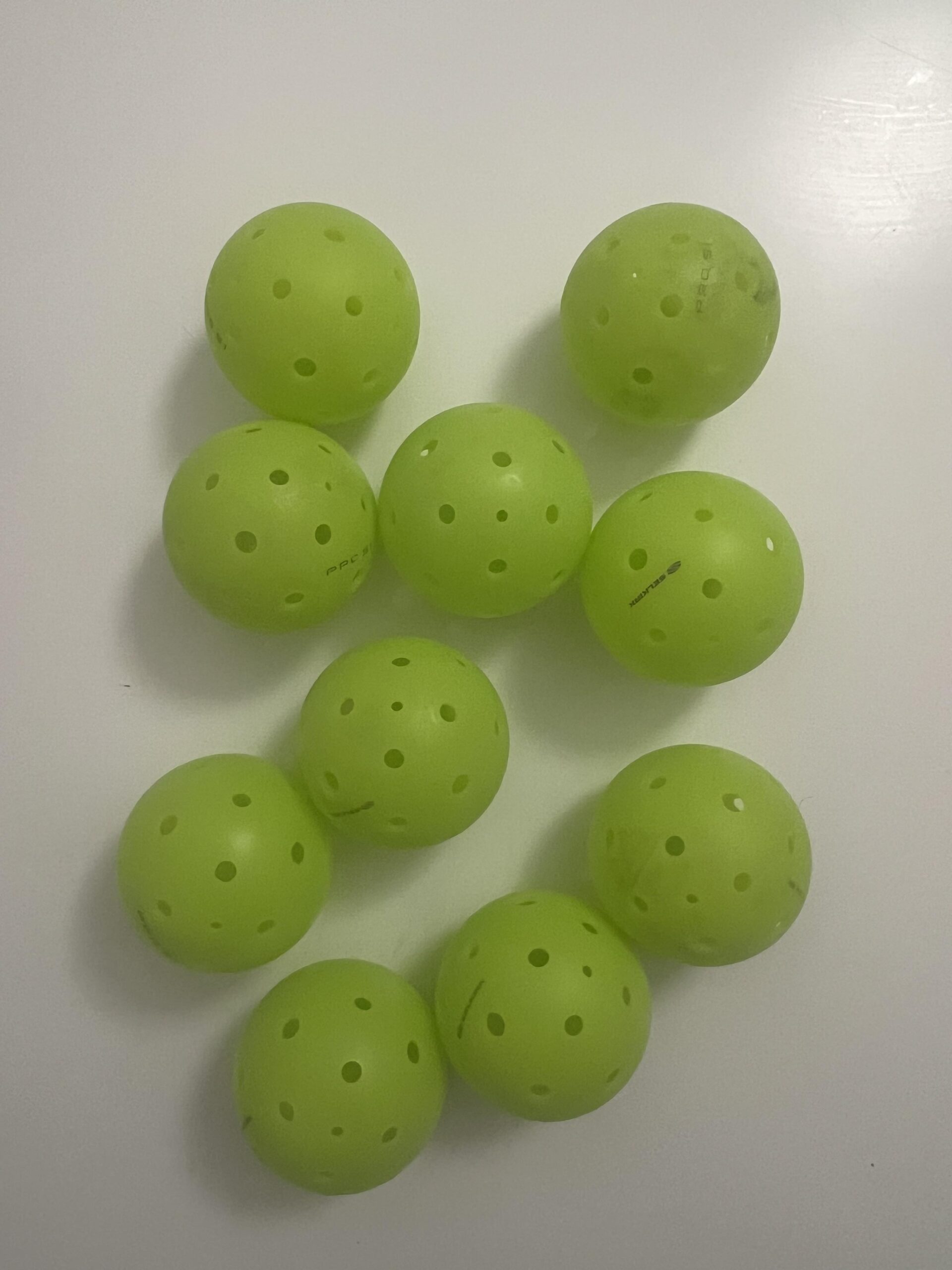
The standout result is durability: 10 of the original 12 balls are still accounted for, and none of those 10 has cracked, become obviously oval or developed a soft spot. The other two disappeared from the club, so I cannot judge their final condition. The balls are visibly scuffed from use, but they still feel lively and consistent.
My short verdict: the Pro S1 is one of my favorite balls to play with. It feels slightly faster and harder than a Franklin X-40, with excellent consistency and, in my experience, better durability. If popularity and tournament familiarity were irrelevant, I would personally choose the Pro S1 over the X-40.
Affiliate disclosure: As an Amazon Associate I earn from qualifying purchases. If you buy through a paid link on this page, The Pickleball Wise may earn a commission at no extra cost to you. I bought all 12 balls myself and received no discount, free product or compensation for this review.
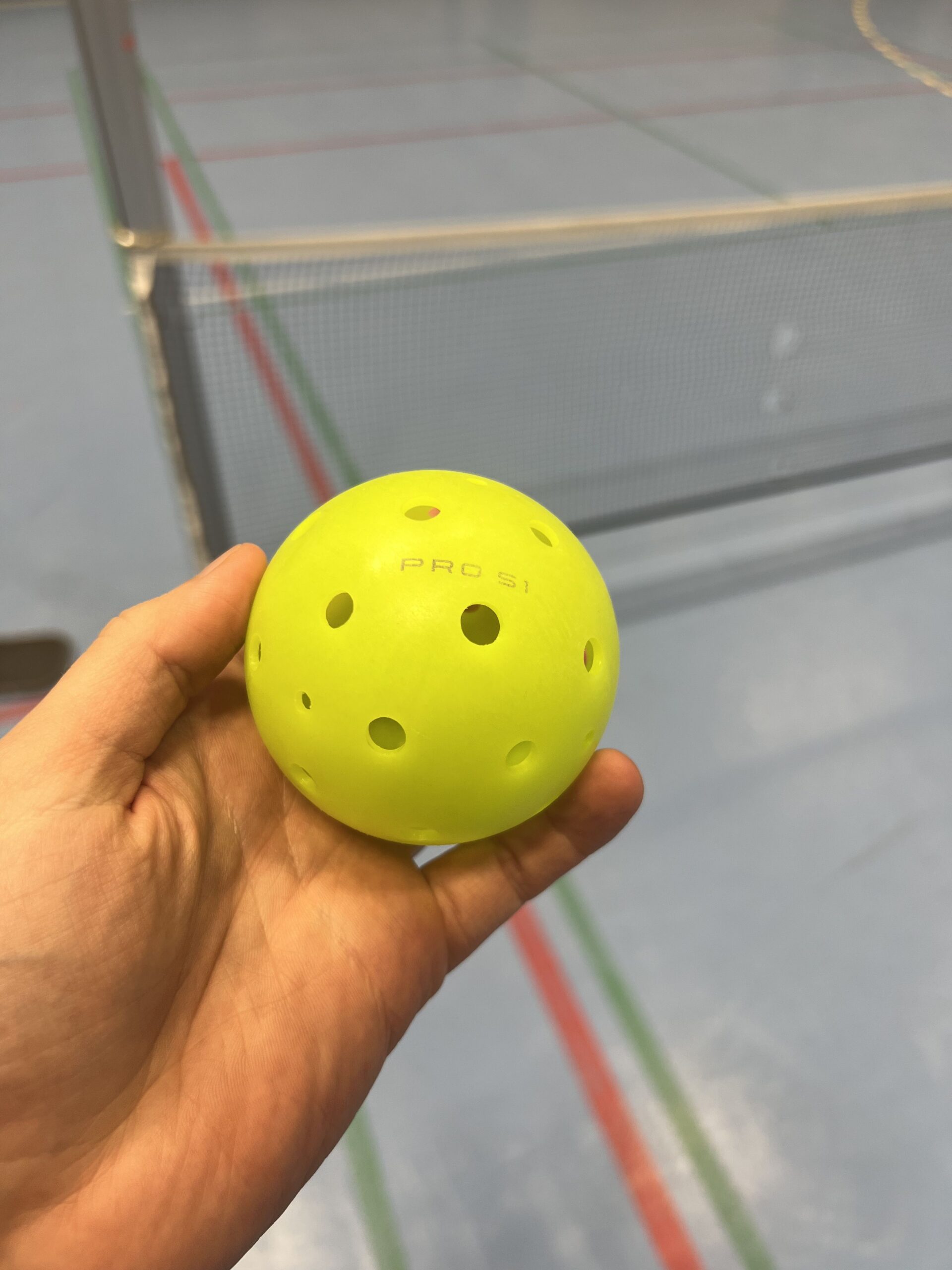
Selkirk Pro S1 Pickleball — 4.6/5
Quick verdict: Fast, lively and impressively durable in my club use. Ten of the 12 balls are still accounted for after more than three months of rotation, with no cracks, obvious warping or soft spots. I slightly prefer the Pro S1 as a ball, but I often practice with Franklin X-40s because they are more common in the competitive environments I play in.
Best for: clubs, outdoor players and hard hitters who want a fast ball and care strongly about crack resistance and useful life.
Skip if: matching the ball used by your regular tournaments or group matters more to you than durability, and that group primarily uses the Franklin X-40.
- Excellent early durability: no cracks among the 10 balls still accounted for
- No obvious warping or soft spots after more than three months of club rotation
- Fast, lively pace that I rate slightly above the Franklin X-40
- Consistent medium bounce and stable flight
- Topspin and slice response feels comparable to the X-40
- Good lime visibility indoors and outdoors
- Very good value at the €2.19 per-ball price I paid
- Contact feels a little harder than the Franklin X-40
- I prefer the X-40’s sound slightly
- It is less commonly used in my competitive/tournament environment than the X-40
- Surface scuffing is visible after months of club use
- Two balls disappeared from the club, so their final condition is unknown
Bottom line
At 4.6/5, the Pro S1 is my favorite of the Selkirk Pro S1, Franklin X-40 and AMOSWIZ balls I have used when I judge the ball itself. Its durability is the biggest reason. I still often choose the Franklin for tournament preparation because matching the ball my competitive group uses matters to me.
How I tested the Selkirk Pro S1
- Exact product: lime Selkirk Pro S1, 12-pack
- Purchased: June 25, 2026
- Price paid: €26.22 for 12 balls (€2.19 each)
- Compensation: none; I paid the full price myself
- Club use: more than three months, at least weekly in rotation with other balls
- Session length: normally 2–3 hours, sometimes around 4 hours
- Surfaces: mainly outdoor asphalt, plus indoor wooden badminton-hall flooring
- Activities: doubles, drills and warm-up
- My involvement: I personally played with them throughout the test period
- Current known condition: 10 of 12 are still accounted for; the other two went missing from the club
- Weight check: two different used balls each measured 26 g on my home digital scale
- Pressure check: one used ball flexed only slightly under hard thumb pressure; informal test, not standardized compression testing
I cannot give a reliable lifetime-hour figure for each individual ball because the Pro S1s rotate with other active club balls. The strongest evidence is therefore the calendar duration, repeated weekly exposure and current condition of the ten balls I can still inspect.
Durability is the biggest reason I rate the Pro S1 so highly
Durability is the Pro S1’s strongest feature in my use. The balls have had a fairly hard life: regular club rotation, outdoor asphalt, repeated hard drives and smashes, plus some indoor play. They now show obvious surface scuffing, but I have not had one of the ten balls I can still inspect crack.
I also have not noticed them becoming obviously oval, developing soft patches around the holes or changing bounce in a way that stands out during play.
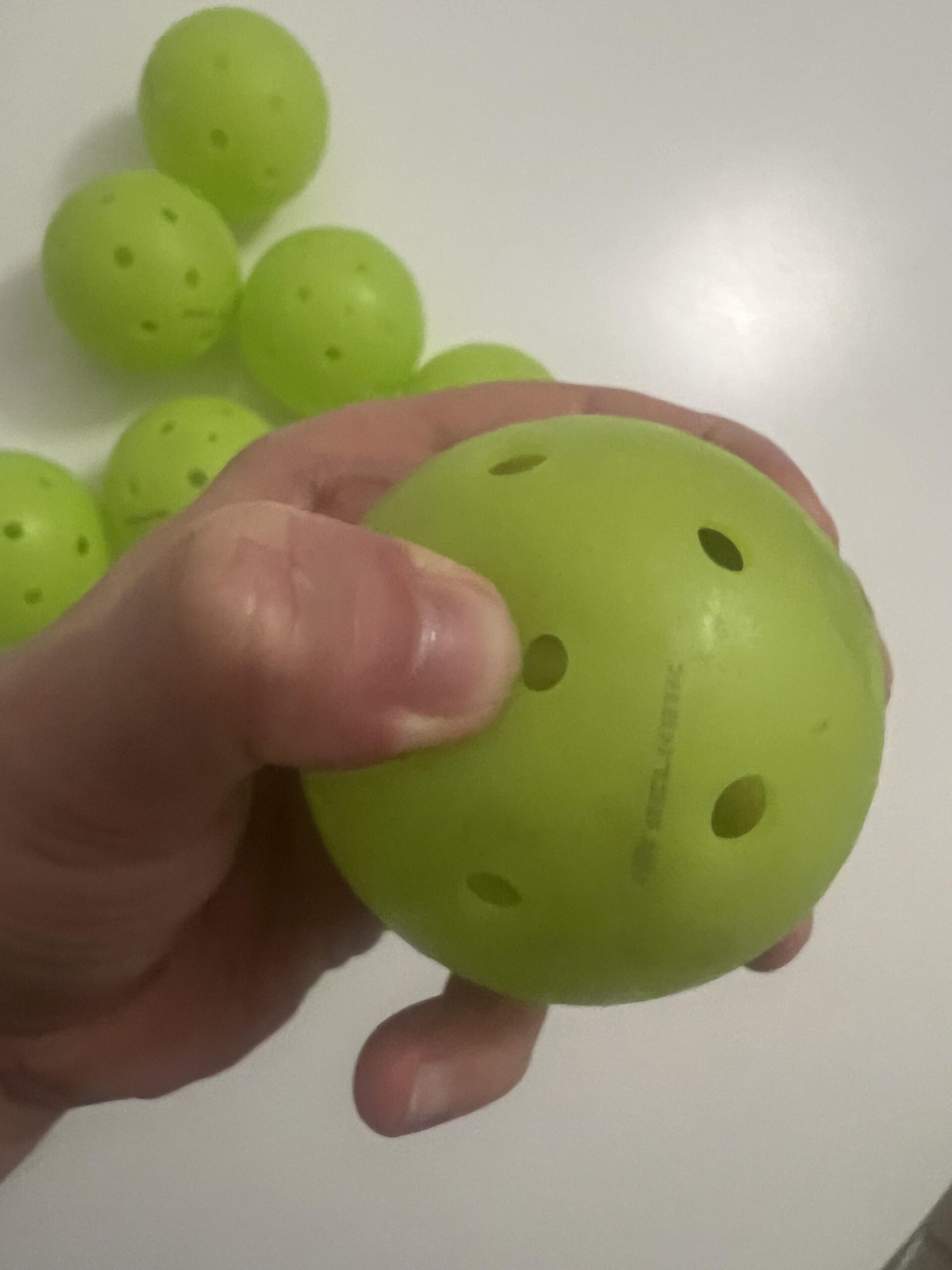
My impression is that the Pro S1 lasts roughly twice as long as the Franklin X-40 in the kind of hard club play I see. I would not present that as a controlled durability ratio: I did not run matched sets for the same number of hits, and our club balls rotate unevenly. What I can say is that I have personally seen Franklin X-40s crack after hard smashes, while none of these ten known Pro S1 balls has cracked yet.
Selkirk itself markets the Pro S1 around durability and currently gives it a 1-year no-crack warranty. That is a manufacturer claim/warranty, not the basis of my score. My own evidence is the condition of the balls I bought and used.
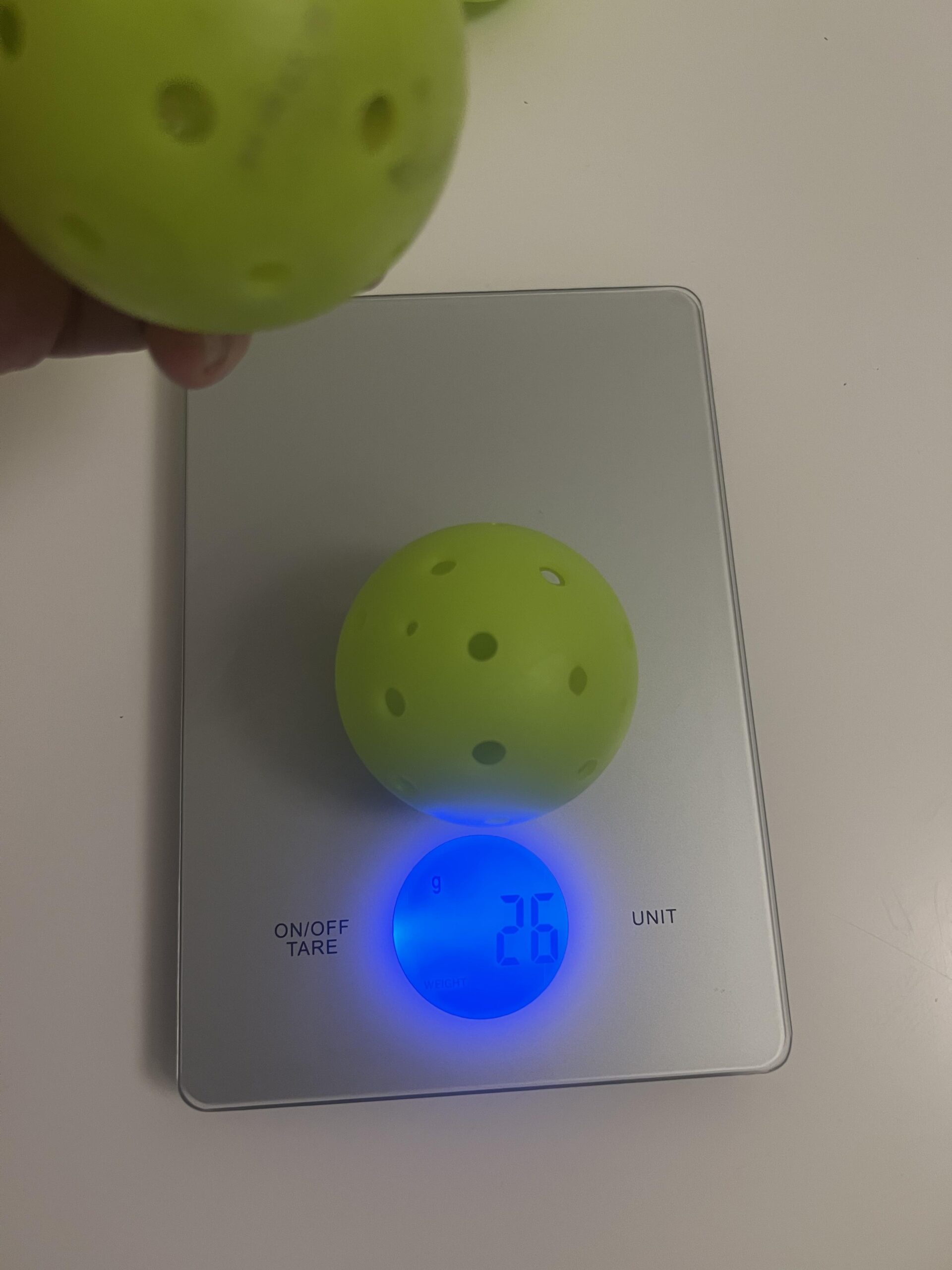
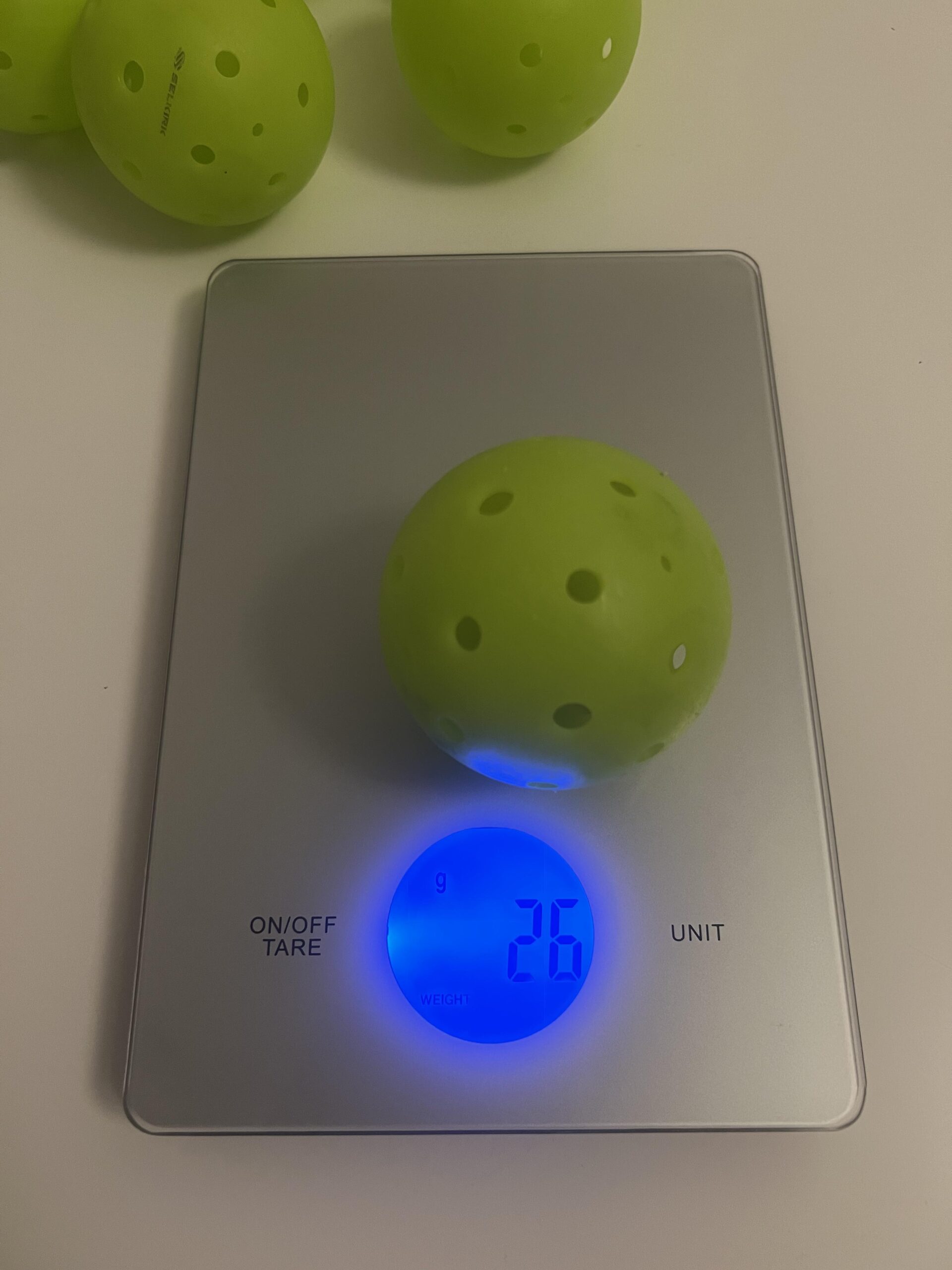
Two different used balls both measured 26 g
I weighed two different used Pro S1 balls on my home digital scale. Both displayed 26 g. That does not turn my kitchen-style scale into a laboratory instrument, but it is useful first-hand evidence and it aligns closely with Selkirk’s published weight of 0.93 oz, which is about 26.4 g.
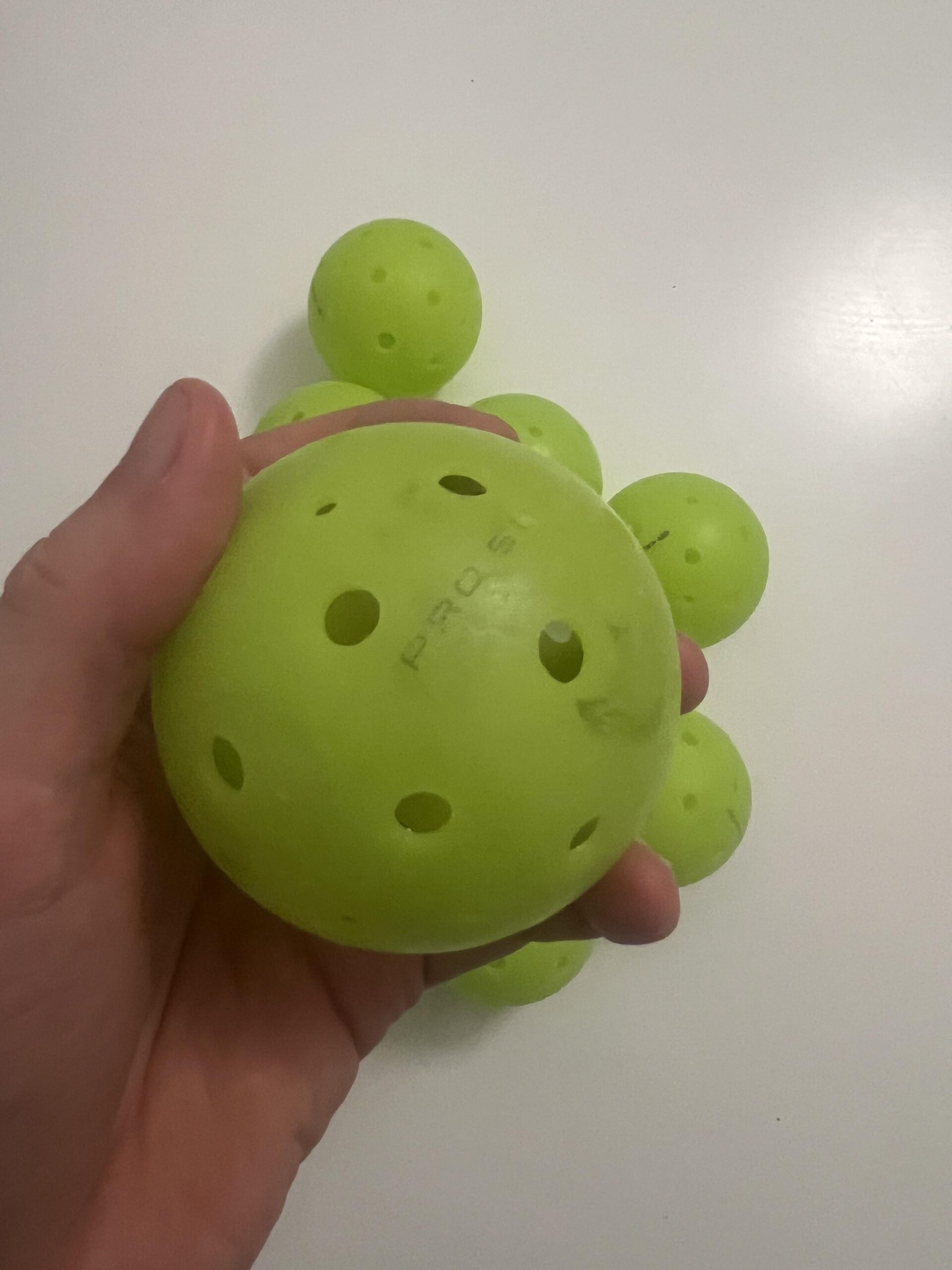
The shell feels firm, but it still flexes slightly under hard thumb pressure
Compared with my general impression of the X-40, the Pro S1 material feels a little harder or thicker to me. I tried a simple hand-pressure check by pressing as hard as I reasonably could with my thumb. I could push the shell in slightly, but not by much.
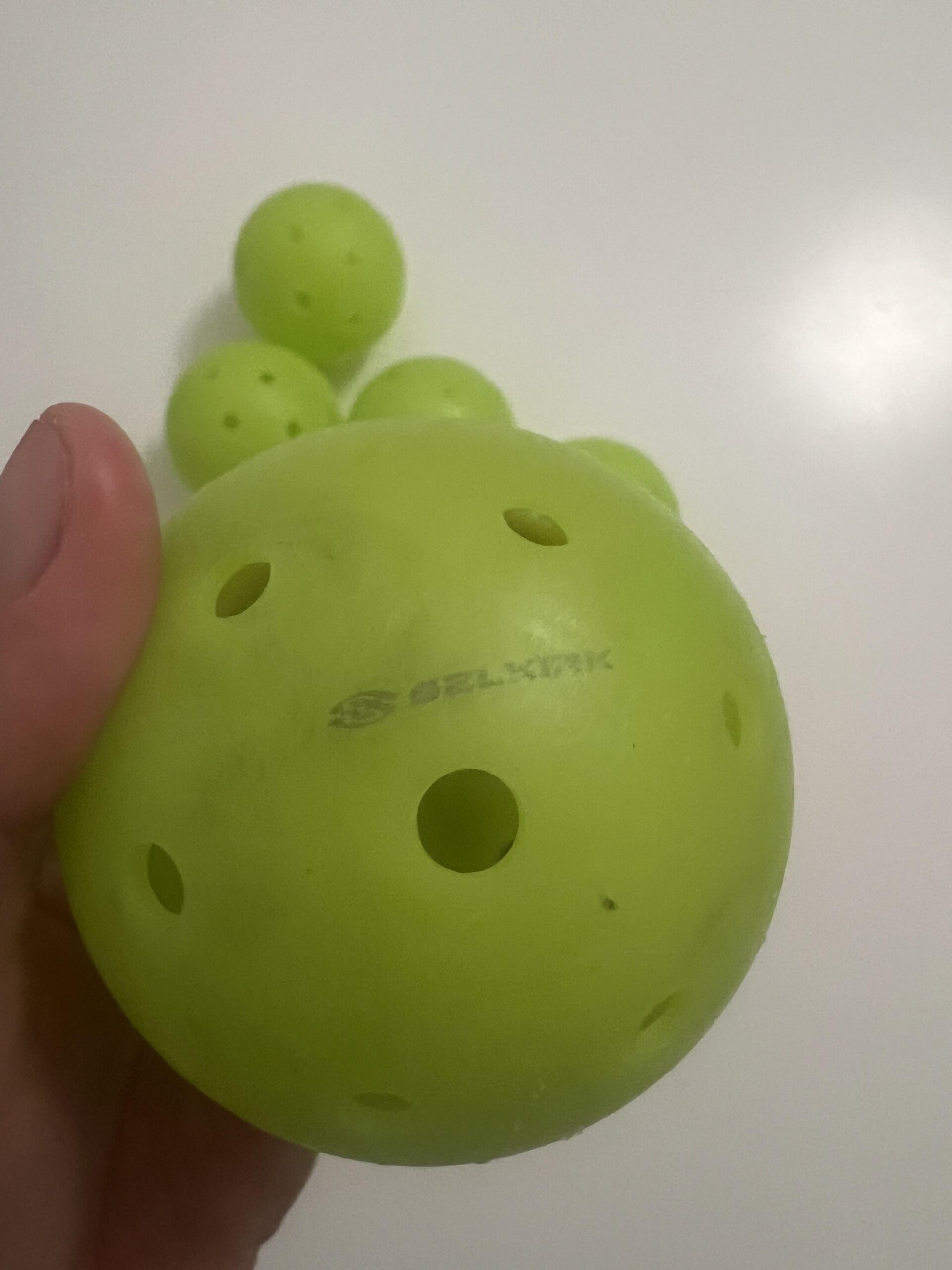
I found the amount of flex broadly similar to what I can produce with a Franklin X-40 by hand. The real difference for me is not a precise compression number; it is that the Pro S1 feels a bit more substantial in play and has held up very well over time.
It is fast, lively and slightly harder-feeling than the Franklin X-40
I would call the Pro S1 a fast ball. On my own rough 1–10 pace scale, I would put the Franklin X-40 around 8/10 and the Selkirk Pro S1 around 8.5/10.
The difference is not dramatic. They are much closer to each other than either is to the slower, softer AMOSWIZ indoor balls I tested.
The Pro S1 contact feels slightly harder to me than the X-40. I also think the S1’s sound is a bit harder/sharper, while I personally find the Franklin sound a little more pleasant.
Bounce, flight and spin have stayed consistent
Bounce has been medium, lively and consistent in my experience. I have not had an individual Pro S1 suddenly feel dead or produce repeatable strange bounces. When an odd bounce happens outdoors, it has been explainable by the asphalt surface, small debris or another obvious court irregularity rather than a ball I could identify as defective.
Flight has also looked stable on serves, drives and faster exchanges. I have not noticed wobble or erratic flight.
For topspin and slice, I would put the Pro S1 approximately level with the Franklin X-40. Both respond well enough that spin has never been a reason for me to choose one over the other.
The lime color has been easy to track
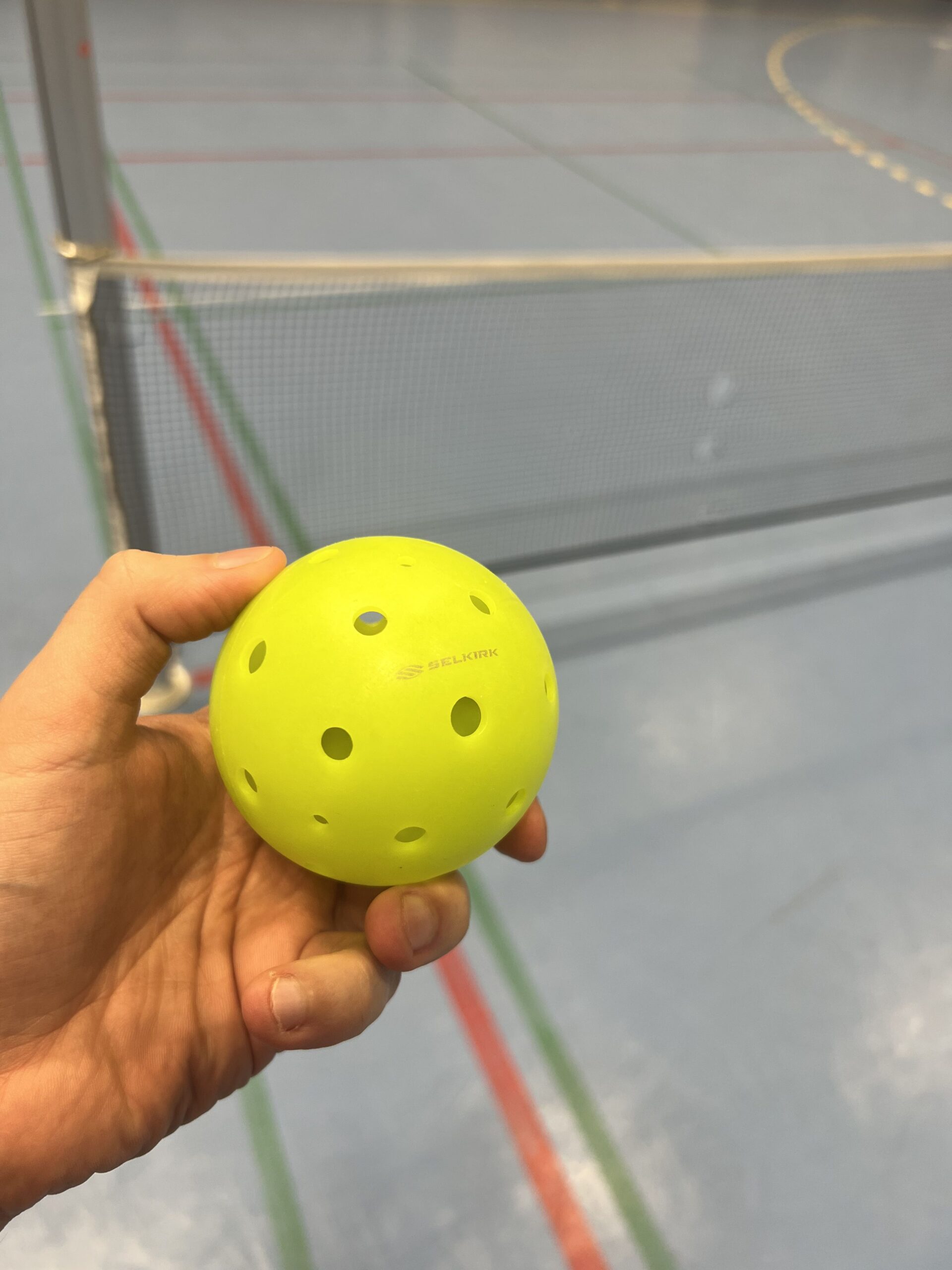
Visibility has been good both outdoors and indoors. The bright lime color stands out well enough for me on asphalt and on our indoor wooden court.
I would not rate visibility as the defining advantage here the way I do with the bright pink AMOSWIZ balls in my green-heavy indoor hall, but I have no meaningful complaint about the Pro S1 color.
Selkirk Pro S1 vs Franklin X-40
This is the comparison that matters most to me because I have used both extensively enough to have a real preference. You can read my separate Franklin X-40 review here.
| What I notice | Selkirk Pro S1 | Franklin X-40 |
|---|---|---|
| Pace | ~8.5/10 in my feel | ~8/10 in my feel |
| Contact | Slightly harder/firmer | Slightly softer/more familiar |
| Bounce | Medium, lively, consistent | Lively and consistent |
| Flight | Stable | Stable |
| Spin | Very good | Very similar in my use |
| Sound | Harder/sharper | I prefer the sound slightly |
| Durability | My clear winner so far | I have seen club X-40s crack under hard play |
| Popularity in my competitive environment | Less common | More common |
| My choice if popularity did not matter | Selkirk Pro S1 | Second |
| My practical tournament-prep choice | Depends on event/group | Often X-40 because I want to practice with the ball I expect to encounter |
If both cost exactly the same and I ignored what everyone else around me was using, I would buy the Pro S1. I would even accept roughly a 25% price premium for the S1 if it were equally common in my competitive environment, because I value its durability.
In real life, however, ball standardization matters. If my regular tournament group is playing with Franklin, I would rather practice with Franklin than optimize purely for which ball I think lasts longer.
Why the Pro S1 makes particular sense for clubs and hard hitters
If your group regularly cracks balls, the durability economics can matter more than a small difference in purchase price. At the price I paid, these cost only €2.19 per ball. Even if they cost more than that, I would personally tolerate up to roughly €3.50 per ball if the durability advantage continued to hold.
That is why I think the Pro S1 is particularly compelling for:
- clubs that put many hard hours on shared balls;
- outdoor groups playing on abrasive courts;
- hard hitters who have cracked softer or less durable balls;
- players who like a fast, firm and lively feel.
If you rarely break balls and mainly want to practice with whatever your local tournament scene uses, the durability advantage may matter less.
What Selkirk says about the Pro S1
Selkirk currently lists the Pro S1 at 38 holes, 0.93 oz and 2.8 inches in diameter, and identifies it as USA Pickleball approved. Selkirk also describes a seamless rotomolding construction and a patented 38-hole aerodynamic pattern.
I cannot personally verify that the manufacturing method itself causes the durability I observed. What I can verify is that two of my used balls weighed 26 g, the known balls have stayed round in my use, and none of the ten I can still inspect has cracked.
See Selkirk’s current Pro S1 specifications →
What I paid and whether the Pro S1 is good value
I paid €26.22 for 12, or about €2.19 per ball. I consider that a very fair price.
Because durability has been so good in my use, I think value is one of the Pro S1’s strengths. My rough personal ceiling would be around €3.50 per ball if I specifically wanted the S1 and expected the same useful life.
That said, I would not automatically reorder them today. The reason is not dissatisfaction. It is that I want to practice with the ball most relevant to the competitive play around me, and that currently pushes me toward Franklin X-40s more often.
Check the current Selkirk Pro S1 price on Amazon (paid link) →
How the Pro S1 ranks against the other balls I have tested
On my personal preference alone, my current order is:
- Selkirk Pro S1 — best combination of speed, consistency and durability for me.
- Franklin X-40 — extremely close, with the advantage of being the ball I encounter more often in my competitive environment.
- AMOSWIZ 26-hole indoor ball — useful for visibility and beginners, but much slower and softer than I prefer.
That does not mean the S1 is automatically the right choice for every player. Match-ball familiarity can be more important than a small preference in feel or durability.
Why I rate the Selkirk Pro S1 4.6/5
My overall rating is 4.6/5. This is an editorial rating based on my documented first-hand experience rather than a laboratory score.
| Criterion | Weight | Score | Why |
|---|---|---|---|
| Playability / feel | 30% | 4.5/5 | Fast, lively and consistent; slightly harder contact than the X-40 and not quite my favorite sound. |
| Consistency | 20% | 4.8/5 | No meaningful ball-to-ball bounce, flight, shape or production issue noticed among the balls I can inspect. |
| Durability | 20% | 4.9/5 | No cracks, obvious warping or soft spots among the ten balls still accounted for after more than three months of club rotation. |
| Visibility | 5% | 4.5/5 | Bright lime color has been easy for me to track indoors and outdoors. |
| Value | 15% | 4.7/5 | €26.22 for 12 was excellent value given the condition after repeated use. |
| Competitive / club fit | 10% | 4.2/5 | Excellent club ball, but less common than the X-40 in my own competitive environment. |
| Weighted rating | 4.6/5 | 4.64 before rounding. | |
My final verdict after 3+ months
The Selkirk Pro S1 is a ball I would happily use for serious play. The pace is fast, bounce and flight have stayed consistent, spin feels good and the shell has handled repeated club use extremely well.
The main reason it is not an automatic replacement for Franklin in my bag is ecosystem rather than performance: I want my practice ball to match what the people and tournaments around me are using. If that constraint disappeared, I would lean toward the Pro S1.
For a club that breaks lots of balls—or for a hard hitter who is tired of seeing balls crack—the Pro S1 is one of the strongest options I have personally used so far.
Frequently asked questions
How durable has the Selkirk Pro S1 been for me?
Ten of my original 12 balls are still accounted for after more than three months of club rotation, and none of those ten has cracked, become obviously oval or developed a soft spot. The other two disappeared from the club, so their final condition is unknown.
How much does a Selkirk Pro S1 weigh?
Selkirk lists 0.93 oz, about 26.4 g. I independently weighed two different used balls on my home digital scale and both displayed 26 g.
Is the Selkirk Pro S1 faster than the Franklin X-40?
Slightly in my subjective experience. I put the Pro S1 around 8.5/10 for pace and the X-40 around 8/10. The difference is modest, not dramatic.
Does the Pro S1 feel hard?
It feels a little harder or firmer to me than the X-40. Under hard thumb pressure I can flex the shell slightly, but not by much.
Selkirk Pro S1 or Franklin X-40?
If I judge only the ball itself, I currently prefer the Pro S1 because of its durability while keeping a fast, consistent feel. For tournament preparation I often still choose the X-40 because it is the ball I encounter more often in my own competitive environment.
Is the Selkirk Pro S1 good for hard hitters?
Based on my experience, yes. Durability is its biggest advantage for me, and I have not cracked one of the ten balls I can still inspect despite hard club play.
Review methodology and sources
This review is based primarily on my own purchase of 12 balls, more than three months of regular club rotation, indoor and outdoor play, inspection of the ten balls still accounted for, two independent 26 g home-scale readings and an informal thumb-pressure check.
Manufacturer specifications—including the 38-hole design, 0.93 oz listed weight, 2.8-inch diameter, USAP approval, seamless rotomolding description and 1-year no-crack warranty—come from Selkirk’s current official Pro S1 product page. I keep those manufacturer claims separate from what I personally observed.

Jonathan Grøn is a pickleball player and racket-sports enthusiast who focuses on practical doubles strategy, rules, skills, and training. He combines regular on-court experience with research from official rules, coaching resources, and other authoritative sources to create clear, useful pickleball guides.