GAMMA Typhoon NeuCore Review: My 6–15 Hour Test (4.3/5)
My GAMMA Typhoon NeuCore review after 6–15 hours of actual play: I bought the original pink-and-white GAMMA Typhoon RPTPP new at the ordinary price of $59.99 USD in July 2026. I used it for technical training and pickleball matches and liked the combination of a forgiving sweet spot, a useful amount of extra reach, predictable contact, controlled short dinks and satisfying power on harder shots. I also felt comfortable using its short handle for my one-handed strokes.
There is an important chronological detail in the genuine owner photo: I photographed this paddle before I started playing with it, when it was sitting on a sheet of transparent plastic. I subsequently used the same model for 6–15 hours. The presence of that plastic in the earlier photograph is not evidence that the paddle remained unplayed or that this is a stock-only review. Conversely, the image cannot show any wear that developed after it was taken.
This is a positive, limited firsthand test. I reported no functional problems over the hours I actually played, but I did not provide the number of sessions, court surface, indoor/outdoor venue or ball model. I did not claim any measured spin RPM, a controlled GAMMA Hellbender comparison, or extended durability. The site’s 4.3/5 editorial rating is calculated transparently from my confirmed observations, not from another reviewer’s score or a star rating I was asked to choose.
Affiliate disclosure: As an Amazon Associate, this site earns from qualifying purchases. The linked genuine product photo, orange call-to-action and other clearly labeled Amazon links on this page open Amazon.com SEARCH results for GAMMA Typhoon NeuCore Pink RPTPP, using affiliate tag owlratings08-20. Qualifying purchases may earn a commission at no additional cost to you. This is not a verified direct product listing or exact ASIN. My own $59.99 July 2026 purchase price is historical and should never be mistaken for a current Amazon.com selling price.
My verdict: forgiving reach and steady control with comfortable one-handed handling
Sweet spot: It felt large and pleasant to hit, without needing a claimed laboratory sweet-spot measurement.
Reach: The teardrop shape helped me reach some difficult balls more easily.
General feel: Shot response was solid and predictable.
Short game: I could play short dinks with control; I did not independently report specific drop shots or resets.
Power: I was satisfied with the strength of harder shots, but did not measure speed or compare power against Hellbender.
Net defense: I was able to block hard incoming balls steadily near the net.
Comfort: The weight was manageable, the grip was comfortable, the short handle suited my one-handed shots and impact had a solid, pleasant sensation.
Condition and value: No functional problems in my 6–15-hour test. I liked the vivid pink design and was satisfied overall. I paid $59.99 but did not separately rate value-for-money.
Pros from my actual playing experience
- Large, pleasant-feeling sweet spot
- Useful extra reach on difficult balls from the teardrop design
- Solid, predictable response on ordinary shots
- Short dinks felt controllable in my play
- Steady blocks against harder incoming balls at the net
- Satisfying power on harder strokes
- Appropriate, manageable-feeling weight
- Comfortable grip and short handle that suited my one-handed strokes
- Solid, pleasant ball-contact sensation
- No functional issue over the limited firsthand test and attractive vivid pink graphics
Trade-offs and things I did not establish
- Short 4½-inch handle (catalog specification): it worked for my one-handed shots, but I did not personally assess a two-handed backhand
- Limited duration: 6–15 hours with no early fault does not establish months of durability
- No firsthand spin performance result, measured RPM, or surface-texture wear test
- No detailed third-shot-drop, hands-battle speed or off-center measurement reported
- Exact sessions, indoor/outdoor venue, court surface and ball model not supplied
- No confirmed grip changes or directly tested Hellbender/Compass comparison
- Current Amazon.com offer and exact ASIN remain unverified; only a labeled search is supplied
Bottom line: 4.3/5 evidence-weighted editorial rating
After 6–15 hours playing and practicing with the original GAMMA Typhoon NeuCore RPTPP, I was generally satisfied. I particularly liked its forgiving sweet spot, extra reach, predictable contact, controllable dinks and steady net blocks. The weight, grip and one-handed handle were comfortable, and hard-shot power was satisfactory. The original photograph predates my playing test, and I don’t claim measurable spin, a current Amazon price, or proven season-long durability. The result is a positive but evidence-limited 4.3/5.
Which GAMMA Typhoon did I actually try?
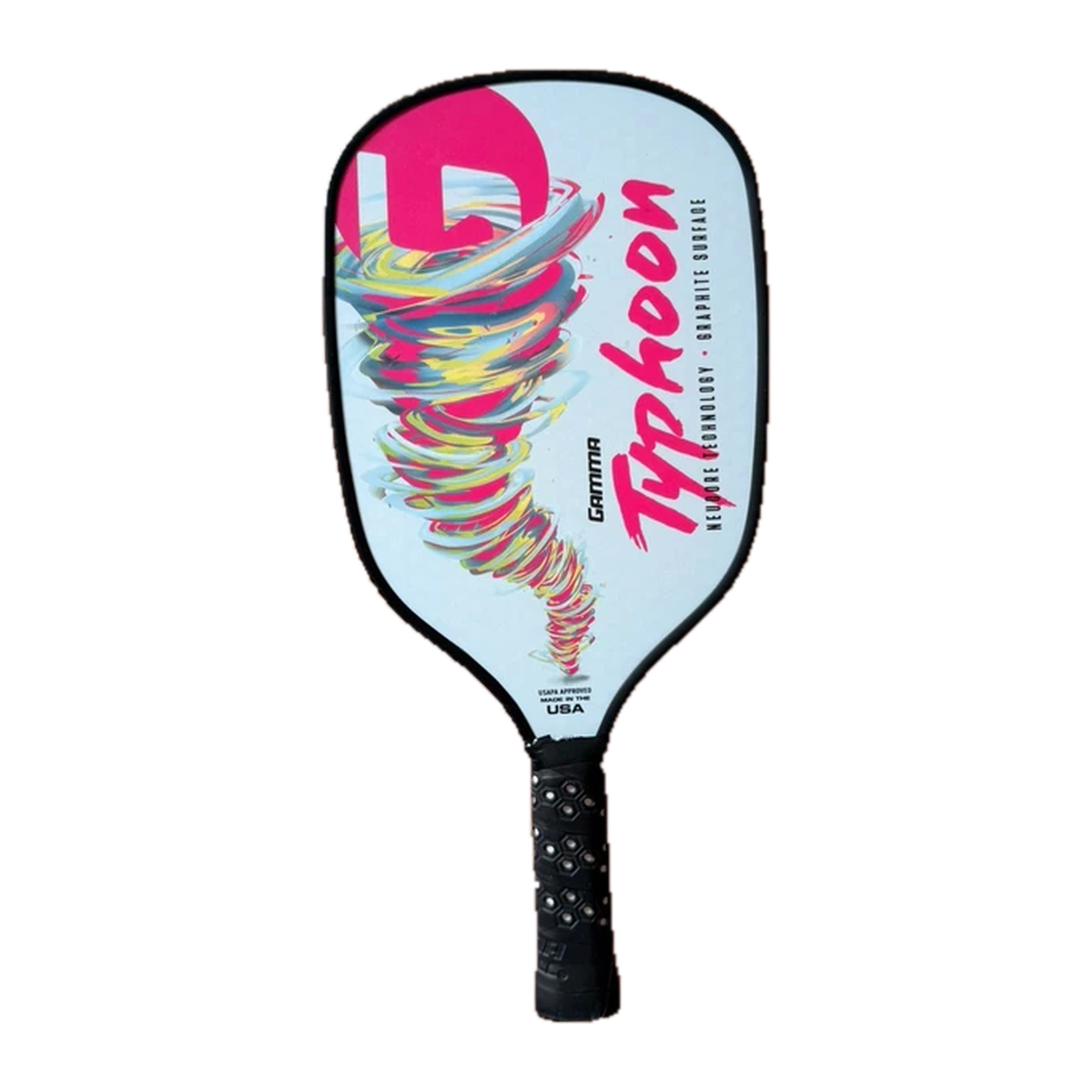
This is the original GAMMA Typhoon NeuCore, model RPTPP, in pink/white with a pale blue-white face, a vivid pink GAMMA G, large pink Typhoon lettering, a multicolored yellow/turquoise/pink tornado, a black edge and a black Honeycomb grip. My original personal photo also shows USA-made and approval-related lettering near the lower face. The genuine owner paddle—not a stock photo or recreated product—appears in the review card, WordPress featured image and structured data.
This Typhoon is separate from the GAMMA Hellbender, GAMMA Shard, the GAMMA Compass and paddles called Typhoon from other brands. They may share a manufacturer or a naming theme, but the construction and play claims from those other models do not automatically describe my paddle.
A historical USA Pickleball model register lists the GAMMA Typhoon RPTPP under Gamma Sports, added April 9, 2021, with a polypropylene honeycomb/fiberglass composite construction and a nominal thickness of 0.600 inch. The listed registration is historical model identification, not a guarantee that every current sanctioned event accepts this exact paddle under its latest rules.
Retailer specifications for the original Typhoon describe a textured fiberglass/composite face, NeuCore polypropylene honeycomb core, an advertised average weight of 7.75 oz, a 16⅛ × 7⅝-inch paddle, a 4½-inch short handle, and a 4⅛-inch grip circumference. Those are model specifications, not measurements I made on my individual example. The original photo shows the branding and appearance but cannot independently establish the composition of the internal honeycomb or confirm any particular face-material chemistry.
Why my original photo shows a paddle on transparent plastic
The original unedited photo shows the Typhoon lying loose on transparent crinkled plastic over a wooden tabletop. It might look like a photograph taken while unpacking. In fact, I confirmed the timing: the photo was taken before I started playing with this paddle. I then went on to use the paddle for 6–15 hours.
That distinction matters for a genuine owner review. The early photograph proves that I had the photographed paddle and documents its model, colors and appearance at that time; it does not visually document later use, precise wear or the number of completed games. My actual use is supported by my separately stated firsthand playing experience and cannot be reverse-engineered from an image.
I did not specify the number of sessions or whether I practiced indoors, outdoors or on any particular court surface. I also did not list the model of ball or any modifications to the grip. I therefore do not invent those details in a convincing-sounding test narrative.
My testing: drills and matches, but no invented test conditions
I used this original Typhoon in a mixture of technical training and games. The total actual playing time was 6–15 hours. I did not provide a detailed training plan, opponent skill level, tournament conditions or calibrated test data. My review is an account of the paddle as it felt to me during that limited real use.
I bought it brand-new at normal price for $59.99 USD in July 2026. I did not report a sponsored arrangement, a specific discount, supplied accessories or a verified factory-original grip configuration. The purchase price is mine and historical; it is not evidence that the paddle is sold for $59.99 today, and it is not itself a standalone statement that I considered it excellent value for money.
The teardrop head gave useful reach and a forgiving sweet spot
One of the clearest positives in my playing feedback was the extra reach on difficult balls. I noticed an advantage from the Typhoon’s unusual shape when trying to make contact with shots that would otherwise be harder for me to reach.
I also reported that the sweet spot felt large and comfortable to hit. This is a personal, practical sweet-spot assessment. I didn’t measure the actual square inches, run a series of off-center rebound tests or establish that it had the biggest sweet spot of every paddle I’ve used. My observations establish a forgiving general hit feeling, not an independently measured sweet-spot map.
These observations are related, so the rating gives them one 25%-weighted sweet-spot-and-reach category, rather than awarding duplicate advantages every time the shape is described in a slightly different way. The paddle’s retail geometry provides context, but the subscore comes from what I actually felt on the court.
Predictable ball response, controllable dinks and stable net blocks
Another strength I noticed was that my strokes felt solid and predictable. I also found that I could play short dinks with control. It is useful to have a paddle that can be hit harder without making every gentle shot feel unmanageable, but my supported experience is limited to the short dinks I actually reported.
At the net, I was able to block hard incoming balls steadily. That’s a separate real observation about net defense. I did not state that I dominated rapid-fire hands battles, execute particular third-shot drops well or repeatedly reset balls from the transition zone, so those performance claims are deliberately absent.
Because predictable contact, short dink control and steady blocking all contribute to the same broad theme of control in actual play, they are combined into one 30%-weighted control-and-soft-game category. This is the largest rating component because confidence managing the ball is a central part of the positive experience I described.
Hard-shot power was satisfying, without a measured speed advantage
I got satisfying power on my harder shots. I didn’t have to report exceptional ball speed, a faster serve, or superiority over Hellbender for this to be a useful positive conclusion. Simply finding the power adequate and satisfying for my real practice and matches is valuable feedback.
I did not choose a head-heavy balance assessment or a direct Hellbender power comparison. Therefore I do not claim that extra head weight was the cause of my experience, nor that this Typhoon outperformed any particular paddle. This power category receives a measured editorial 4.1/5 because the evidence is positive but limited to one qualitative power observation.
A separate 2021 Typhoon review by Braydon Unsicker at Pickleball Effect describes stronger power than Hellbender in his own play. That is his result, not my comparison, and it contributes nothing to my editorial score.
Handling: manageable weight and a comfortable one-handed grip
The Typhoon’s weight felt appropriate and manageable in my ordinary play. I didn’t call it exceptionally light, dangerously head-heavy or tiring over long matches. My supported observation is simply that it was comfortable enough to manage for the sessions I played.
I found the black GAMMA Honeycomb grip comfortable, and the short handle worked well for my one-handed strokes. The model’s 4½-inch handle specification is worth noticing if you use two hands, but I did not personally report two-handed discomfort. A short handle can work for one player and not another. It would be wrong to turn an independent reviewer’s two-handed complaint into my own negative experience.
I also described solid, pleasant contact feel. That subjective sensation is separate from measured vibration or noise levels, neither of which I supplied. I group manageable weight, one-handed handle comfort, grip feel and ball contact in the same 20%-weighted handling category so the several closely related ergonomic answers do not inflate the overall rating.
What I can—and cannot—say about spin
I did not provide a firsthand spin observation for this specific Typhoon in the selected answers. Therefore I cannot say I personally generated unusually strong topspin, better serve rotation or more spin than a GAMMA Hellbender or a modern carbon paddle. I also did not measure RPM or determine how the textured face changes after extended use.
For background, the product description promotes spin potential from the textured composite surface. An independent reviewer also discusses the spin in his own game. Those may be useful reasons for another player to test the surface, but they do not become my personal results and are excluded from the editorial score.
Early condition and my pink-and-white color preference
I liked the vivid pink color of the paddle. The original photograph clearly shows the oversized pink G and Typhoon lettering, plus a tornado graphic with yellow, pink and turquoise accents on a pale face. I did not separately state that I bought it because of the art or that the lighter face accumulated visible stains after use.
I also reported no functional problems in my actual 6–15 hours. That’s a useful short-term result but not a durability study. The photo taken before play can’t be used to verify that no wear occurred after play. I did not give an account of surface scratches, edge-guard damage, changes to the grip or a decline in hitting performance over months.
My overall selected summary was simply that I was satisfied with the paddle and how it played. That positive conclusion, the liked pink design and absence of an early functional fault are grouped in one smaller 10%-weighted category. It is not a score for season-long reliability or an independently confirmed value-for-money judgment.
My $59.99 purchase: historical cost, not live Amazon pricing
I paid $59.99 USD in July 2026, buying this original pink-and-white Typhoon new at the ordinary price for that purchase. I did not specifically answer that I would buy it again, recommend it at a different current price, or prefer it to a more expensive replacement. I was satisfied overall, but that is not a license to invent a stronger price-value opinion.
At the time this article was prepared, a specific live Amazon.com ASIN and offer for the exact pink RPTPP were not verified. Rather than sending a shopper to a made-up product page, I provide a clearly labeled Amazon US model search for GAMMA Typhoon NeuCore Pink RPTPP (affiliate). Results might contain a differently colored Typhoon, a used original paddle, a separate product or no stock at all. Always check the model, color, condition, seller and actual price before purchasing.
Transparent evidence-weighted editorial rating: 4.3/5
This numerical score was calculated by the site from my actual selected firsthand experiences. I was not required to choose an overall star number. I reported enough separate firsthand topics—sweet spot, reach, control, dinks, blocking, power, grip and overall satisfaction—to support a cautiously positive editorial score, while keeping unanswered spin, specific drop shots and long-term durability unscored.
| Firsthand theme | Category | Weight | Contribution | Grounding in my selected observations |
|---|---|---|---|---|
| Sweet spot and difficult-ball reach | 4.4/5 | 25% | 1.100 | Large, comfortable sweet spot and useful extra reach for difficult balls (5A and 6A counted together, not a measured off-center test). |
| Predictable control, short dinks and net blocking | 4.4/5 | 30% | 1.320 | Solid predictable response, controllable short dinks and steady blocks against hard shots (7B, 8A, 11A); no claimed measured third-shot drops. |
| Power on stronger strokes | 4.1/5 | 15% | 0.615 | Satisfied with the power of hard shots (9A), without claiming superior speed, extra serve depth or head-heavy power. |
| Manageable weight, one-handed handle and contact comfort | 4.3/5 | 20% | 0.860 | Appropriate manageable weight, pleasant Honeycomb grip, short handle well-suited to one-handed strokes and solid comfortable ball contact (4A, 12A, 13A, 14A clustered). |
| Short-term reliability, overall satisfaction and design | 4.0/5 | 10% | 0.400 | Owner liked pink appearance and general playing performance; no functional problems during real 6–15-hour test (15A,17A,18B). No supported value-for-money score or long-term durability claim. |
| Weighted total | 100% | 4.295/5 | Rounded 4.3/5 | |
The calculation is 1.100 + 1.320 + 0.615 + 0.860 + 0.400 = 4.295, rounded to 4.3/5. The star graphic uses 86% fill, and the Product/Review structured data reports the same 4.3 score. No externally sourced review score, claimed manufacturer performance, or unselected checkbox contributes to those numbers.
My observations about a pleasant sweet spot and reach are related and have one category; short dinks, predictability and stable blocks share a broader control category; the weight/grip/handle and solid contact sensations form one handling category. This avoids counting a single favorable feeling repeatedly.
How other Typhoon players’ findings differ from my own test
Other people’s testimony is identified separately, not presented as my first-person testing. In Braydon Unsicker’s independent GAMMA Typhoon review, he found a useful combination of power and control, but a short handle that did not suit his two-handed backhand. I confirmed that the same handle suited my one-handed strokes; I did not test or adopt his two-handed experience.
Barb Romig’s buyer review praises the feel and weight for her hands, while JoAnn Cade’s review notes that the Typhoon felt shorter than a GAMMA Compass she had used before. Neither is a direct comparison that I personally reported, and neither provides long-term durability proof for my photographed pink version. Different retail colors may be aggregated in customer reviews.
Who should consider the original GAMMA Typhoon?
For another separately owner-tested GAMMA graphite paddle, see our original GAMMA 405 Graphite (RP405) owner review. Over 6–15 hours of play, the owner liked its light hands speed, reach, spin and touch but reported a genuinely narrow sweet spot, with extra mishits and tougher off-center net blocks. The GAMMA 405 SensaCore is a different model from this Typhoon NeuCore, and these articles do not establish a controlled head-to-head comparison.
In my limited firsthand test, the original Typhoon is a potentially good fit for a player seeking forgiving contact, some added reach, controllable short dinks, reliable net blocking, satisfactory power and a comfortable shorter handle for one-handed play. These were the aspects I actually found useful in drills and matches.
If your main requirement is a long handle for a two-handed backhand, a very particular spin rating, or proven wear resistance over hundreds of hours, I would not rely on my own data to answer those questions. The 4½-inch handle is a retailer-listed specification; whether that suits you is personal. The exact 2021-era RPTPP model should not be confused with a later GAMMA Shard, a Hellbender or unrelated Typhoon-named products.
For separate authentic owner tests and related paddle context, read the GAMMA Compass NeuCore owner review, the GAMMA Riley Newman 206 Signature review and the GAMMA Lindsey Newman Havoc Signature review, along with our best pickleball paddles guide. These are not controlled side-by-side comparisons against my Typhoon unless explicitly stated as such by their individual authors.
Frequently asked questions
Did you actually play with the GAMMA Typhoon if the photo shows it on plastic?
Yes. I confirmed the photo was taken before I began playing; afterwards I used this paddle for 6–15 hours in drills and games. The picture is authentic but records the earlier state, not my later play.
How large did the Typhoon’s sweet spot feel?
It felt large and comfortable during my use. I did not provide a numerical sweet-spot size, detailed edge map or quantified mishit test.
How did it perform on dinks and defensive blocks?
I was able to play controlled short dinks and block hard incoming balls steadily at the net. Specific drop-shot success rates and hands-battle speed were not reported.
Did the Typhoon have enough power?
Yes, I was satisfied with the power of my harder shots. I did not measure ball speed or say it outperformed Hellbender.
Was the short handle uncomfortable?
Not for my own one-handed shots: I reported that the handle suited them and that the Honeycomb grip was comfortable. I made no claim about two-handed backhand comfort.
How much spin could you get?
I did not provide a firsthand spin-performance result or RPM measurement for this Typhoon, so the review does not claim one.
How durable was the paddle?
I experienced no functional problems during 6–15 hours. That is not enough to promise years of life, and the original photograph was captured before play.
How much did you pay?
$59.99 USD in July 2026, bought new at ordinary price. This is not today’s Amazon price, and my survey did not separately confirm a value-for-money verdict.
Why is your rating 4.3/5?
The site combines five distinct evidence categories for 4.295/5, which rounds to 4.3/5. The 86% star display and Review schema use the same editorial outcome. It is not a numerical score I personally submitted.
Final verdict
After 6–15 hours of technical practice and matches, I was satisfied with the original pink/white GAMMA Typhoon NeuCore RPTPP. I liked the combination of a generous sweet spot, useful reach, solid predictable strokes, controlled short dinks, stable net blocking and satisfactory hard-shot power. The weight and Honeycomb grip were comfortable, its shorter handle suited my one-handed play, and impact felt pleasant. I didn’t observe a functional problem during the short test, but the original pre-play photo and limited hours cannot establish long-term durability or spin performance. The transparent editorial verdict is 4.3/5.

Jonathan Grøn created The Pickleball Wise. He coaches beginner pickleball players and captains a pickleball team in Series 2. He combines on-court experience with official rules and coaching resources to write practical guides on doubles strategy, skills, and training.