ONIX Z3 Composite Review: My 1–5 Hour Indoor Test (Original Red/White)
My ONIX Z3 Composite review after 1–5 hours: I tested the original Red/White version with the large red number 3 in ordinary indoor doubles club games using indoor pickleballs. I bought it myself in August 2026 for $49.99 with no discount, free product or sponsorship. My overall score is 3.0 out of 5, a number I personally selected.
In the short time I used it, I liked the way the paddle felt light and quick in the hand. It helped me react quickly in tight net exchanges, and I noticed clear pop on short net shots. I also got powerful drives, good serve length, faster groundstrokes and effective high-ball putaways. It felt like a significant power upgrade from a basic wooden paddle and gave me the direct contact response I preferred.
These are the only playing strengths I specifically confirmed. I did not submit first-hand assessments of this paddle’s dinks, third-shot drops, spin, sweet spot, grip comfort, durability or outdoor performance. My 3/5 score is genuine, but I did not provide a reason for holding it below four or five stars. Rather than invent negatives to justify it, I have kept the score and the tested observations separate.
Affiliate disclosure: As an Amazon Associate I earn from qualifying purchases. The Amazon US link below contains affiliate tag owlratings08-20; qualifying purchases may pay this site a commission at no additional cost to you. I bought this Z3 myself, without any sponsorship, product gift or discount. The affiliate destination is a search-results page, not an exact-product checkout link: the Amazon.com ASIN for the original Red/White Z3 has not been independently verified, and listings for the later Z3 V2 should not be mistaken for this paddle.
My verdict: lively response and quick hands in a short indoor test
Fast at the kitchen: the Z3 felt light and quick, and I could react promptly in tight net exchanges, including when balls came at me hard.
Short-stroke pop: I got a noticeable response on short shots at the net and liked the direct feel at impact.
Offense: I could drive the ball firmly from the baseline, finish high balls effectively and send serves deep without extra strain.
Compared with basic wood: I experienced a substantial increase in power relative to a simple wooden beginner paddle. I also felt my groundstrokes carried more speed than with a previous, otherwise unspecified paddle.
Rating context: I explicitly rated it 3/5. My selected answers were positive and offense-focused, so there is no verified specific defect or negative playing property to attribute to me.
What I personally liked
- Light-feeling, quick handling in my hand
- Fast reactions in close kitchen-line exchanges
- Clear pop on shorter net shots
- Substantial power upgrade over a basic wooden paddle
- Powerful drives and groundstrokes with added pace
- Effective high-ball putaways
- Good serve depth without extra effort
- Direct ball-contact response that I liked
What my short test did not establish
- Only 1–5 hours of play; no long-term assessment
- No confirmed first-hand verdict on dinks, drops or defensive resets
- No reported spin or slice performance comparison
- No measured weight, sweet-spot size or off-center test
- No owner-reported grip modification or durability outcome
- No detailed reason supplied for my 3/5 rating
Bottom line: my actual 3.0/5 score
I enjoyed the Z3’s quick feel, direct pop, powerful drives, good serve depth and high-ball finishing ability in my brief indoor doubles test. My selected score is 3.0/5. That rating is not a weighted calculation, and it is not an invitation to manufacture shortcomings I never reported. This is a short, deliberately scoped review of what I experienced.
Which ONIX Z3 did I actually test?
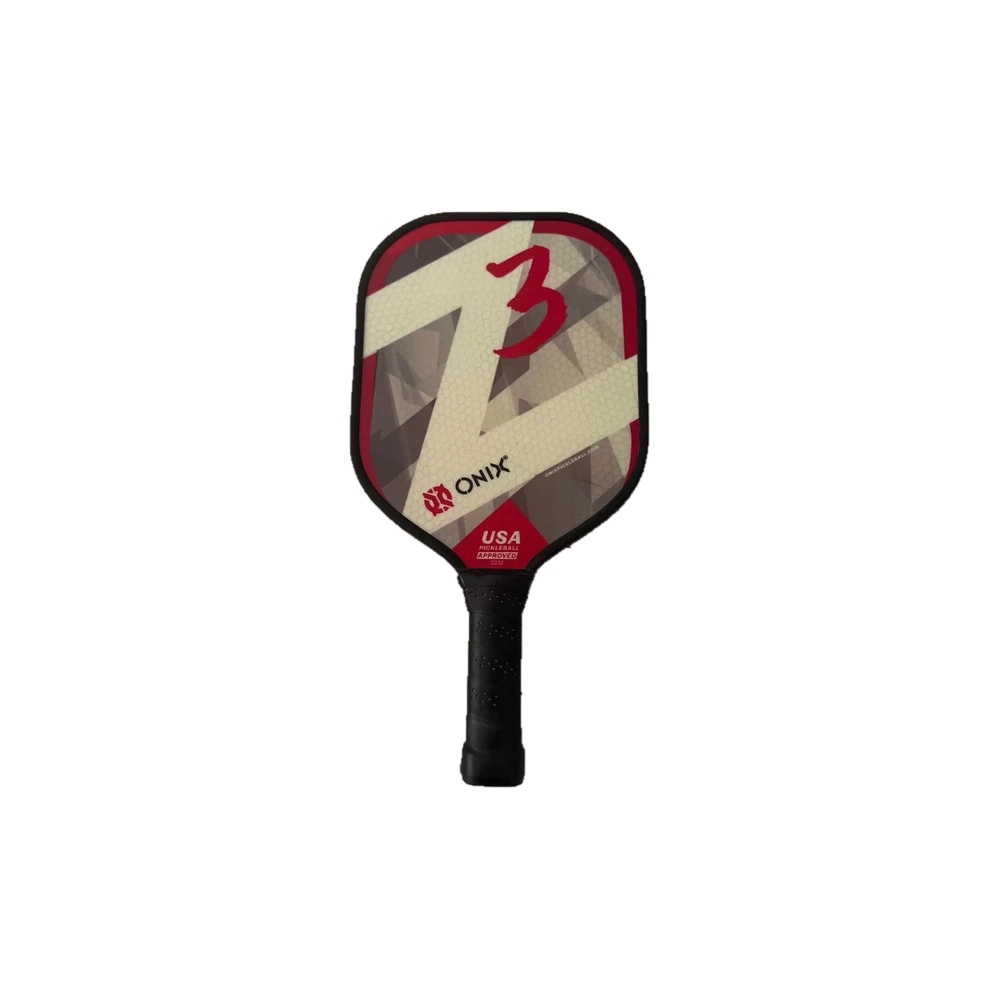
The paddle in my original photo is the ONIX Z3 Composite Red/White with the old large red “3” graphic, grey-and-white geometric face, black perimeter guard and black wrapped handle. I separately confirmed this original graphic as my model. The genuine owner photograph has simply been cut out onto a transparent background for the featured image and product card; the face artwork, visible markings and grip were not redrawn or replaced.
This matters because the manufacturer’s current catalog also lists a Z3 with redesigned V2 artwork that has a different visual treatment and some differing dimensional descriptions. The newer Z3 V2 is not the same photographed version. I have not borrowed first-hand experiences of the later variant to describe this original Red/White paddle.
ONIX’s original Z3 Composite product page lists a composite face, polypropylene honeycomb core, protective edge guard, wide-body shape, approximately 7.5–8.2 oz manufacturer weight range, 15.5-inch overall length, 8.125-inch face width, 5-inch handle and 4.25-inch grip circumference. These are published manufacturer specifications, not measurements of my actual sample.
The same original product page describes its core as 14 mm in the overview yet lists the paddle thickness as 0.5 inch in the specifications. Because those are not exactly equivalent, I do not present a precise measured thickness for my paddle. I did not measure it. I also did not verify a live approval database entry for my individual sample, even though the paddle photo bears a historic USA Pickleball Approved 2022 marking and ONIX markets Z3 as approved; tournament players should verify the current accepted equipment listing.
My first-hand test: 1–5 hours, indoor doubles
My testing took place in regular indoor doubles club games using indoor pickleballs. I estimated total use at 1–5 hours; I did not supply an exact hour count or number of match sessions. I bought the paddle in August 2026 at $49.99, with no discount, gift or sponsorship.
I did not provide a grip modification history, added tape details, measured paddle mass or a named venue. The black wrap is visible in the original photo, but that does not establish whether it is still the factory wrap or has been changed. I have not stated that I used aftermarket modifications, nor assumed that the setup remained unaltered throughout its history.
Because the test was short, I focus on the categories I actually selected: perceived hand speed, short-contact pop, baseline drive power, serve depth, faster groundstrokes, high-ball finishing, quick net reactions and direct contact feel. A brief session can be useful for those impressions without proving durability or complete performance across every type of shot.
Handling: light in the hand and quick at the net
The Z3 felt light and quick in my hand. During tight exchanges around the kitchen, I could bring it into position promptly and react quickly when opponents sent the ball toward me. I made this observation twice in slightly different ways: I felt fast in close net duels, and I could react quickly to hard incoming balls.
That is a practical benefit in doubles, where several exchanges can happen before there is time to take a full backswing. I was able to use the paddle’s maneuverability in normal, reactive play.
This is a perceived handling result. I did not weigh the specific Z3, measure swingweight or compare it in a controlled test with a named modern paddle. The 7.5–8.2 oz range comes from ONIX’s catalog; my statement about lightness comes from how the paddle actually felt to me.
Short-stroke pop and close-range hitting
One thing I particularly noticed was clear pop on short shots at the net. The paddle responded directly when I met the ball with a compact stroke. I also said I liked the direct feel of ball contact. Those are complementary observations: I enjoyed both the liveliness and the way the shot connected with the face.
Pop on a short volley is not exactly the same thing as maximum drive power, measured exit speed or soft-game precision. I reported the first as a positive feeling on the court, and I separately reported powerful groundstrokes and drives. I did not report whether that pop caused balls to fly too high on dinks, made resets tricky or changed the accuracy of my third-shot drops. Those would be unsupported additions.
Baseline drives and the upgrade from a wooden paddle
My Z3 delivered powerful drives from the baseline. I was able to hit the ball firmly with a bigger swing, and I reported that my groundstrokes gained pace compared with my previous paddle. That earlier paddle was not named in that particular answer, so I have not assigned it a make or model.
I also selected a broader comparison: the Z3 was a substantial power upgrade over a basic wooden beginner paddle that I had used. This is an owner-reported, relative impression. It does not mean that the Z3 is more powerful than contemporary premium carbon-fiber models, and it does not establish the amount of extra ball speed in miles per hour.
In that limited context, the Z3’s composite face gave me the attacking response I was looking for. Other testers may compare it with different equipment and reach a different power conclusion. The important point here is the starting baseline I personally used.
Serves: good depth without extra effort
My serves had good length without needing extra effort. I appreciated that I could get the ball deeper with a comfortable motion. I did not record serve speed, placement percentages or exact distances, so the observation is one of practical depth rather than measured velocity or precision.
I also did not submit a separate spin-serve result. A paddle giving me deeper serves is not enough evidence to claim it produced unusually high topspin, slice or side-spin. I would need to test and report those individually.
High balls and putaways
When opponents gave me an elevated ball, the Z3 made putaways easier to finish. That was one of my explicitly selected positive observations. I could take advantage of a high contact point and play an effective attacking shot.
This finding fits with the direct response and baseline power I felt elsewhere. Yet I did not claim that all overheads landed, that the paddle reached a particular swing speed or that its sweet spot was especially large. The result is narrower: high-ball finishing felt easier to me during my short indoor doubles test.
Blocking and counters: what I did and did not confirm
I could react quickly to hard balls at the net, and I found the Z3 useful in fast net exchanges. These are direct, practical handling findings. They tell me that the paddle was easy for me to bring into position in normal doubles rallies.
They do not automatically prove that my defensive blocks absorbed pace especially well, that my resets were accurate or that off-center counters remained stable. I did not choose answers on twistweight, mishits, sweet-spot forgiveness or specific defensive reset performance, so I am keeping those separate. The guide to pickleball paddle twistweight explains those technical concepts without claiming measurements for my Z3.
Spin, dinks, drops and sweet spot: no invented findings
Some Z3 owners discuss topspin, dinks or the paddle’s broad face; the manufacturer also describes the shape as offering a large sweet spot. But my submitted answers contain no firsthand spin, dink, drop, slice or sweet-spot performance assessment for this particular short test.
That distinction matters. I will not turn manufacturer marketing or another player’s experience into a claim that I generated a certain amount of spin, found dinks consistently accurate or enjoyed exceptional off-center forgiveness. If those qualities are your primary buying criteria, the pickleball paddle spin, grit and RPM guide can explain how to evaluate them without implying that I tested them here.
I also did not submit long-term wear or grip-comfort results. The original photo establishes what the paddle looked like at the moment of photography, not how its internal core or grip performed over months.
Why I rated it 3/5 despite reporting good offense
My actual rating is 3.0/5. I selected that number myself. Most of the selected observations I supplied describe the same general positive theme: quick offensive handling, good pop, stronger drives, useful serve depth and easier high-ball finishes.
I did not also supply a specific reason for deducting two stars. So it would be misleading to write that I disliked its dinks, found a tiny sweet spot, suffered excessive vibrations or discovered weak construction just to create a plausible explanation for the score. I did not report those problems.
The score is a personal overall judgment that can legitimately be less enthusiastic than a list of individual strengths. The short review describes the evidence I provided, and I leave any unreported reservations unresolved. That is more useful than a fabricated sub-score or a negative experience borrowed from another owner’s review.
| Area | My confirmed observation | Scope and limits |
|---|---|---|
| Hand speed | Light, quick, responsive in tight net rallies | Felt response, not measured swingweight |
| Net pop | Clear pop on short strokes | Not a reported dink or reset result |
| Groundstrokes and drives | Powerful hits and greater pace | Compared with an unnamed earlier paddle; no ball-speed figure |
| Earlier wooden paddle | Substantial power upgrade | Only relative to that basic wooden starting point |
| Serves | Good depth without extra effort | No measured serve speed or spin |
| Finishing | Easier high-ball putaways | No measured putaway percentage |
| Overall | My personal rating: 3.0/5 | Owner-selected score; detailed deductions not supplied |
How this Z3 relates to my other paddle reviews
For another separate, owner-tested ONIX paddle, see my ONIX Stryker 4 Graphite Black review (6–15 hours, 3/5). It records a light, quick-handling feel in doubles. This is a link to a separate personal test, not a measured Z3-versus-Stryker comparison.
Related first-hand comparison: I have also tested the ONIX Z Junior Composite Orange for 1–5 hours. I found the junior paddle lighter and more maneuverable than this full-size Z3, although I also experienced many edge hits with the junior paddle. That is a specific handling comparison, not a measured power, spin or forgiveness ranking.
I have separately reviewed the Gearbox GX5 Power 8.5 oz Blue and Gearbox CX11Q Quad Control 7.8 oz Purple. Those reviews cover different paddles and separate owner-reported test periods. They are useful examples of how I describe power and control, but I did not submit a direct Z3-versus-Gearbox comparison for this review, so I am not creating an artificial winner.
Likewise, I do not claim to have benchmarked this original Z3 against the redesigned Z3 V2, a modern CRBN model or a Paddletek paddle during the same sessions. Other people may have tested those pairings; they do not belong under my personal experience.
External reports and product specifications — not my first-hand observations
Separated outside context: ONIX describes the original Z3 as a wide-body composite paddle with a polypropylene core, an edge guard and an official 7.5–8.2 oz weight range (manufacturer’s product page). Some customers have reported lively net pop after upgrading from a wooden beginner paddle; others have described difficulty with slices or a desire for more maximum power (SportChek’s republished owner reviews and Golf Galaxy’s Z3 customer reviews). Those reviewers’ precise paddle colors or generations are not always verified, and their positive or negative findings are not additional claims about my own Red/White Z3.
Who might find this original ONIX Z3 interesting?
Based only on what I confirmed, I can see its appeal to someone who wants a light-feeling paddle for quick indoor doubles exchanges and a noticeable boost in pop and drive pace compared with a very basic wooden paddle. The ability to serve deep without extra effort and finish high balls made it enjoyable for the attacking part of my game.
But I assigned it 3 out of 5, not an enthusiastic top score, and my test lasted only 1–5 hours. I cannot responsibly pronounce it the best paddle for soft game, spin or durability without having reported those results. The original ONIX model page provides model information, but a current retailer might instead stock Z3 V2; check the large-red-“3” artwork before purchasing the older design.
Frequently asked questions
Is this review of the original ONIX Z3 or the Z3 V2?
It is the original Z3 Composite Red/White design with a large red number 3, as confirmed by my original photo and model selection. It is not the redesigned Z3 V2.
How many hours did I use it?
Approximately 1–5 hours in regular indoor doubles club games with indoor pickleballs. I did not provide a precise hour or session count.
Did the Z3 feel quick at the kitchen?
Yes. It felt light and quick, and I could react rapidly in close net exchanges and to hard incoming balls.
Did I get good power from it?
Yes, within the comparisons I actually made: I got powerful drives, more pace on groundstrokes, strong short-stroke pop and easier putaways. I also found it a significant power upgrade over a basic wooden paddle, but did not compare it with a named high-end modern power model.
What about Z3 spin, dinks or sweet spot?
I did not report those attributes in my short test. Other users or the brand may describe them, but I have not presented them as my results.
What did I actually pay?
I paid $49.99 in August 2026, buying it myself with no discount, sponsorship or free product. That is a historical personal purchase, not a current retailer quote.
Why is the rating only 3/5 if I liked the power?
3/5 is the overall score I personally submitted. My selected options concentrated on positive offensive attributes, and I did not supply specific drawbacks explaining the score. I have not invented any.
Is it currently approved for tournaments?
The photographed face carries a historical USA Pickleball Approved 2022 marking and ONIX states that the Z3 meets approval requirements. I did not independently check the current approved-paddle list for the precise old Red/White sample, so tournament players should verify the current listing.
Review integrity: All first-person playing observations above come solely from my selected first-hand answers. My genuine original photo is used as featured/product-card art without changing the product. I have not invented exact hours, additional personal comparisons, measured power or spin, off-center results, grip modifications, specific negatives, long-term durability or reasons for my 3/5 score. Manufacturer claims and other purchasers’ experiences are labelled separately.

Jonathan Grøn created The Pickleball Wise. He coaches beginner pickleball players and captains a pickleball team in Series 2. He combines on-court experience with official rules and coaching resources to write practical guides on doubles strategy, skills, and training.