Paddletek Bantam ALW-C 12.7mm Review: My 6–15 Hour Test (Pink)
My Paddletek Bantam ALW-C 12.7mm Pink review after 6–15 hours: I bought the updated, 5.25-inch-handle version for $249.99 in September 2026 and used it in indoor doubles with indoor pickleballs. It feels light, balanced and unusually quick in kitchen exchanges, while its pop, drives, put-aways and topspin are real strengths. But that same liveliness made dinks float too high and defensive resets harder. Off-center blocks sometimes twisted the paddle in my hand; adding weight tape improved stability.
Ownership and test limits: This is an independently purchased paddle, with no free sample, sponsor, or discount. My reported time was a 6–15-hour range, not an exact hour log or a guess from its photograph. I did not supply my playing rating, measured paddle weight, exact number of matches, tape amount or placement, a dedicated long-term durability test, or personal RPM/ball-speed measurements. My qualitative findings below are limited accordingly.
Affiliate disclosure: As an Amazon Associate I earn from qualifying purchases. The Amazon US search-results link below includes my affiliate tag owlratings08-20. Qualifying purchases may earn the site a commission at no extra cost to you. This review is independent; I paid the full $249.99 myself. This is a search link, not a verified exact-ASIN product checkout page.
My verdict: explosive and quick, but a tougher touch game
Best quality: fast handling at the kitchen. Short speed-ups, counters and backhand rolls felt easy to bring into position. The paddle was also balanced rather than noticeably head-heavy.
Power and spin: I got plenty of pop on punch volleys, strong pace on drives and serves, confident put-aways, topspin on serves and dipping topspin on third-shot drives.
Main difficulty: dinks tended to launch high, and hard-hit balls were difficult to reset softly. The responsive face took several hours of adjustment, rather than feeling immediately intuitive in the soft game.
The stability compromise: a useful center hitting area coexisted with speed loss near the edge and torsional movement on some mishits. I personally improved stability with extra weight tape, though I did not document where or how much.
My buying fit: I would recommend it mainly to offensive, improving intermediate-to-advanced players who prioritize quick hands, topspin and pace above the easiest defensive resets.
What I liked
- Very fast hand movement and balanced feel at the kitchen
- Strong pop on short punch volleys and speed-ups
- Powerful serves, drives and finishing overheads
- Good topspin on serves, drives and backhand rolls
- Most of the face felt usable away from the outer edge
- Well-built feel and stable spin response over my short test
What held it back
- Dinks could pop up too high
- Defensive resets against hard drives were demanding
- Off-center contacts could lose pace and twist the face
- Needed weight tape for better stability in my setup
- Limited reach cost me some poaches in doubles
- Grip circumference felt on the thick side despite comfortable contact
Bottom line: 4.0/5 based on my reported play
The Bantam ALW-C 12.7mm rewards the aggressive side of my indoor doubles game far more readily than it helps my defensive resets. I liked its pace, movement and spin, but I needed to manage pop-ups and off-center hits. At the $249.99 I actually paid, it is worth considering whether speed and offensive response matter enough to justify the control compromise.
Which ALW-C did I test? The pink 12.7mm with 5.25-inch handle
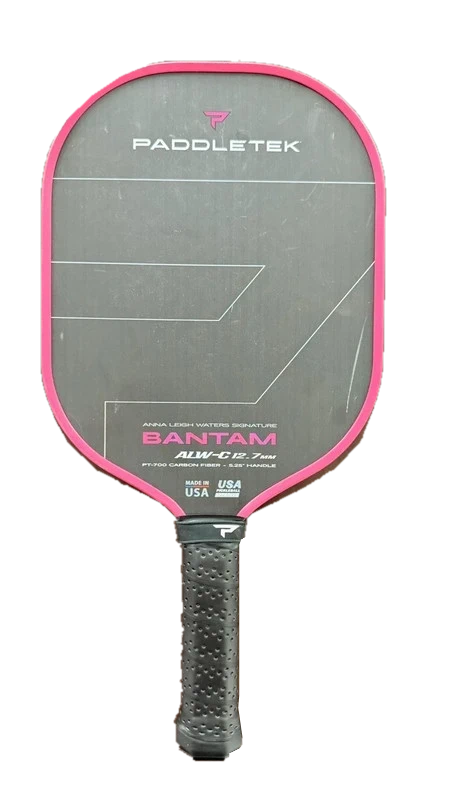
My original image clearly shows the pink edge guard, dark carbon face, Anna Leigh Waters signature branding and the ALW-C 12.7mm designation. It also prints a 5.25-inch handle specification. That matters: the earlier ALW-C release featured a 5-inch handle, so not all online “ALW-C” reviews describe exactly this generation. The photo is mine, and the background was removed for the single featured/product-card image without redesigning the paddle.
Published specs for the updated ALW-C include a PT-700 carbon face, polymer honeycomb core, nominal 12.7mm core and a widebody/standard shape. The updated-model test by Stephen Mijangos at Pickleheads lists a 5.25-inch handle and a 7.5–7.8 oz weight range; Chris Olson’s October 2024 updated ALW-C report at Pickleball Studio separately documents this longer-handle generation. These are external specifications, not measurements of my specific paddle.
My test conditions, ownership and the modification that mattered
I played with this paddle for an estimated 6–15 hours in ordinary club indoor doubles using indoor balls. I bought it myself in September 2026 for $249.99, without a discount or any brand involvement. I did not specify a venue, brand of indoor ball, number of match sessions, official playing level or logged rally statistics. I also did not perform a controlled laboratory test.
The most important setup change was weight tape. Before that change, hard blocks and some off-center contacts could feel unstable enough that the paddle twisted in my hand. The tape improved that sensation. Because I did not state its mass, placement or whether every shot impression came before or after the change, I cannot give a reproducible tape recipe or claim that every stock ALW-C will respond identically. For the principle behind twist resistance, see my pickleball paddle twistweight guide.
Kitchen hand speed: the strongest reason I liked this paddle
The first thing I liked was how quick the ALW-C felt at the kitchen line. I could get into counters and backhand-roll positions comfortably, and short speed-ups felt responsive without needing a large swing. The paddle did not feel head-heavy in my hand. That was especially relevant in indoor doubles, where exchanges can turn into rapid counters at close range.
It is important not to confuse quick handling with automatic stability. I liked the balance and speed, but hard contact away from the center could still twist the face. That is why I eventually preferred the more stable feel after adding weight tape. Both observations can be true at once: low-feeling hand weight helped movement, while insufficient mass distribution for my blocking preference showed up during off-center contact.
Power and pop: excellent for attacking, less friendly for finesse
I consistently liked the paddle’s offensive response. Punch volleys had significant pop; serves and full-swing drives got good pace without needing maximum effort; and overheads or put-aways were effective finishing options. The crisp impact and sharp sound on harder contact reinforced that direct, lively impression. I am describing how it felt in matches, not measured ball speed or acoustic output.
I also reported that the Bantam TKO-C produced more maximum power in my separate experience. That does not negate the strong power I felt from this ALW-C. It means the compact, quick ALW-C was lively and fast for its shape, while the TKO-C felt like the stronger maximum-power option. No same-day instrumented comparison or exact TKO-C thickness was supplied.
Spin: serves, dipping drives and backhand rolls
Topspin was another clear positive. I could produce visible topspin on serves, third-shot drives dipped with rotation and backhand rolls felt productive. In my separate personal comparison, the ALW-C gave me more spin than the Paddletek Bantam TS-5. This is a qualitative judgment, not a personal RPM measurement or a controlled study with matching balls and court conditions.
The face’s grippy feel did not lead me to claim indefinite durability: spin and texture seemed stable over the 6–15 hours I used it, but that is not evidence of how the surface behaves after 50, 100 or 200 hours. My paddle spin, grit and surface-wear guide explains why visible texture, friction and actual spin are different concepts. An independent PPA Tour Paddle Lab entry includes instrument data on a tested ALW-C 12.7mm, but those numbers were not generated in my play.
Dinks and resets: the most important control drawback
For my style of play, control was the biggest cost of the offense. Dinks could rise higher than I wanted because the face had so much response to relatively small movements. I also found it difficult to soften hard incoming drives into defensive resets. The short game was not impossible, but it took several hours of adjustment; I did not mark a later full resolution of the problem, so I will not claim it disappeared.
This is why I would not simply tell a beginner that the ALW-C is an easy, forgiving all-court paddle. It has a relatively generous usable hitting area, but that is a different form of forgiveness from predictable soft-shot launch. Someone seeking effortless drops and resets may appreciate a more control-focused design, even if that sacrifices the ALW-C’s lively pop.
Sweet spot and off-center hits: usable face, demanding edges
I felt that a fairly large part of the face was useful. Yet shots close to the perimeter sometimes lost pace, and off-center contact demanded more precise technique. In particular, hard blocks could rotate the paddle in my grip. Those experiences are not mutually exclusive: the center area can feel tolerant while the outer edge performs less well under pressure.
Weight tape improved stability in my actual setup, but I did not test multiple measured configurations or estimate a numerical sweet-spot increase. I therefore distinguish my feel-based observation from laboratory twistweight measurements. If you mainly defend fast drives and rarely attack first, this is the weakness I would pay closest attention to in a demo.
Grip and shape: comfortable to hold, but thick for my preference
My grip answers contained one apparent conflict: I selected both comfortable grip and too thick. The fairest reading is that the grip was comfortable in hand, although its circumference felt somewhat thick. I am not claiming that the grip thickness was perfect or that I changed the grip; I did not report fitting an overgrip.
The compact shape helped my reactions in rapid exchanges, but it also cost me reach on some poaches. I did not report a personal two-handed-backhand test, so I am not presenting one, even though the 5.25-inch handle is longer than that of the original 2023 version.
Build feel and durability: a promising short test, not a long-term verdict
During my 6–15 hours, the construction felt solid and the face did not seem to lose its spin or surface character noticeably. I am comfortable calling that a positive early impression, not proof that the paddle is indestructible or will maintain performance for years.
I did not report a core-crush problem, grip breakdown, measured surface abrasion, or other specific defect. Those unchecked options are not evidence that such failures can never occur, either. The genuine owner image has ordinary visual marks, but a photograph cannot establish a reliable number of playing hours or the internal condition of the core.
How it compared with the Bantam TS-5 and TKO-C
In a separate first-hand review of my Volair Mach 1 FORZA 16mm Blue, I found the ALW-C faster to maneuver at the kitchen line. That was my qualitative impression across separate indoor doubles test periods, not a same-day measured swingweight experiment. The FORZA also gave me strong spin and pop but was demanding on dinks, resets and off-center hits; see its complete 16–30-hour owner report for context.
| Compared paddle | My selected first-hand comparison | What I did not claim |
|---|---|---|
| Paddletek Bantam TS-5 (Horizon Yellow review) | The ALW-C gave me more spin. | No RPM, ball-speed or same-session benchmark was supplied. |
| Paddletek Bantam TKO-C | The TKO-C had more maximum power. | No precise TKO-C generation, thickness or measured speed was supplied. |
For another independently bought paddle used in indoor doubles, see my 11SIX24 Pegasus All Court review. I did not select a direct ALW-C versus Pegasus comparison, so this is a useful related review, not a claimed head-to-head winner.
What I paid versus current advertised prices
My verified owner-reported payment was $249.99 in September 2026, with no discount. That should not be confused with a current deal. For market context, Pickleball Central has advertised some ALW-C 12.7mm configurations at $149.99 against $249.99 MSRP. That listing shows selectable colors and stock conditions; it does not establish today’s availability or price for my exact pink version, and I did not pay $149.99.
Because I could not verify a single exact pink-version Amazon.com ASIN, the card links to clearly labelled Amazon US search results (affiliate link). Verify the color, core thickness, handle generation, seller and return terms before ordering. No specific Amazon checkout product or inventory level is being represented as verified.
My rating: 4.0/5, with the trade-offs visible
This 4.0/5 editorial score is a structured synthesis of the 36 checkbox observations I supplied, not a numerical score I directly selected, an instrument measurement or an average of other reviewers’ ratings. Each component is a reasoned five-point editorial interpretation of my reported strengths and weaknesses; the categories sum to 100% and the weighted total is 4.01/5, rounded to 4.0/5. Value for money is deliberately not a scored category because I supplied my price but no explicit personal value verdict.
| Criterion | Editorial rating | Weight |
|---|---|---|
| Hand speed & maneuverability | 4.8/5 | 20% |
| Power & pop | 4.5/5 | 20% |
| Spin | 4.6/5 | 15% |
| Soft-game control | 2.9/5 | 20% |
| Forgiveness & stability | 3.4/5 | 15% |
| Grip comfort & short-term build feel | 3.7/5 | 10% |
The main positives are speed, attacking pace and spin. Soft-game control gets the weakest score, while stability is held back by the off-center twists that I improved with weight tape. The grip/build category reflects comfortable material, a somewhat thick circumference and only short-term construction observations. This method helps keep the overall rating, stars and pros/cons consistent rather than making one favorable sentence override the weaknesses.
Who I would recommend the ALW-C 12.7mm to
I would recommend the pink 12.7mm ALW-C mainly to offense-minded improving intermediate and advanced doubles players who value quick hand positioning, aggressive topspin and decisive put-aways. My recommendation is based on what I actually played, not the assumption that using a pro-signature paddle automatically makes someone play like a professional.
I would be more cautious for players who primarily want soft-touch resets, low-risk dinks or maximum stability on rushed, off-center blocks. Those weaknesses matter particularly because my actual experience was indoors, where the ball and play conditions may differ from outdoor sessions. I cannot say from this test how it would compare on specific outdoor balls or courts.
What independent testers found — separate from my experience
External context only, not my personal results: Stephen Mijangos at Pickleheads (updated ALW-C review, November 2024) described excellent hand speed and spin with troublesome dink pop-ups; Chris Olson at Pickleball Studio (October 2024) documented the updated 5.25-inch version and its power focus; and Matt Khoury’s independent ALW-C 12.7/14.3 review also emphasized fast offensive response with a precision/control trade-off. These sources are useful context and may concern different colors or tested configurations. None substitutes for my indoor matches, my tape modification, or my $249.99 receipt-price report.
Frequently asked questions
Is the ALW-C 12.7mm easy to control?
Not automatically in my experience. I had excellent attacking response but my dinks rose too high and hard defensive resets were difficult. I needed hours to adjust the soft game.
Is it a fast paddle at the kitchen?
Yes in my qualitative 6–15-hour indoor doubles test. It felt quick and balanced, and I liked counters, backhand rolls and compact speed-ups. I did not measure swing weight myself.
Does weight tape help?
It improved my stability against twisting. I did not document its exact placement, amount or final weight, so I cannot prescribe a repeatable setup.
Is the pink ALW-C the same as the old short-handle ALW-C?
No assumption should be made from the name alone. My photographed pink 12.7mm model has 5.25 inches printed for the handle; the original 2023 ALW-C was commonly reviewed with a 5-inch handle. Check the exact generation and thickness.
Would I recommend it to a beginner?
My explicit recommendation was for offensive improving intermediates and more advanced players. I would not infer that the high pop and difficult soft-game response make it an ideal first paddle.
Review integrity: Facts labelled “I/my” come from the owner’s submitted questionnaire. External specifications and reviewer reports are linked and labelled separately. The single product photo is an actual archived owner photograph with background removed. No extended test, outdoor play, precise paddle mass or laboratory data is claimed.

Jonathan Grøn created The Pickleball Wise. He coaches beginner pickleball players and captains a pickleball team in Series 2. He combines on-court experience with official rules and coaching resources to write practical guides on doubles strategy, skills, and training.