Paddletek Bantam TS-5 Review: My 16–30 Hours (Horizon Yellow)
My Paddletek Bantam TS-5 Horizon Yellow review after 16–30 hours: I bought this lightweight fiberglass paddle myself for $89.99 in September 2026, without a discount or sponsorship, and used it in indoor doubles with indoor balls. My rating is 4.0/5. It felt quick and well balanced at the kitchen, blocked hard drives accurately, offered a large forgiving sweet spot and made ordinary dinks and third-shot drops easy to place. My reservations are the limited maximum power, less spin than modern raw-carbon paddles, and reduced depth on some returns.
Those strengths and weaknesses are different sides of the same lightweight design. I could hit good, forceful shots down the sideline, but I had to create the pace with a bigger swing; the TS-5 did not supply the same maximum power I have felt from heavier high-end paddles. My basic drops were accurate, but advanced drops demanded more precision. Usable spin did not mean elite spin, and the comfortable grip still felt a little bulky.
First-hand test boundaries: The 16–30 hours is my own reported range, not an estimate from the photo. I did not provide an exact session count, measured paddle weight, match score, ball brand, laboratory RPM or speed reading, tape setup, or long-term wear log. I do not claim these data or any play on outdoor courts.
Affiliate disclosure: As an Amazon Associate, I earn from qualifying purchases. The US Amazon search link on this page uses affiliate tag owlratings08-20; qualifying purchases may earn a commission at no additional cost to you. I bought the paddle independently at full price, with no free sample, promotion, discount or sponsorship. Because I have not verified a specific Amazon ASIN for Horizon Yellow TS-5, this is clearly a paid search-results link, not an exact-product checkout link.
My 4/5 verdict: quick hands and dependable touch, not effortless power
Fast doubles handling: the TS-5 felt lightweight and balanced. I could move it quickly for counters and react to hard drives near the kitchen line.
Easy basic control: my dinks, standard third-shot drops and placed serves felt accurate. The sweet spot was generous and I noticed very few mishits.
The power limit: forceful sideline drives were possible when I swung harder, but I got less effortless maximum pace than with heavier premium paddles. Some returns lacked depth against stronger opponents.
Good enough spin, not my highest-spin paddle: I could add useful rotation, yet high-speed topspin attempts sometimes sailed long, and modern raw-carbon paddles produced more spin for me.
Who I would choose it for: someone moving up from a beginner set who values speed, control and forgiveness above maximum finishing power.
What I liked in my test
- Light, well-balanced feel and very quick hands at the kitchen
- Controlled blocks against hard third-shot drives
- Precise dinks, ordinary third-shot drops and serve placement
- Large sweet spot with very few mishits
- Comfortable impact, comfortable grip material and less fatigue over longer sessions
- Better-feeling construction than my cheap beginner paddles
What held the TS-5 back
- Limited maximum power versus heavier performance paddles
- Had to swing harder to add pace
- Some returns lacked depth against stronger players
- Advanced drop placement was less precise than on modern control paddles
- Less topspin than premium raw-carbon alternatives; some drives sailed long
- Grip felt somewhat thick or bulky despite being comfortable
Bottom line: my own overall rating is 4.0/5
The Bantam TS-5 helped the part of my doubles game that depends on reaction speed, control and forgiveness. I enjoyed the handling and comfortable feel. I could attack with it, but the power required more effort, and advanced spin-driven offense was less convincing than with modern performance paddles. Four out of five is the overall score I personally selected, not an average of other reviewers or a calculated laboratory number.
Which paddle was actually tested? Horizon Yellow TS-5, not TS-5 Pro
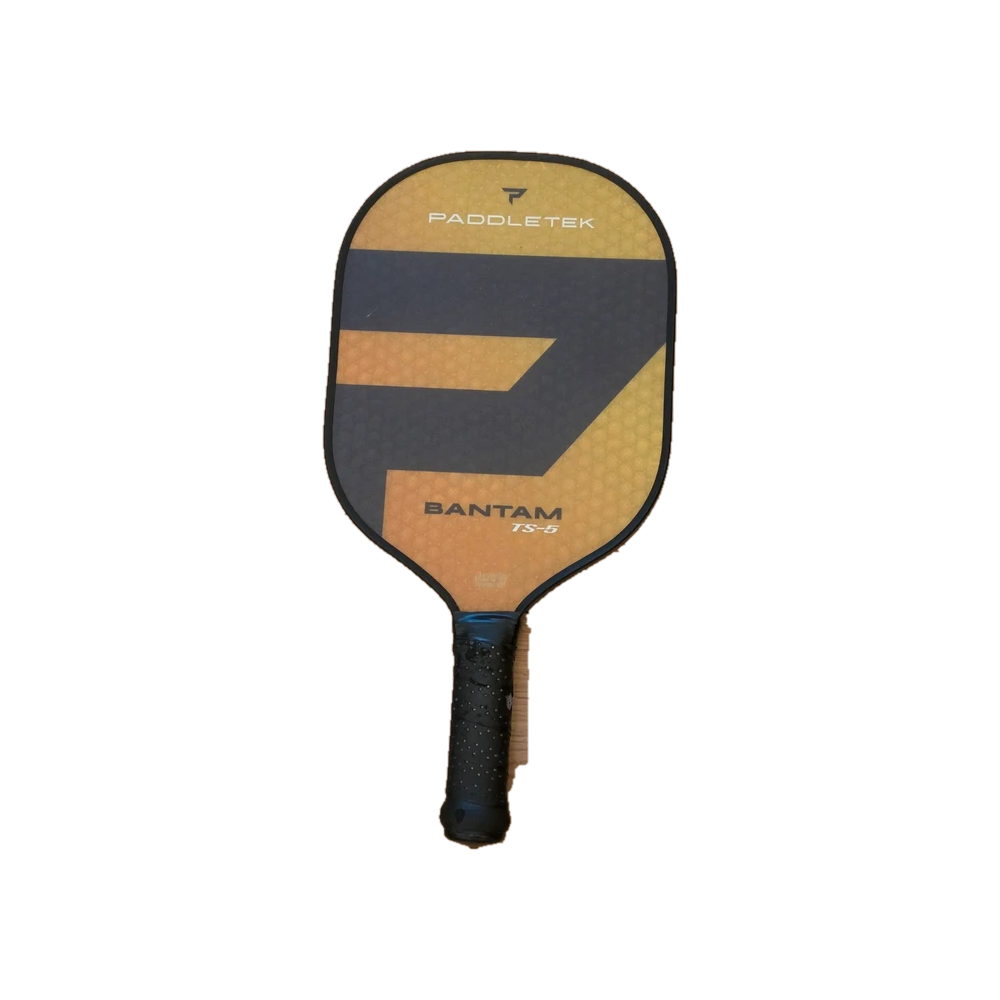
The genuine owner photograph shows an orange-yellow face with Paddletek lettering, black geometric horizon graphics, BANTAM TS-5 printed near the throat, a black edge guard and a black perforated grip. The background has been removed from one real photograph; the paddle itself was not artificially recreated. The original remains archived. The color is Horizon Yellow rather than Purple Aurora.
Paddletek’s TS-5 product page describes a 12.7 mm Bantam PolyCore, 7.0–7.5 oz manufacturer weight range, a 5-inch handle and a standard-shape paddle. Independent reviewer Brandon Mackie at Pickleheads also describes a fiberglass face with a polymer-honeycomb core. Exact dimension listings differ slightly: Paddletek calls the standard shape 16 × 8 inches, while Pickleheads lists 15⅝ × 7¾ inches. These are published product figures, not measurements of my own paddle.
This is the traditional fiberglass TS-5, not the thicker TS-5 Pro or the carbon-faced Bantam ALW-C 12.7mm I reviewed separately. Those differences matter when comparing grip, spin or power claims across generations and models.
My test conditions and the $89.99 I paid
I selected 16–30 hours of actual play, in ordinary indoor doubles club matches with indoor pickleballs. I bought the paddle for $89.99 in September 2026, with no discount and no sponsor relationship. I did not log an exact number of sessions or identify the ball manufacturer, venue, official player rating or paddle weight. I also did not report changing the grip or adding weight tape, so this article does not invent a customized setup.
For separate pricing context, Paddletek currently displays $89.99 for its TS-5. That happens to match what I paid, but it is not evidence of a live Amazon offer or availability in the specific Horizon color. My $89.99 is an actual owner-reported historical purchase, not a derived market estimate.
Speed at the kitchen: why the low weight mattered most
The TS-5’s light feel was immediately useful in indoor doubles. I experienced fast reactions at the kitchen, good balance and easy paddle movement during counters. When an opponent drove a ball hard at me, I could get the paddle into position and block accurately. Fast positioning and good shot placement were separate strengths; the paddle did not require a heavy-feeling swing just to meet the ball.
I also found that longer sessions were less tiring for my arm with this lightweight setup, and I did not experience hand or wrist pain during my reported play. That is a statement about my personal comfort, not a medical claim about tendon injuries or treatment. I did not weigh my own paddle, so I cannot assign a specific number of grams to the comfort difference.
Power: good sideline shots, but I had to generate the speed
These two observations may look contradictory, but describe different situations. I could produce good, powerful-looking shots along the sideline when I chose to attack. However, I also found that I needed a harder swing to generate sufficient pace. The TS-5 did not give me the same maximum power I associated with heavier high-end paddles.
In my own separate playing experience, shots with the TS-5 also had less depth than with the CRBN-3X Power. I am not claiming a measured ball speed, an exact return distance, an identified CRBN specification, or a controlled same-day experiment; this is my qualitative comparative judgment. My returns sometimes fell short against stronger players even when I felt that my placement was generally good.
A useful buying distinction follows: being able to hit hard when I supply a full swing is not the same as effortless high-end put-away power. Players who value fast hands and well-placed shots may accept that compromise. Players who expect a paddle to add substantial pace on a small swing should compare it with modern power designs before buying.
Dinks, drops and serves: control was the main attraction
My dinks were easy to place, and I could land ordinary third-shot drops accurately. Serve placement was another positive, especially compared with the cheaper beginner set I had used previously, where my serves had not felt as successful. I took to the TS-5 almost immediately rather than needing a long adjustment period.
That does not mean every touch shot was equally easy. I also said that advanced third-shot-drop placement was less precise than with modern control paddles. The distinction is about shot complexity, not conflicting opinions: basic drops were dependable for me, while more exacting touch shots exposed limits. I did not report controlled success rates or that I failed all difficult drops.
Spin: usable rotation, but below modern raw-carbon paddles
I could put useful spin on the ball, so I would not describe the TS-5 as incapable of rotation. But compared with more recent textured raw-carbon paddles, I could generate less topspin. When I attempted especially hard topspin drives, some balls sailed long instead of dipping as much as I wanted.
One specific comparison I personally selected was less spin than the Six Zero Double Black Diamond in my separate playing experience. That is useful relative context, not a measured RPM comparison. I did not specify a particular Double Black Diamond thickness or testing day, and I am not attributing another reviewer’s laboratory numbers to myself.
The paddle spin, grip and surface-friction guide explains why surface roughness and perceived spin are not the same as repeatable RPM data. Based on my experience, the TS-5 had adequate everyday spin but fell short when I tried to play the more aggressive topspin game that some newer paddles enabled.
Sweet spot and forgiveness: very few mishits
The TS-5’s sweet spot felt large, and I had very few mishits across my reported indoor play. That was a clear strength independent of its modest maximum power. A forgiving face helped me make regular contact during doubles exchanges and supported the confidence I had in routine blocks and placement.
I did not map the location of the sweet spot, measure off-center ball speed or quantify twistweight. A large felt sweet spot does not prove perfect edge-hit stability, but I had not selected complaints about twisting or harsh vibrations for this paddle, so I am not inventing them.
Grip, impact feel and comfort: pleasant, if a little bulky
The grip had a comfortable feel when I held and used the TS-5, while also feeling somewhat thick or bulky. Those can coexist: I liked how the grip contacted my hand without considering its circumference ideal. I did not say I replaced it or measured its circumference.
On contact, the ball came off the face quickly, but the overall impact still felt pleasant. I did not experience hand or wrist discomfort in my own sessions. I am not interpreting that as evidence that the paddle prevents injuries, eliminates vibration, or works identically for players with different hand sizes.
Build quality after 16–30 hours: favorable, but no long-term claims
My selected durability observation was simple: the TS-5 felt better built than cheap starter paddles. I did not report a measured change in surface roughness, edge-guard wear, grip failure, internal core damage or a specific lifetime. With a 16–30-hour test I can report construction feel, not promise years of durability or zero defects.
The original image documents the actual Horizon color and physical paddle, but any visible cosmetic marks cannot be translated reliably into hours of use. I have not used the photo to manufacture a longer test or a performance claim.
My comparisons with CRBN-3X, Six Zero and the other Paddletek
| Paddle | My own reported comparison | Limit of this evidence |
|---|---|---|
| CRBN-3X Power | I got less shot depth with the TS-5. | I supplied no measurements or same-day controlled comparison. |
| Six Zero Double Black Diamond | I produced less spin with the TS-5. | No RPM readings or precisely identified Six Zero configuration. |
| Cheap beginner set | My TS-5 serves were better and the construction felt superior. | The beginner-set brand and specifications were not provided. |
| Paddletek Bantam ALW-C 12.7mm Pink | See my separate first-hand review for its faster offensive feel, pop and more demanding soft game. | This questionnaire did not establish an overall TS-5-versus-ALW-C winner. |
These differences also explain my review score. A comparatively affordable, light and forgiving TS-5 can be a genuinely good first serious paddle while a player with more offensive goals might later prefer a carbon-faced, harder-hitting model. A comparison on one property does not automatically establish a universal winner. For another independently purchased Paddletek tested in indoor doubles, see my Bantam EX-L Pro Riptide Blue first-hand review. It reports lively pop and fast reactions but a narrow-feeling sweet spot; this is a separate owner’s test, not a controlled TS-5-versus-EX-L Pro comparison.
Why I gave it 4.0 out of 5
Four stars was the overall rating I explicitly chose after my 16–30-hour test. It is not an average of outside customer ratings or an AI-generated attempt to estimate my preference. The editorial judgment below translates my actual answers into the reasoning behind those four stars. I did not give separate numerical subratings, so I will not claim I did.
| Criterion | Evidence from my test | Editorial reading |
|---|---|---|
| Handling and reaction speed | Light, balanced, easy counters and accurate blocks | Clear strength |
| Routine touch and serve placement | Precise dinks, basic drops and serves; fast adjustment | Clear strength |
| Forgiveness | Large sweet spot, very few mishits | Clear strength |
| Maximum power and depth | Good sideline shots with effort, weaker depth than CRBN-3X | Important limitation |
| Spin | Useful spin, but some drives long and less than Six Zero DBD | Important limitation |
| Comfort and early build feel | Comfortable but thick grip; lower fatigue; solid construction impression | Positive with caveat |
Pros, cons, four filled stars and the Product/Review structured-data rating all use 4.0/5. I have not manufactured a decimal subscore formula or instrument readings to make the rating look more objective than the owner evidence permits.
Who I would buy the Bantam TS-5 for
Based on this test, I think the TS-5 is an excellent candidate for someone’s first serious pickleball paddle, especially if they value maneuverability, reliable contact, accurate basic touch shots and a lighter feel. That is the recommendation I expressly selected after playing with it, rather than a claim about how every beginner will perform.
I would caution players who want maximum drive depth, deep returns against hard hitters, or advanced spin-heavy offense that the paddle asked me to provide more swing effort and still fell behind selected modern premium paddles. I also tested only indoor doubles, so I cannot claim equivalent behavior with a specific outdoor ball or in singles competition.
What other reviewers said — clearly separate from my test
External context only: Brandon Mackie’s independent Pickleheads hands-on review (September 2023) also describes quick handling, a forgiving sweet spot and precise routine touch, alongside limited power and spin at more advanced levels. The Paddletek TS-5 product page includes customer feedback from Susan C. about handling and Jeanne S. about light weight and spin. These independent and customer reports may involve TS-5 examples in other or unstated colors. They are not proof of my shot results, 16–30 hours, or $89.99 purchase. The TS-5 Pro and newer ALW-C are distinct models.
FAQ
Is the Paddletek Bantam TS-5 worth $89.99?
I bought it for exactly $89.99 without a discount and personally rated it 4/5. In my indoor doubles experience, the easy handling, control and forgiveness justified a positive recommendation as a first serious paddle, with acknowledged limits on power and spin.
Is the TS-5 better for control or power?
For me, routine control stood out more. I placed dinks, standard third-shot drops and serves precisely. I could hit forceful sideline shots but needed a stronger swing and missed some depth versus a heavier premium power paddle.
Does the TS-5 generate topspin?
Yes, I found useful spin, but not the same amount as with a modern raw-carbon paddle such as the Six Zero Double Black Diamond in my own separate experience. Some hard topspin drives sailed long.
Is the handle comfortable?
In my test it felt comfortable and I reported no hand or wrist pain, although the grip circumference struck me as a little thick. I did not measure or alter the grip.
How does this differ from the TS-5 Pro or ALW-C?
My Horizon Yellow is the original-style TS-5 fiberglass 12.7 mm, not the 14.3 mm TS-5 Pro or the carbon-faced ALW-C. These names should not be treated as interchangeable when shopping or reading reviews.
Evidence and independence: All statements about my own performance reflect selected owner-reported experiences from 16–30 hours of indoor doubles. I did not claim controlled testing, an injury benefit, extended durability, a guaranteed Amazon offer, or precise measured weight. Product specifications and other reviewers’ findings are explicitly sourced and kept separate. The single product image is a background-removed real owner photo.

Jonathan Grøn created The Pickleball Wise. He coaches beginner pickleball players and captains a pickleball team in Series 2. He combines on-court experience with official rules and coaching resources to write practical guides on doubles strategy, skills, and training.