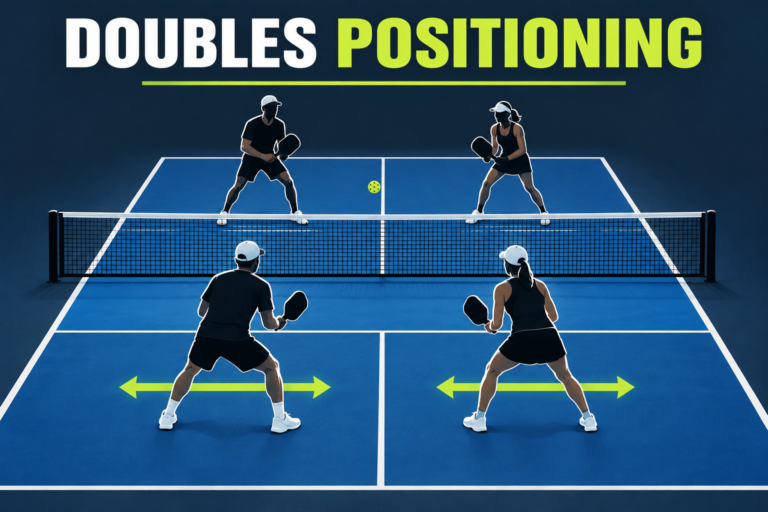
Pickleball Poaching in Doubles: When to Go
Poaching in pickleball doubles means one partner deliberately crosses into space the other partner would normally cover to intercept a ball. A good poach is not “taking your partner’s shot.” It is a coordinated decision that gives your team a better contact while the partner is ready to cover the space you leave behind.
USA Pickleball includes effective poaching among higher-level doubles strategy skills, alongside stacking, resets, counterattacks, and coordinated partner movement. The important word is effective: the shot only helps if the interception and the team’s next position are both better than simply letting your partner play the ball.
Use the PERMISSION → TRIGGER → COVER test
1. PERMISSION: Does your partner understand the move?
A planned poach should be discussed before the point. An opportunistic poach still needs an established partnership rule such as “mine,” “go,” or a clear expectation about who covers the vacated side. Surprise the opponents, not your partner.
2. TRIGGER: Is this ball actually better for you?
Look for a predictable or attackable ball: a return likely to travel through the middle, a higher ball you can contact in front, or a situation where your partner is still back and your forward position lets you intercept cleanly. Do not cross simply because you can reach the ball.
3. COVER: What happens if the ball comes back?
Every poach opens space. Know whether your partner will switch behind you, whether you will recover to your original side, or whether the poach is intended to finish the point. If neither player knows who owns the next ball, the first contact was not enough.
The best poach is usually created before the ball arrives
Poaching works better when you read a pattern than when you chase a ball after it has already crossed the net. Watch the opponent’s court position, paddle preparation, and previous choices. If your partner’s shot has limited the opponent’s likely reply, you can begin moving before the ball is obvious.
This is one reason planned poaches are easier to learn. You and your partner can deliberately create the trigger—for example, a serve or return pattern that encourages a predictable reply—rather than improvising a full-court crossover during a neutral rally.
A high-value poach situation: partner back, you forward
DUPR highlights a common opportunity when one partner is still back and the other is already established forward. If the opponent sends a reachable ball toward the deeper partner, the forward player may be able to intercept it earlier, remove reaction time, and prevent the opponents from repeatedly targeting the player who is still transitioning.
But the interception should still pass the trigger test. If reaching the ball pulls you far off balance or exposes an easy open court, staying home may be better. The aim is to improve the team’s position, not merely touch more balls.
Poach higher, more attackable balls—not every middle ball
A ball you can contact comfortably in front and above a low defensive contact gives you more options to redirect or attack. A low stretched poach often does the opposite: it pulls you out of position to play a ball your partner may have handled more comfortably.
This connects to the same contact-height logic used in the counter guide. Being aggressive is useful when your balance and contact point support aggression. Crossing farther does not make a poor contact better.
Planned poach vs. opportunistic poach
A planned poach is called before the rally. Both partners know who will cross and who will cover. This is useful when you have identified an opponent’s return pattern or want the more aggressive net player to hunt a predictable ball.
An opportunistic poach develops during the rally. You read a weak or predictable ball and cross because your contact is clearly stronger than your partner’s likely contact. It requires better anticipation and faster communication because the coverage plan was not pre-set.
If you and your partner are still learning basic doubles positioning, start with planned poaches. They make the cause-and-effect easier to see.
Where should you hit the poach?
The target depends on your contact. If you intercept high and balanced, attacking into open space or at the feet of a moving opponent can be effective. If the ball is lower, prioritize control and keep the next opponent contact difficult rather than forcing a winner.
One useful option is hitting behind the opponent who has begun moving to cover the middle. Another is using the middle itself when both opponents are moving and responsibility is unclear. The target should come from opponent movement, not from a fixed “always poach here” rule.
The recovery rule most poaching advice skips
After you cross, make an immediate team decision: switch, recover, or finish.
Switch: your partner fills the side you vacated and you stay on the new side.
Recover: you intercept the ball but move back toward your original position because the rally remains neutral.
Finish: the poach produces such a strong attack that both players hold ready positions for a likely weak reply rather than immediately racing back to preset sides.
The worst option is leaving the decision unspoken. Two players chasing the same next ball—or both abandoning the same sideline—is how a successful first poach turns into a losing second contact.
A simple two-player poaching drill
Start with one partner at the Kitchen and one partner a few steps deeper. A feeder sends balls mostly toward the deeper player, mixing neutral balls with occasional higher or more central balls.
The forward player must call stay or go before crossing. After every “go,” both partners must also call switch or recover immediately after the poach. Score the drill on three decisions: Was the poach justified? Was the contact controlled? Did both partners cover the next space correctly?
This turns poaching into a teamwork skill instead of a reflex to grab the ball.
The main takeaway
A strong poach has three parts: your partner understands the move, the incoming ball gives you a genuinely better contact, and both players know how the court will be covered afterward. If one of those is missing, staying in position is usually the cleaner choice.
Use poaching to create coordinated pressure—not to prove which partner can reach the most balls.
Related doubles strategy
Poaching works best when it is supported by clear partner communication and sound court coverage. Teams that want predictable left-right roles may also combine those ideas with stacking.
Poaching drill progression
Good poaching practice should reward the right interception, not the player who crosses the court most often. A useful drill progression teaches the pair to recognize a trigger, communicate the move, intercept in balance and cover the space that opens afterward.
This is the practice companion to our pickleball poaching guide, which owns the strategy, triggers and target choices. Here the progression is CALL → READ → GO → CONTACT → COVER → DISGUISE → TRANSFER.
What to score in poaching drills
Score four layers separately: decision (was the poach justified?), movement (did the player arrive balanced?), contact (did the interception improve the rally?) and coverage (did both partners handle the space afterward?). A winner from a poor decision should not automatically count as a perfect rep.
Drill 1: Stay or go?
Put one player at the Kitchen and the partner a few steps deeper. A feeder alternates between balls the forward player should leave and higher or more central balls that create a clear interception. The forward player calls stay or go before moving.
Do not score the shot yet. Score only whether the player correctly identified a ball that offered a better contact than the partner was likely to have.
Drill 2: Cross, contact and freeze
Use predictable attackable feeds. The poacher crosses, intercepts the ball and freezes immediately after contact. Check balance, spacing and whether the player crossed only as far as needed.
If the player is falling sideways or cannot recover, reduce the crossing distance. A poach is valuable because it improves the team’s contact; reaching more court is not the goal.
Drill 3: Switch or recover?
After every poach, both partners must immediately call switch or recover. On switch, the partner fills the vacated side. On recover, the poacher returns toward the original side while the rally stays neutral.
Run the movement for one extra ball so the call has a consequence. This connects directly to the communication habits in our doubles communication drills.
Drill 4: Poach or fake?
The forward player may either cross or show an early step toward the middle and stay home. The feeder or opponent plays the next ball live. The goal is to learn that pressure can come from movement without committing to every interception.
Keep the fake small enough that the player can still protect the sideline. This stage adds uncertainty without turning the drill into random movement.
Drill 5: Target after the poach
Give the poacher two large targets: open space behind a moving opponent and a controlled middle/feet target. Call the target before contact. If the poach arrives low, prioritize control rather than forcing a winner.
The purpose is to connect the interception to opponent movement. A high balanced contact may support aggression; a lower contact should still make the next opponent ball difficult.
Drill 6: Random poach plus next ball
The feeder now mixes stay balls, poach balls and balls that punish an overcommitted crossover. After any poach, play at least one more ball. Score the rep only if the initial decision and the team’s next coverage are both functional.
This prevents the common training error of ending the rep as soon as the poacher touches the ball. Opponents may defend the interception or exploit the vacated space.
Drill 7: Live planned and opportunistic poaching
Play doubles points in two rounds. In round one, the serving or receiving team may call one planned poach before the point. In round two, remove the call and allow only opportunistic poaches created by the rally.
Award a bonus point for a justified poach followed by correct coverage, not merely for winning with the interception. If players begin forcing the bonus, remove it and play normal points. The behavior should survive without the scoring incentive.
Troubleshooting
| Problem | Return to |
|---|---|
| You cross on balls your partner could handle better | Stay-or-go recognition |
| You lose balance after crossing | Cross, contact and freeze |
| Both partners cover the same side afterward | Switch-or-recover calls |
| Opponents read every move | Poach-or-fake |
| You intercept well but choose poor targets | Two-target poach |
| The open sideline gets exposed | Random poach plus next ball |
| Poaching disappears or gets forced in matches | Live planned-to-opportunistic points |
A simple 20-minute poaching session
- 3 minutes: stay-or-go calls.
- 3 minutes: cross, contact and freeze.
- 4 minutes: switch-or-recover plus one extra ball.
- 4 minutes: poach-or-fake with live target choice.
- 6 minutes: live planned and opportunistic poaching.
This is an editorial practice template, not a validated training dosage. Adjust the volume to your level and available players. For broader partner work, use our two-person pickleball drills; for court ownership principles, see doubles positioning.
The progression
CALL → READ → GO → CONTACT → COVER → DISGUISE → TRANSFER. Establish shared language first, learn which balls justify the move, cross only as far as needed, make a controlled contact, solve the open space, add fakes and finally let the poach emerge from live patterns.
Sources
USA Pickleball: Skill Level Four — partner movement, stacking and effective poaching within advanced doubles strategy.
DUPR: When to Poach in Pickleball? — practical poaching situations and decision-making context.

Jonathan Grøn created The Pickleball Wise. He coaches beginner pickleball players and captains a pickleball team in Series 2. He combines on-court experience with official rules and coaching resources to write practical guides on doubles strategy, skills, and training.