Pickleball Net Rules: Ball, Posts & Net System (2026)
In pickleball, a ball that touches the net or the top rope/cable between the posts normally stays live if it crosses legally. Net posts and support hardware are different: they can be permanent objects or trigger specific replay rules. A player touching the net system while the ball is live is a fault.
The useful way to understand the rule is not “did something touch the net?” but what part of the net system was touched, by what, and when? This guide uses the current 2026 USA Pickleball Official Rulebook, especially Section 13, plus the official 2026 rule-change document.
Pickleball net rules at a glance
| What happens? | 2026 ruling | Why |
|---|---|---|
| Ball clips the net between the posts and crosses | Play continues | The playable net/top cord between the posts remains live |
| Serve clips the net and lands in the correct service court beyond the NVZ | Play continues | There is no automatic service-let replay |
| Ball strikes a net post before landing in the opponent’s court | Hitter loses rally | The post is a permanent object |
| Ball legally bounces in the opponent’s court, then reaches a permanent object such as a post before being returned | Receiver loses rally | Rule 10.C.5 applies after a legal bounce |
| Returned ball crosses and contacts an in-court crossbar/support covered by Rule 13.B.2 | Replay | Specific net-support replay rule |
| Player, paddle, clothing or carried item touches the net/support while ball is live | Player fault | Live-ball player contact with net system is prohibited |
| Ball travels around the outside of the post | Can be legal | An ATP does not have to pass over the net |
| Ball is hit between the net and post, or under the net | Hitter fault | Those paths are specifically prohibited |
1. A net-cord ball normally stays live
Rule 13.A treats the net itself and the rope or cable at the top between the net posts as playable. If a rally ball clips that part of the net, crosses, and otherwise remains legal, keep playing.
The same basic principle applies to a serve. Under the 2026 serving rule, the served ball may touch the net as long as it clears the opponent’s Non-Volley Zone and lands in the correct service court. USA Pickleball confirms that wording in its 2026 Rulebook Change Document.
That means a tennis-style “let” call is the wrong default. If the serve clips the tape and lands legally, the receiver should play it. For the rest of the service requirements, see our pickleball serving rules.
2. The net post is not treated like the playable net
Net posts and their connected support structures fall under the permanent-object/net-support rules rather than the ordinary live-net rule. This distinction matters because the result can change depending on whether the ball has already bounced legally.
A notable 2026 clarification changed the old blanket “ball hits post, hitter loses” approach. Rule 10.C.5 now says that when a ball has already bounced in a player’s court and then contacts a permanent object before that player returns it, the fault is against the player who failed to return it. USA Pickleball’s own example is a ball that crosses, lands in the opponent’s court and then—because of spin or wind—touches the net post. The player who hit the shot wins that rally. See entry 2070, “Net Post Winner,” in the official 2026 change document.
3. Crossbars and portable-net supports have a special replay rule
Portable nets create a case that ordinary “permanent object” logic does not fully describe. Rule 13.B.2 provides a replay when a returned ball crosses the net and contacts a crossbar or another part of the net support system within the court boundaries.
This is why it is risky to memorize “ball hits hardware = fault.” The exact hardware and location matter. A post outside the playing area, an in-court center support and the playable net material do not all produce the same result.
There is also an awkward edge case in the 2026 text: Rule 10.C.5 says a receiver faults if a legally bounced ball reaches a permanent object before being returned, while Rule 13.B.2 expressly describes a replay for certain in-court net supports before or after a bounce. A 2027 rule-change proposal was submitted to clarify that interaction, which is evidence that the current wording is not perfectly clean. In a sanctioned event, let the referee/event interpretation control that rare scenario rather than inventing a house ruling.
4. You may hit around the post—but not through the gap or under the net
Rule 13.C allows a return around the outside of the net post. An around-the-post shot can travel below net height because it does not need to cross over the top of the net. Our pickleball ATP guide covers when that geometry becomes available.
That does not make every path near a portable net legal. The 2026 rules separately prohibit hitting the ball between the net and the net post and prohibit hitting it under the net. Those are faults against the player who hits the ball.
5. The ball must cross the plane of the net before you hit it
Rule 13.F requires the ball to cross entirely to your end of the net before you make ordinary contact. You cannot reach across and intercept an opponent’s shot while it is still on their side.
After a legal hit, your paddle or body may cross the plane as part of the continuation of that stroke, provided you do not commit another fault by touching the net system, the opponent or the opponent’s court while the ball is live.
There is a special exception when a ball bounces on your side and then spin or wind carries it back across the net without being touched. Once the ball has crossed completely back to the opponent’s side, the rules allow you to reach over, under or around to return it—while still avoiding the net and opponent’s court.
6. Touching the net system while the ball is live is a player fault
A player does not get the same freedom as the ball. If you, your paddle, clothing or something you are carrying contacts the net or its support system while the ball is live, the current rules treat that as a fault.
This often matters on Ernes, ATP attempts and balls pulled sharply toward the sideline. The shot can be spectacular and still be lost if the player brushes the net or support system before the ball is dead. See our Erne guide for the related Non-Volley Zone and landing requirements.
A five-step net ruling check
- Was it the ball or a player that made contact? Player contact with the live net system is a fault; ball contact needs the remaining checks.
- What did the ball touch? Playable net/top cord, post/permanent object, or an in-court crossbar/support?
- Had the ball crossed the net legally? A return must cross as required before special support rules can apply.
- Had it already bounced in the receiver’s court? That timing can change which side is at fault under Rule 10.C.5.
- Does a specific replay rule override the normal fault result? In-court support contact and certain net malfunctions have explicit replay provisions.
This decision order is more reliable than the shortcut “anything that touches the net is a let” or “anything that touches a post is automatically the hitter’s fault.” Both shortcuts miss current 2026 exceptions.
Net rules vs net dimensions
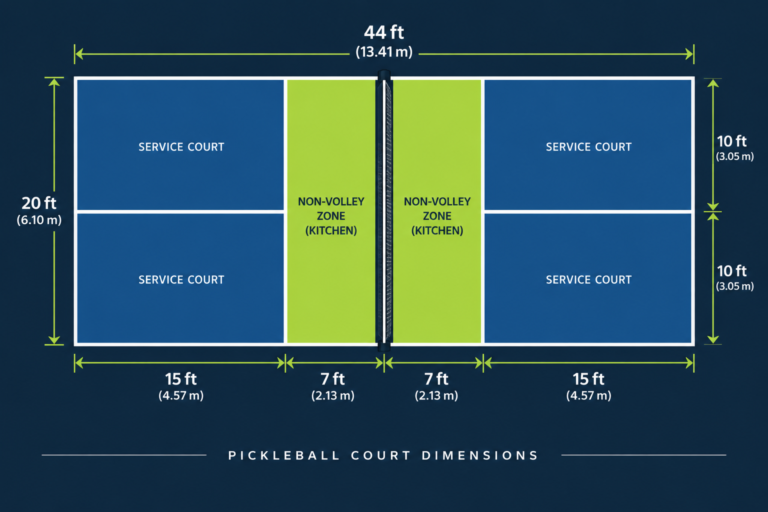
This article is about what happens during play when the ball or player interacts with the net system. If you are looking for the official height, width and court measurements instead, use our pickleball court dimensions guide.
Sources & Further Reading
- USA Pickleball — Official Rules hub and 2026 Official Rulebook
- USA Pickleball — 2026 Rulebook Change Document

Jonathan Gron is a pickleball player and racket-sports enthusiast who focuses on practical doubles strategy, rules, skills, and training. He combines regular on-court experience with research from official rules, coaching resources, and other authoritative sources to create clear, useful pickleball guides.