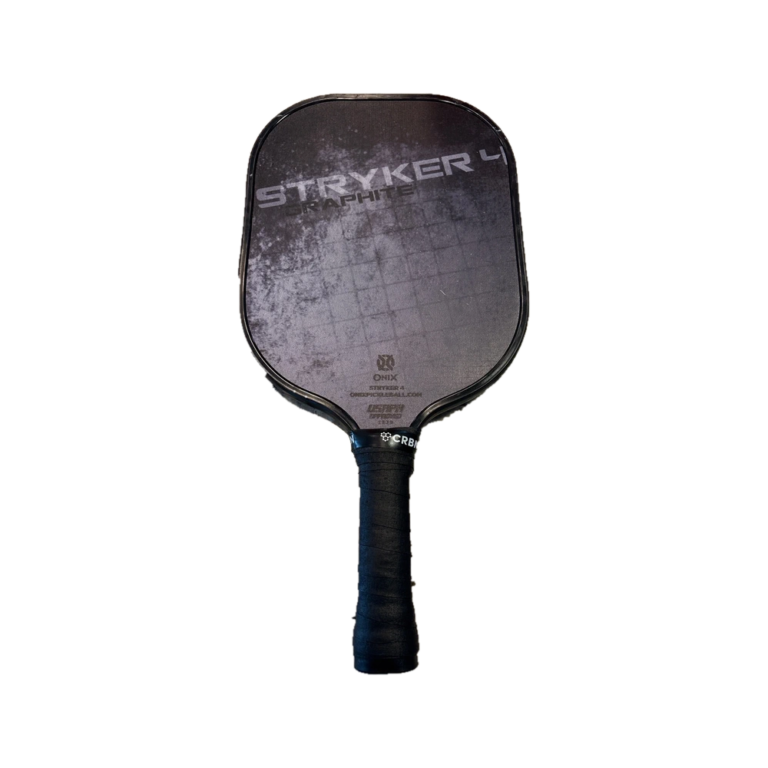
Babolat RBEL Touch Review: My 16–30-Hour Test (4.4/5)
My Babolat RBEL Touch review (original blue/white 14mm model): I bought this exact paddle new at the ordinary selling price of $59.95 USD in July 2026, and I personally played with it for approximately 16–30 hours. I used it for drills and informal recreational games, mostly with indoor pickleball balls on hard-court surfaces against players of about my own ability. My main positive observations were quick handling, precise placement, very good general control, comfortable soft-shot feel, useful topspin and satisfying offensive power.
I also found the sweet spot relatively forgiving, liked the soft feel of the light-colored grip and experienced pleasant shock absorption on contact. I could reach low balls well with it. I had previously handled the Babolat MNSTR+ and found this RBEL Touch faster in the hand. My clear personal drawback is simpler: I did not like its blue appearance. That design reservation should not be mistaken for a performance defect.
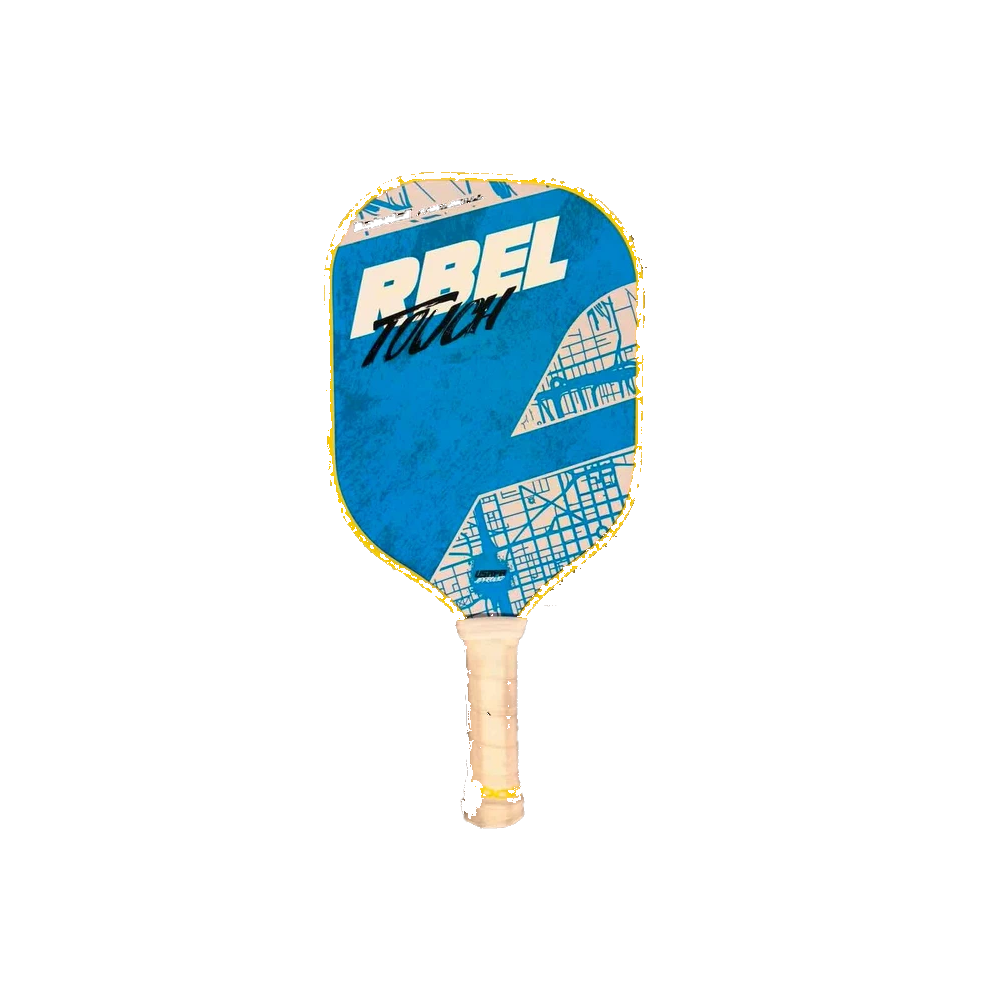
The original owner photo below shows the real turquoise-blue and white paddle with a bright yellow bumper and pale grip after several weeks of use. The background was removed without altering the product itself. I did not report whether the grip was factory original or later changed; the comfort judgment applies to the grip on the actual paddle I played.
Affiliate disclosure: As an Amazon Associate, ThePickleballWise earns from qualifying purchases. The clickable owner photograph and orange button below open Amazon.com search results for the original blue Babolat RBEL Touch using tag owlratings08-20. They are sponsored affiliate links and may earn a commission without additional cost to you. I could not independently verify a current exact blue Touch ASIN or live Amazon price, so they are explicitly marked SEARCH, not a direct product listing. The $59.95 figure was my own historical July 2026 purchase price, not an Amazon offer.
My verdict after 16–30 hours
The Babolat RBEL Touch was quick and comfortable in my hand, let me react rapidly at the net and offered the precise control I wanted for recreational play and drills. Its short-game feel was especially appealing, while topspin and offensive pace still felt useful rather than weak. Against the MNSTR+ I also handled, I preferred the Touch’s quicker feel in the hand.
I would recommend it to other players who value quick handling and accurate touch. The design itself did not appeal to me, and I cannot promise the same results for longer-term durability or a different player’s grip and court conditions.
Pros I personally confirmed
- Light, responsive feel and quicker reactions at the net
- Precise placements and very good overall control
- Comfortable, accurate short soft shots
- Satisfying offensive power and good topspin
- Relatively forgiving-feeling sweet spot
- Soft pale grip and pleasant impact absorption
- Helpful reach on low balls
Cons and evidence limits
- I disliked the blue appearance—an actual personal negative
- No controlled speed, spin, swingweight or sweet-spot measurements
- 16–30 hours without a functional failure cannot prove multi-season durability
- Exact current Amazon.com ASIN, seller and price for the original Touch are unverified
Bottom line
4.4/5 evidence-weighted editorial rating: a strong personal playing experience, especially for fast hands, placement and comfortable touch. The blue design is my documented downside. My own review supports the original 14mm RBEL Touch—not the RBEL Power or any newer RBEL model.
My actual test conditions: what this review covers
I played with this paddle for 16–30 hours, using it for stroke drills and informal recreational pickleball. My answers specify that I primarily used indoor pickleball balls on a hard-court / synthetic court surface with players at roughly my level. They do not specify the exact ball brand, venue, total number of sessions, temperature, skill rating or standardised shot count, and I will not invent them.
For clarity, I did not select either singles or doubles as an explicit match-format claim in my latest answer. The fact that other reviewers tested the RBEL series in both formats does not mean I did. And although the original model appears in the USA Pickleball approval database, I did not report entering a sanctioned tournament with it.
| Firsthand fact I reported | What I did not establish |
|---|---|
| Bought new at the normal selling price for $59.95 USD in July 2026 | The exact store, present-day price, discount history or current Amazon offer |
| 16–30 hours of drills and casual recreational play | Exact session count, singles/doubles split, sanctioned tournament use or multi-season longevity |
| Mainly indoor balls on hard-court surfaces, with similar-level opponents | Exact ball model, court location or measured environmental effects |
| Quick hands, accurate shots, touch, satisfactory power and topspin | Measured RPM, ball speed, swingweight or controlled accuracy percentage |
| Comfortable pale grip, forgiving sweet spot and good low-ball reach | Factory grip provenance, measured sweet spot or a medical outcome |
| No functional failure during my own test and photo after several weeks | Years-long face, grip, edge guard or core durability |
Quick hands: the biggest advantage I felt
The first quality I would mention to another player is the light, quick feel. When the ball came back fast, I found that the RBEL Touch helped me respond quickly during intense exchanges. I specifically noticed faster reactions near the net. This was consistent with how agile the paddle felt when I moved it through ordinary drills and casual points.
Those are related descriptions of one practical handling benefit—not three independent proof points for a test-lab speed ranking. I did not measure swingweight or time my reaction speed with a stopwatch. The conclusion is that I found this particular paddle easy to maneuver and responsive under the conditions I actually played.
I also personally compared how quickly this paddle moved in my hand with the Babolat MNSTR+ and found the RBEL Touch faster. That comparison is specifically about handling speed. I did not select a claim that this Touch had more power, higher RPM or greater forgiveness than the MNSTR+, so I will not quietly turn the faster-handling observation into a sweeping head-to-head victory.
The manufacturer’s reported average weight, around 7.6 oz (215 g), fits the light-oriented positioning of this original Touch model, but I did not physically weigh my unit. If you are choosing based on swing speed, remember that static grams alone do not describe balance or swingweight. Our 14mm vs 16mm pickleball paddle guide explains why construction and weight distribution matter as well.
Shot placement, soft control and the short game
I felt I could put the ball where I wanted and had very good overall control over the paddle. For shorter, softer shots I also had a pleasant, accurate feel. That combination made the Touch satisfying during my drill sessions and recreational games, when being able to steer the ball mattered as much as hitting hard.
I am deliberately keeping those claims at the level I actually reported. I did not answer specific prompts about third-shot drops, blocks or resets. It would be easy to write that those advanced patterns were all excellent, but I do not have personal evidence for them from this questionnaire. What I can say is that general placement and controlled short soft contact were strengths in my hands.
Unlike a manufacturer’s phrase such as “precision technology,” these observations come from the shots I actually hit. Still, they are not controlled hit-location statistics; my accuracy may depend on the day, the ball, opponents, court and how I adjusted my own strokes.
Power and topspin: enough for my offensive game
My experience was not limited to gentle touch shots. I specifically selected that the RBEL Touch gave me satisfactory power on offensive shots and that I could produce good topspin. So despite its light feel, it did not strike me as a paddle lacking useful attacking response during the recreation and drills I described.
The description “satisfactory power” is intentional. I did not claim that it was the hardest-hitting paddle I have ever owned. Some external reviewers think a heavier Babolat MNSTR has greater maximum power, but I did not provide a direct power comparison in my own answer. That separate opinion should not be attributed to my play.
Likewise, I did not conduct a measured spin test or track grit retention over hundreds of balls. Good topspin is a subjective, repeated play impression within my reported 16–30 hours, not a verified RPM count or proof that the surface will produce the same rotation after years of use.
Forgiveness, low balls and comfort
I found the sweet spot relatively forgiving. That describes the feel I had when making contacts rather than a mapped area measured across the paddle face. It worked well enough for my control-focused play that I did not experience a strongly unforgiving response in my own description.
The light-colored grip felt soft and comfortable, and I liked how pleasantly the paddle absorbed contact shock. These factors supported a comfortable overall experience, but I did not claim a tested effect on elbow pain or a medical condition. Other reviewers have discussed such possibilities; my own observation is simply impact comfort.
I also selected that the paddle helped me reach low balls. That is a firsthand gameplay observation, not a claim that its 16.1-inch listed length is longer than every competing model. Reach combines reaction time, physical positioning, blade orientation and the particular shots played.
One thing I have not established is whether the wrap seen in my photo is unchanged from the factory. I did not select the questionnaire’s option confirming a completely unmodified paddle. This review therefore says the grip I actually held was soft and comfortable rather than asserting that a precise factory Babolat grip construction caused the result.
What I disliked: the blue design
My clearest genuine criticism is cosmetic: I did not like the blue appearance. The photographed original is distinctly turquoise-blue with white graphics and a bright yellow perimeter. The look may appeal to many people, but it is not the style I prefer.
This is a legitimate negative in a first-person review even though it is subjective. It has a small 5% weighting in my editorial rating because playability, control and comfort matter more to me than the design. It would not be reasonable to invent performance faults just to balance this one actual criticism; conversely, it would not be reasonable to conceal it because the rest of the performance was good.
Did the paddle last during my test?
I reported no functional failures during my actual 16–30 hours of use. That’s encouraging for my particular sample, but this is not the same thing as a multi-year durability test. My photo was taken after several weeks of use; a photograph cannot independently determine my total playing hours or certify that a core, edge guard or grip will last indefinitely.
From the photo alone, neither a factory defect nor a precise wear history can be substantiated. I did not report measuring face roughness, testing for dead zones, inspecting internal core integrity or checking how the yellow edge guard responds after hundreds of hard impacts. Those things remain untested, not necessarily good or bad.
An unrelated owner, Patrick Voo, described a spray-painted and solvent-cleaned RBEL Touch that still worked for practice. That paddle had been modified and was deemed unsuitable for competition by its reviewer; it is not evidence that my photographed paddle was painted, that I modified mine or that the original approved model is inherently illegal.
My $59.95 purchase vs manufacturer and retailer prices
My purchase information is specific: $59.95 USD paid for a new RBEL Touch at its normal selling price in July 2026. It was the actual cost of my unit. I did not provide the store name or a separate checked answer saying “great value for the price,” so I am not putting a stronger value-for-money claim in my mouth.
For historical context, Dick’s Sporting Goods shows the original blue/white Touch with a $119 reference price and $59.50 sale price, currently listed unavailable there. That happens to be close to what I paid, but it is a separate retailer price, not a record of my transaction. Other retailers may show different prices or sold-out inventory, and old listings can remain indexed long after stock has disappeared.
The current exact Amazon.com ASIN and live Amazon selling price for the original blue/white Touch could not be verified. Consequently, the linked Amazon.com model SEARCH results are a safer destination than a guessed direct listing. Check the full model name, 14mm thickness, blue/white graphics and seller before purchasing, especially because RBEL Power and newer RBEL paddles are not the exact item reviewed here.
Original RBEL Touch 14mm specifications: external data, not my measurements
The specifications below come from product listings and the independent USA Pickleball equipment database. They give shoppers useful context, but I did not measure my particular paddle’s thickness, mass, surface materials or grip dimensions.
| Property | Published original RBEL Touch specification |
|---|---|
| Model / older retailer style | Babolat RBEL Touch · 160004 / 160004Z (retailer catalogue identifiers) |
| Core thickness | 14 mm (0.55 in) |
| Average empty paddle weight | Approximately 7.6 oz / 215 g ± 5 g |
| Size | Approximately 16.1 in long × 7.8 in wide |
| Grip length | 5 in; grip circumference listed around 4 in |
| Face material | Manufacturer/retailer catalogue: 65% carbon fiber, 35% fiberglass composite |
| Core material | EVA-enclosed polypropylene honeycomb |
| Design | Blue/white face graphics, yellow edge bumper and light grip |
| USA Pickleball model record | RBEL Touch · 14mm · carbon/glass · polypropylene honeycomb · Pass · added 20 December 2019 |
Source checks: Dick’s exact older blue/white 160004Z listing, TennisRacquets original 160004 listing, and USA Pickleball approved-paddle entry.
The approval database entry confirms that a model with this name and construction was recorded as passing in 2019. It does not prove every individual used paddle is unchanged, that my unit was independently inspected for competition, or that older certification is a permanent guarantee under any future rule change.
What other real players thought (not my results)
External hands-on reports help put the original RBEL Touch into context, but they are not part of my playing time or 4.4/5 scoring calculation.
In InPickleball’s panel review, Katherine Hedden discussed good control, comfortable shock absorption and useful power, while Jamie Elliott reported a soft grip and favorable control on low shots, including from a wheelchair. Those are specific experiences from other players with different circumstances; I cannot claim to have tested from a wheelchair.
A Pickleball Superstore buyer account signed J.S. quotes his wife describing the exact RBEL Touch as light, controllable, helpful for her dinking accuracy and good for spin while still retaining satisfying smashes. Because she is the player, her reported experience should not be falsely attributed to the purchaser as his own on-court test.
Mason Kelley at Pickleballogist describes his own two-week RBEL test and highlights quick handling and a forgiving feel. He also considers the older MNSTR to have greater maximum power and dislikes the blue look. My personal comparison with the MNSTR+ is limited to quicker handling; I did not copy Kelley’s power comparison into my verdict. His technical discussion also uses loose “foam core” wording, while the published exact Touch specifications identify an EVA-enclosed polypropylene honeycomb core; I use the specific catalogue information rather than treating inconsistent review terminology as a measurement.
These outside accounts broadly agree that the original Touch appeals to control- and speed-oriented players, while leaving room for individual taste and trade-offs. Their reported impressions neither inflate my rating nor establish the exact conditions of my test.
Transparent method: how my 4.4/5 editorial rating was calculated
This is an editorial overall rating calculated from the owner’s documented firsthand answers, not an overall star score the owner selected and not an aggregate of online customer ratings. The initial questionnaire allowed multiple statements per theme. I grouped overlapping statements into independent buyer-relevant criteria before assigning weights, so “light,” “quick at the net” and “quick reaction” are not counted three times.
| Actual firsthand criterion | Weight | Editorial subscore | Weighted points |
|---|---|---|---|
| Quickness and court handling Light and quick in my hand; quicker reactions in intense exchanges and at the net; faster handling than the MNSTR+ I also used. |
25% | 4.6/5 | 1.150 |
| Placement, control and soft touch I could place balls precisely, liked overall control and had a comfortable, precise feel on short soft contacts. |
25% | 4.6/5 | 1.150 |
| Attacking power and topspin I generated good topspin and found offensive hitting power satisfactory, without a measured power or spin-speed comparison. |
25% | 4.3/5 | 1.075 |
| Comfort, forgiveness and low-ball play The light-colored grip was soft, the paddle absorbed impact comfortably, its sweet spot felt forgiving and it helped me reach low balls. |
20% | 4.5/5 | 0.900 |
| Personal aesthetic appeal I explicitly did not like the blue design, despite liking the paddle’s on-court performance. |
5% | 2.5/5 | 0.125 |
| Total | 100% | 4.400 → 4.4/5 | 4.400 |
Complete calculation: 4.6 × 25% + 4.6 × 25% + 4.3 × 25% + 4.5 × 20% + 2.5 × 5% = 4.400/5 → 4.4/5. Five-star graphic fill = 88%. The card, this summary, SEO metadata and Product/Review structured-data rating all use 4.4/5.
I kept the appearance objection as an actual minor negative. The good general recommendation is a cross-check on my positive playing experience, not another bonus category. My absence of functional failures during 16–30 hours does not create a scored long-term-durability category; neither do the prices I did not explicitly judge for value. I also did not assign a neutral score to any unselected question or use other reviewers’ impressions as my own.
Related model: my separate 2023 RBEL test
I have also used and reviewed the Babolat RBEL 2023 blue/black/yellow 14mm in a separate short doubles test (1–5 hours). That is not the older blue/white RBEL Touch reviewed on this page. In the 2023 review I described quick handling and good dink control and disliked its blue design. I did not provide a direct RBEL 2023-versus-Touch ranking, so the two articles should not be described as a controlled head-to-head comparison.
Separate original RBEL Power review
For the heavier sister model, I have also published my Babolat RBEL Power original 160003 14mm firsthand review. During 6–15 hours of doubles I liked its forceful drives and solid dinks, but felt the weight after longer exchanges and disliked the bulky yellow edge guard. This is not the blue/white RBEL Touch tested on this page, and it is not a same-day controlled head-to-head comparison.
Related BALLR+ 16mm firsthand review
I have also reviewed the distinct Babolat BALLR+ black/blue 16mm model 160022-100 over 6–15 hours. Its control-focused, spin-friendly and soft-shot feel and longer two-handed grip were positives for me. This is not the older RBEL Touch 14mm tested here, and I did not conduct a controlled head-to-head of the two models.
Who this original Babolat RBEL Touch suits best
Based on how it actually played for me, I would recommend the original RBEL Touch to players who prioritize quick reactions, deliberate ball placement, soft contact feel and an easy-to-handle paddle, but still want satisfactory offensive pace and useful topspin. My 16–30 hours give me more confidence than a couple of swings in a shop, although they are still not evidence for years-long durability.
I’d be less enthusiastic about recommending it purely for its blue styling—because I personally disliked the look—or to someone who expects evidence of maximum measured spin/power across all current premium paddles. And I would not tell a reader that my favorable result with this original model proves that a newer Babolat RBEL or the heavier RBEL Power behaves identically.
For a broader selection of genuinely tested paddles, see our Best Pickleball Paddles guide, whose original seven-paddle ranking is kept distinct from this newly published individual test. If comparing core thicknesses, read the 14mm vs 16mm explanation. Our Paddle Matcher can help you compare appropriate shapes and grip preferences without assuming the name on the face tells the whole story.
Frequently asked questions
Is the Babolat RBEL Touch really lightweight?
In my 16–30 hours of recreational play and drills, it felt light and quick in the hand, including rapid net exchanges. Retailers publish an approximate 7.6 oz weight, which I did not personally weigh.
Does the original RBEL Touch have good control?
Yes for me. I could place shots precisely, found its general control very good and liked its touch during shorter, softer contacts. I did not record exact accuracy percentages or standardized drill outcomes.
Does the RBEL Touch have enough power and spin?
For my own offensive strokes, power felt satisfactory and I could generate good topspin. That is not a claim that it hits harder than an MNSTR+ or produces a measured number of RPM.
What is different from the Babolat MNSTR+?
I personally found the RBEL Touch faster in the hand than the MNSTR+. I did not select a direct comparative power, spin or forgiveness verdict against that model.
How many hours did I test it?
I reported 16–30 hours of actual play. I did drills and informal recreational games using mostly indoor pickleball balls on hard-court surfaces against players of roughly similar skill. The photo was taken after several weeks of use.
Was it worth $59.95?
I paid $59.95 new in July 2026 at its then-regular selling price. I recommend the paddle on performance, but I did not separately answer a value-for-money question; I cannot present that purchase amount as a current retail or Amazon price.
Is it legal for tournament play?
USA Pickleball’s approved-equipment register lists the original Babolat RBEL Touch 14 mm model with Pass status and an entry date of December 20, 2019. Verify current competition requirements and the condition of the exact paddle before an event. I did not report using mine in a sanctioned tournament.
Was its durability proven?
I did not observe a functional failure during 16–30 hours. That is a useful short-term observation but cannot establish years of wear resistance or a brand-wide failure rate.
Photo and disclosure note: The displayed product image is from my genuine original photograph, with only the background cleaned. Its photo date is after several weeks of use; the 16–30 hours come from my own answers, not wear estimation. Online hands-on sources and published specifications are clearly separated from the owner’s firsthand test. Amazon links are tagged sponsored search links, not verified exact offers. Published 14 November 2026.

Jonathan Grøn created The Pickleball Wise. He coaches beginner pickleball players and captains a pickleball team in Series 2. He combines on-court experience with official rules and coaching resources to write practical guides on doubles strategy, skills, and training.