JOJOLEMON Shark 100 Review: 120-Hour Competitive Test
I have used the JOJOLEMON Shark 100 for more than two months of competitive club pickleball, averaging around 15 hours per week — roughly 120 hours so far. It replaced the BAGAIL paddles I started with, and it has been a major upgrade in power, spin, speed and durability. I still use it happily today.
Its biggest weakness for me is control and consistency. Most of the time it feels fast and powerful, but I occasionally get an unexpectedly poor direction on a serve or harder shot. After briefly trying a premium Ben Johns JOOLA Perseus for one game, the difference I noticed most was not just more power and spin — it was the more predictable, consistent response.
Affiliate disclosure: As an Amazon Associate I earn from qualifying purchases. If you buy through a paid link on this page, The Pickleball Wise may earn a commission at no extra cost to you. The performance comments below are based on my own long-term use of the paddle.
JOJOLEMON Shark 100 — 4.3/5
Quick verdict: excellent durability, strong power, good spin and fast handling for the money. The main thing holding it back from feeling truly premium to me is control consistency, especially when I am trying to be very precise at higher pace.
I am still happy using it after roughly 120 hours, and I liked it enough to buy another Shark 100 for my girlfriend. For the price, I think it gets surprisingly close to much more expensive performance paddles without fully matching their consistency.
- Great power for the price
- Good spin and fast handling
- Excellent durability after roughly 120 hours
- Comfortable once I added an overgrip
- Still feels competitive enough for serious club play
- Control can feel inconsistent
- Occasional unexpected directional misses
- Stock grip feels small to me
- Does not have the same premium consistency I felt from a JOOLA Perseus
Bottom line
A very strong value paddle that has survived heavy use far better than my beginner set. I would happily keep competing with it, but advanced players chasing maximum precision may eventually want a more premium upgrade.
My long-term verdict after roughly 120 hours
I bought the JOJOLEMON as my upgrade from the BAGAIL paddle set I started with. The difference was immediately meaningful. The JOJOLEMON gave me more usable power, more spin and a faster, more performance-oriented feel, while also holding up much better under frequent hard hitting.
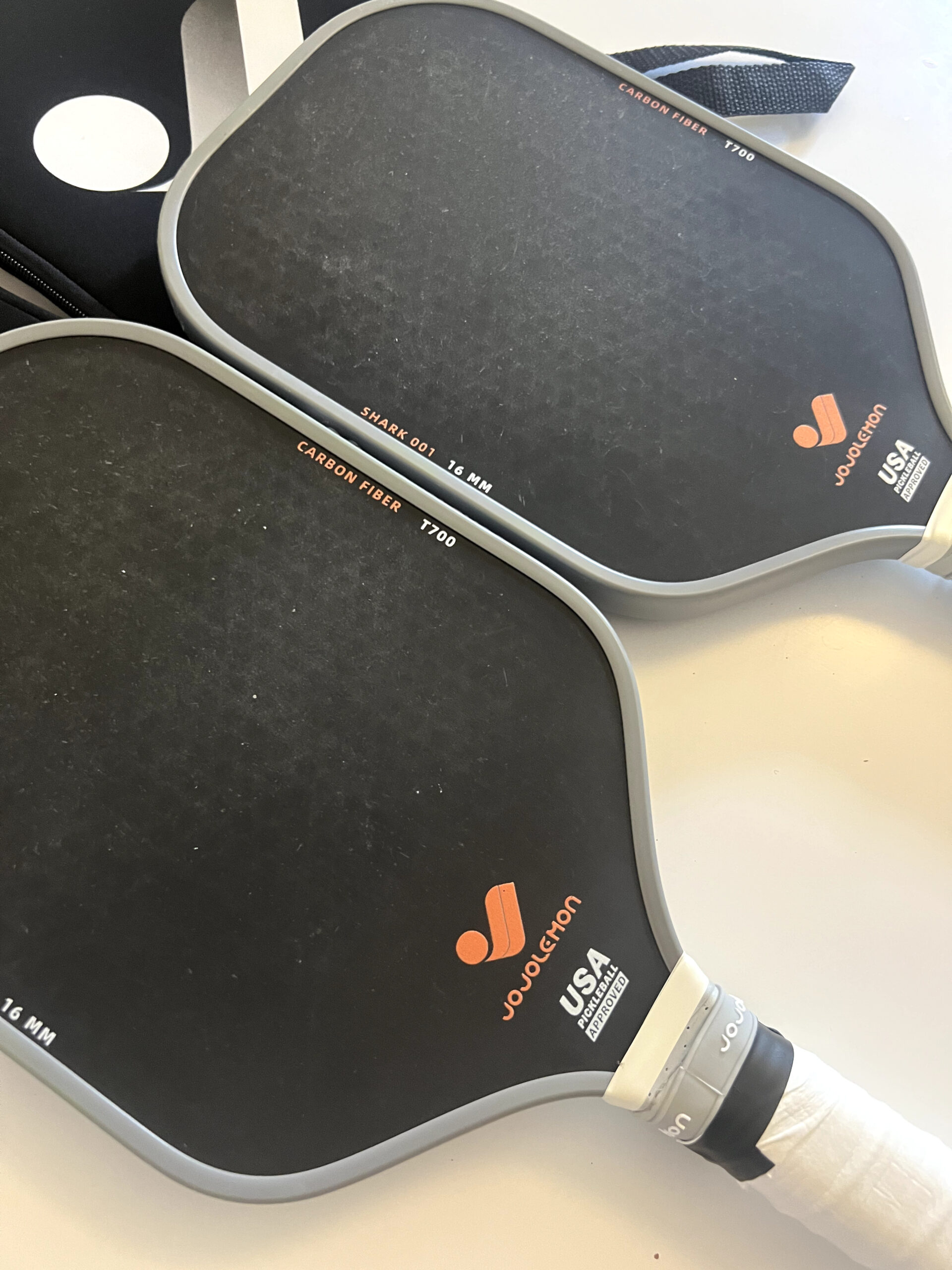
After more than two months of club play at around 15 hours per week, the paddle is still structurally fine. The face is dirtier than when it was new, but I have not had the kind of surface breakdown I saw very quickly on the BAGAIL paddles.
That matters to me because I hit hard and play often. A paddle can feel impressive for the first few sessions, but durability becomes much more important once it is being used week after week.
How I tested it
- Test duration: more than two months
- Estimated play time: around 120 hours so far
- Typical weekly use: roughly 15 hours
- Environment: competitive club play
- Playing style: I hit hard and value power, speed and spin
- Previous paddle: BAGAIL beginner paddle set
- Premium comparison: one game with a Ben Johns JOOLA Perseus
- Long-term status: still in active use
The 120-hour figure is an estimate based on my typical weekly volume rather than a stopwatch-tracked laboratory test. It is still a much longer real-world test than a few practice sessions or a weekend demo.
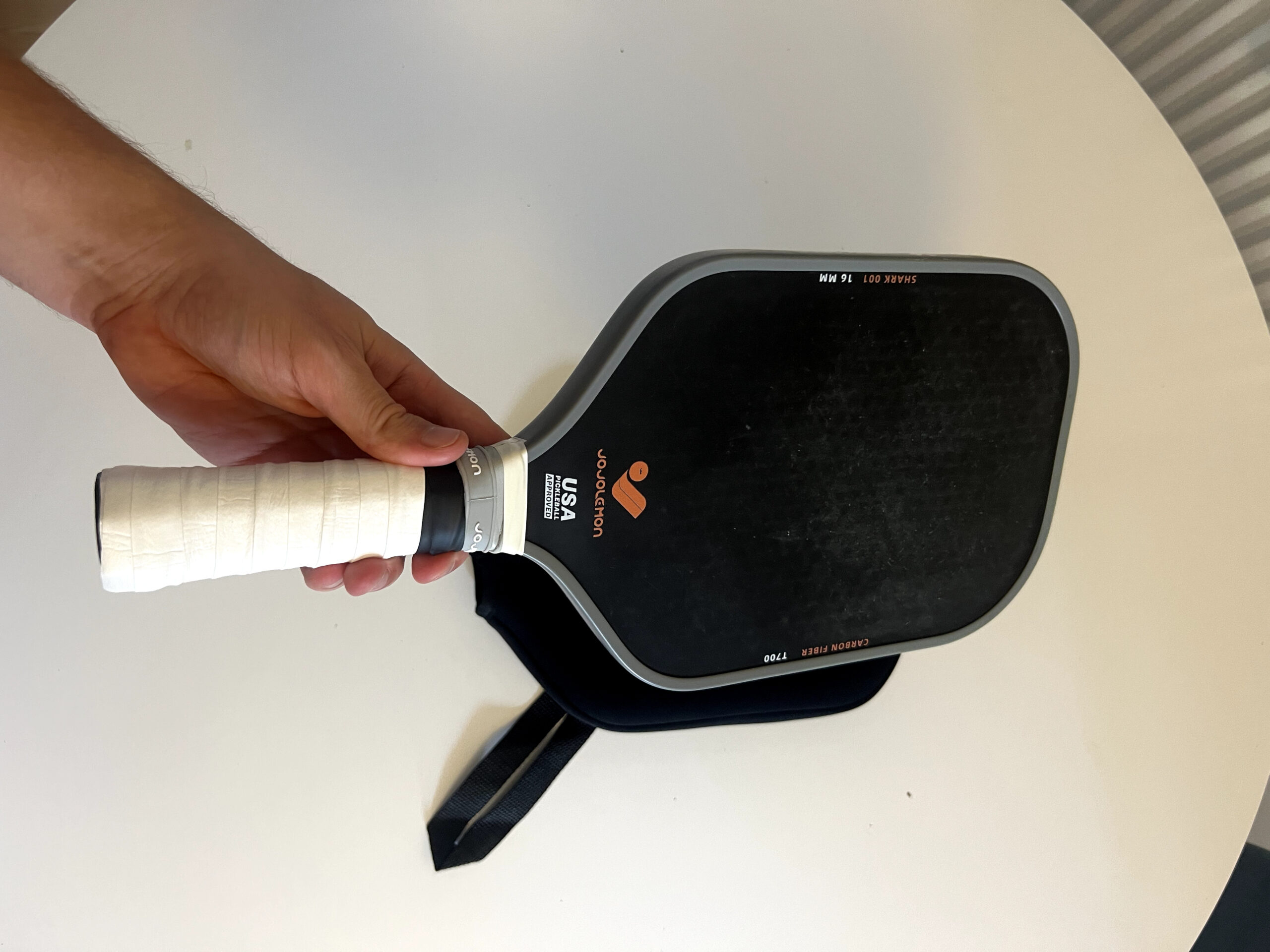
Measured paddle weight: 229 g
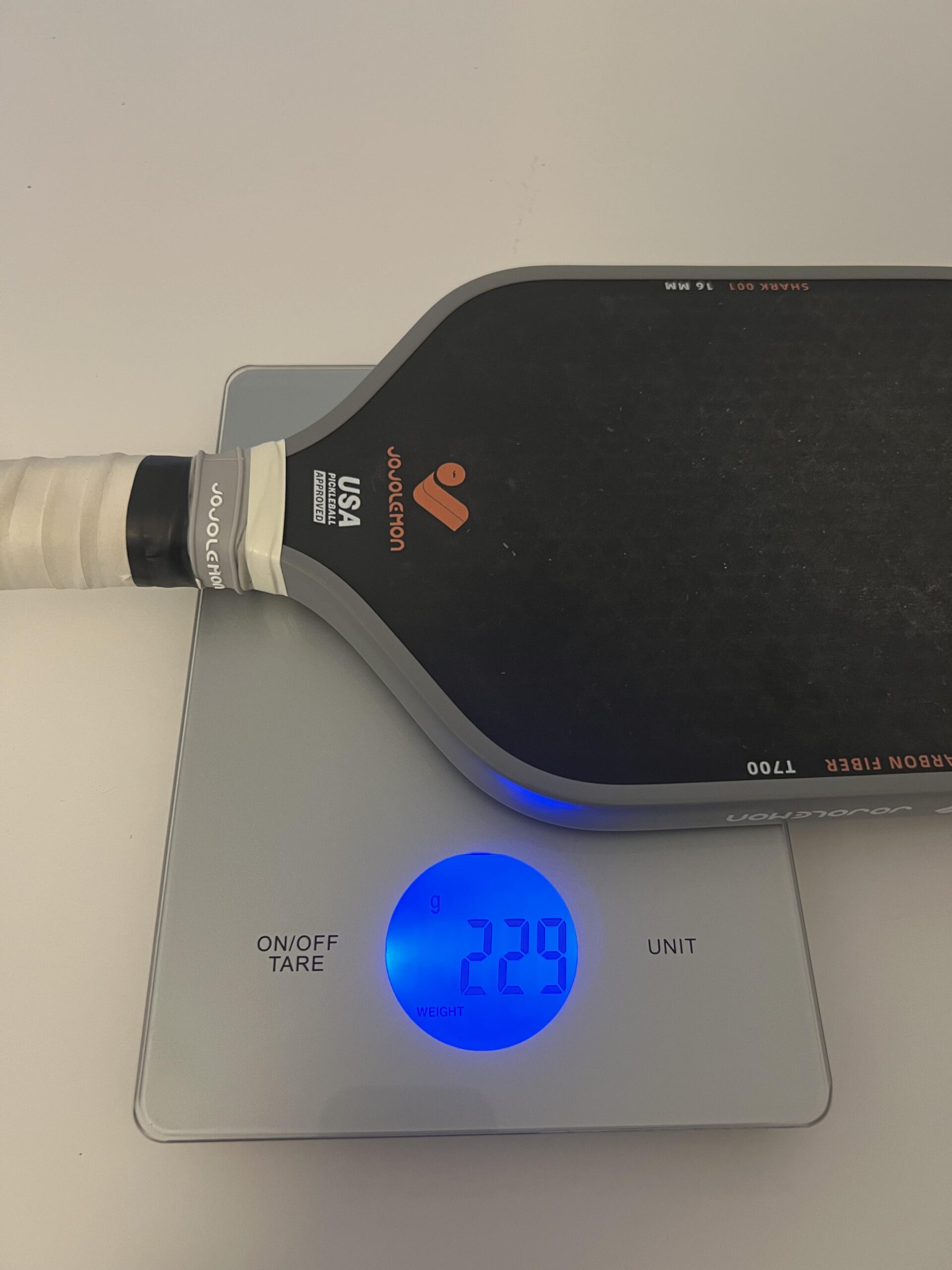
I measured my own Shark 100 at 229 g. That is a measurement of this specific paddle rather than a promise that every unit will weigh exactly the same, but it gives a useful real-world reference alongside the manufacturer’s listed weight range.
My paddle measurements
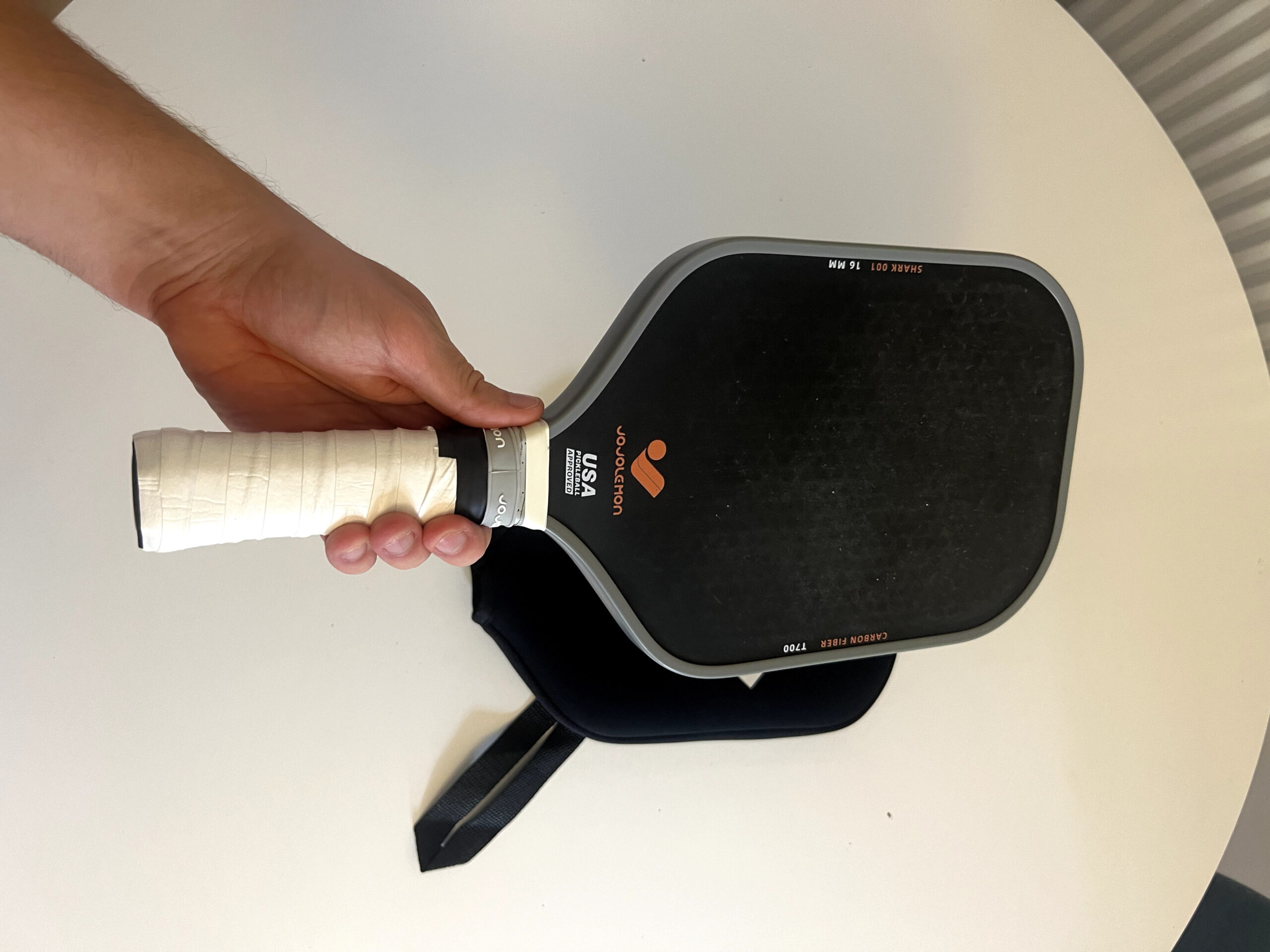
I also photographed my Shark 100 against a tape measure so the size of the exact paddle I tested is documented visually.
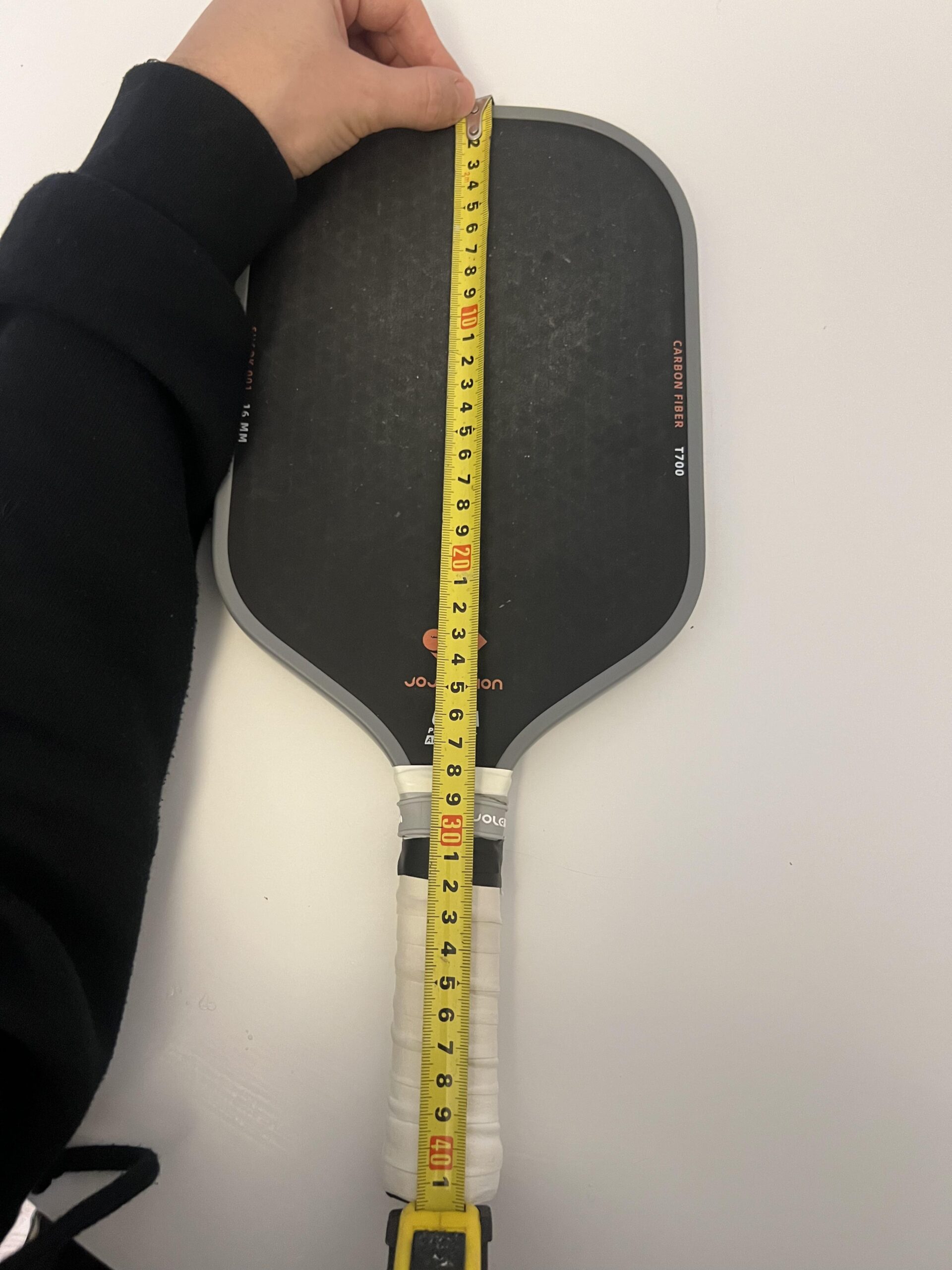
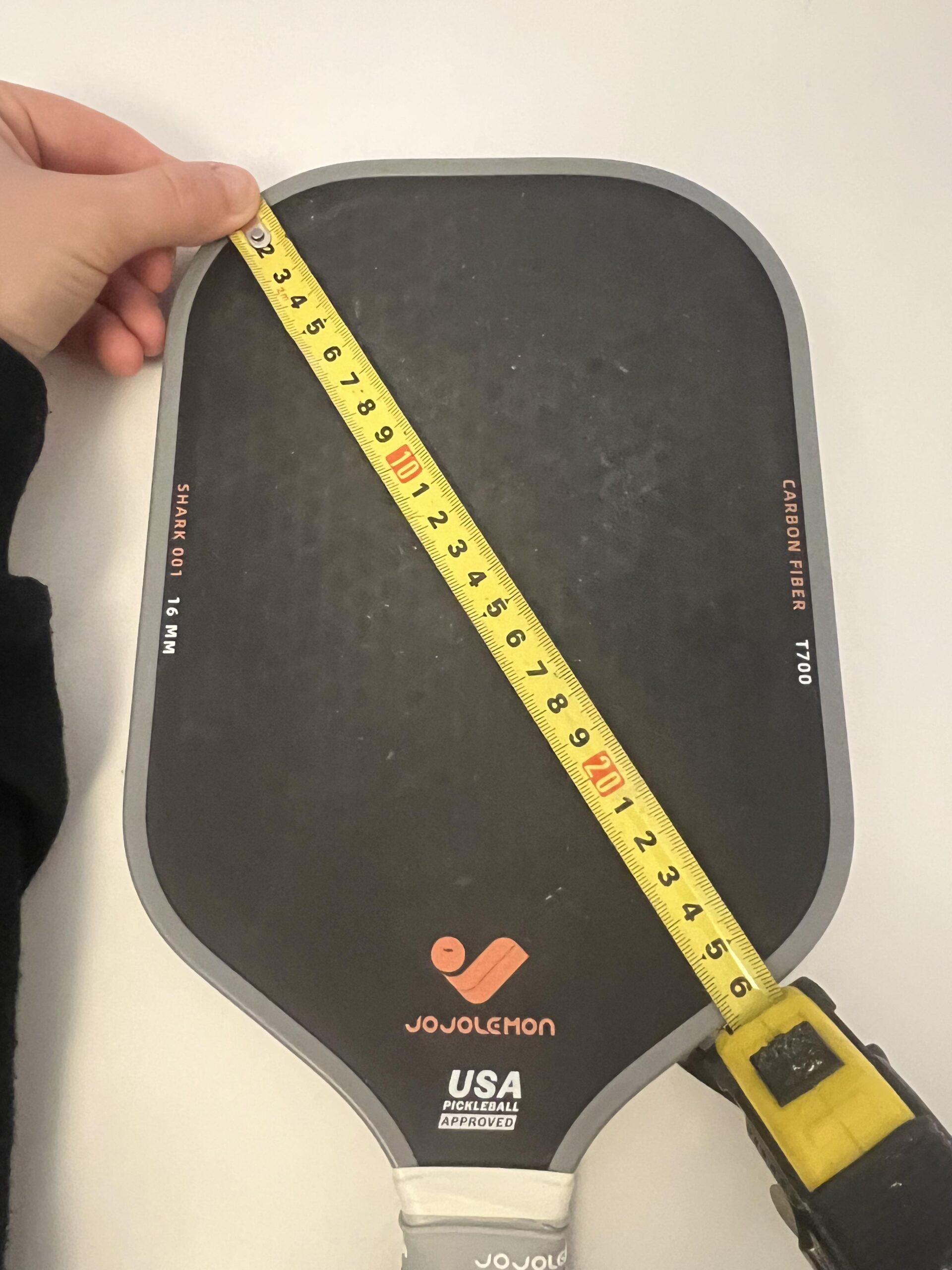
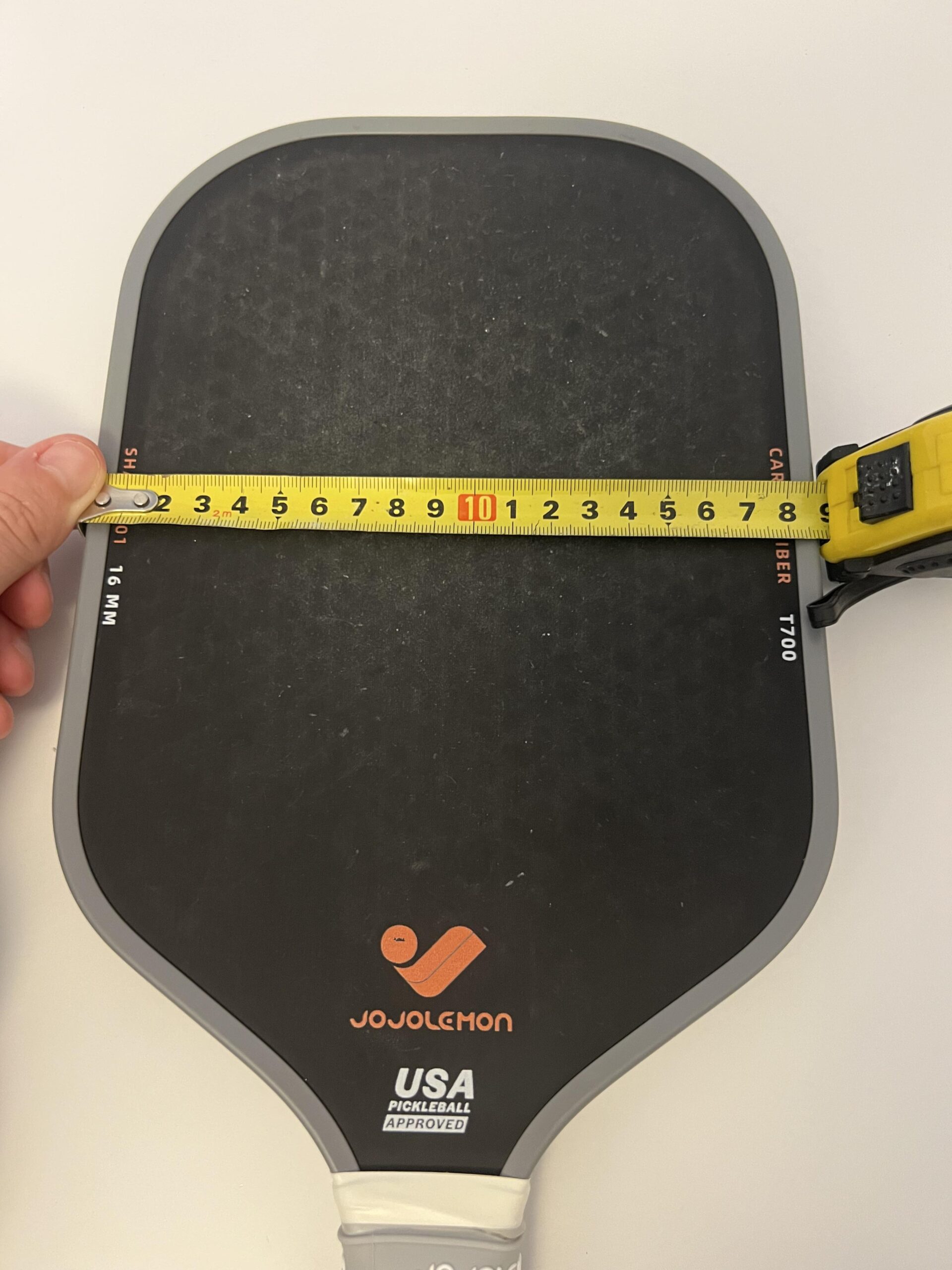
Exact model and listed specifications
This review is for the JOJOLEMON Shark 100, 16 mm Standard version sold under Amazon ASIN B0CT92CGZP. The exact Amazon listing I bought describes a carbon-fiber paddle with a 16 mm polymer core, T700SC carbon-fiber construction, a PTFE/Teflon-treated surface, thermoformed construction and foam-injected edges.
Current Amazon link note: The buying buttons on this review currently point to an active JOJOLEMON 16 mm Shark 100-family listing (ASIN B0DD7C9WGH), because the exact B0CT92CGZP listing I tested is not currently returned by the Amazon integration. Amazon may show a different color or selectable variant, so confirm the 16 mm Shark 100 configuration before buying.
| Specification | Listed for this version |
|---|---|
| Core thickness | 16 mm |
| Core | Polypropylene / polymer honeycomb |
| Face | Carbon fiber, T700SC |
| Surface treatment | PTFE / Teflon coating |
| Grip circumference | 4.25 in |
| Handle length | 5.2 in on the Amazon listing I bought |
| Listed weight | 7.9–8.2 oz |
| My measured sample | 229 g |
| Construction | Thermoformed with foam-injected edges |
Included cover and hanging strap
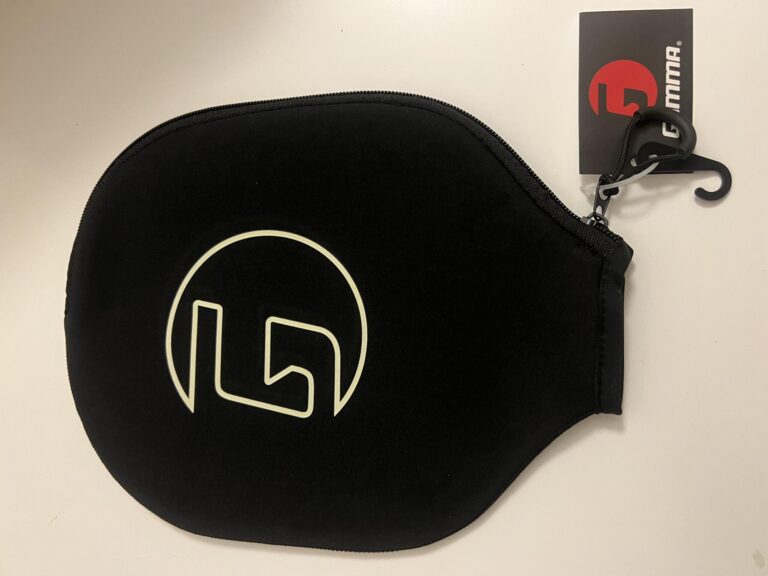
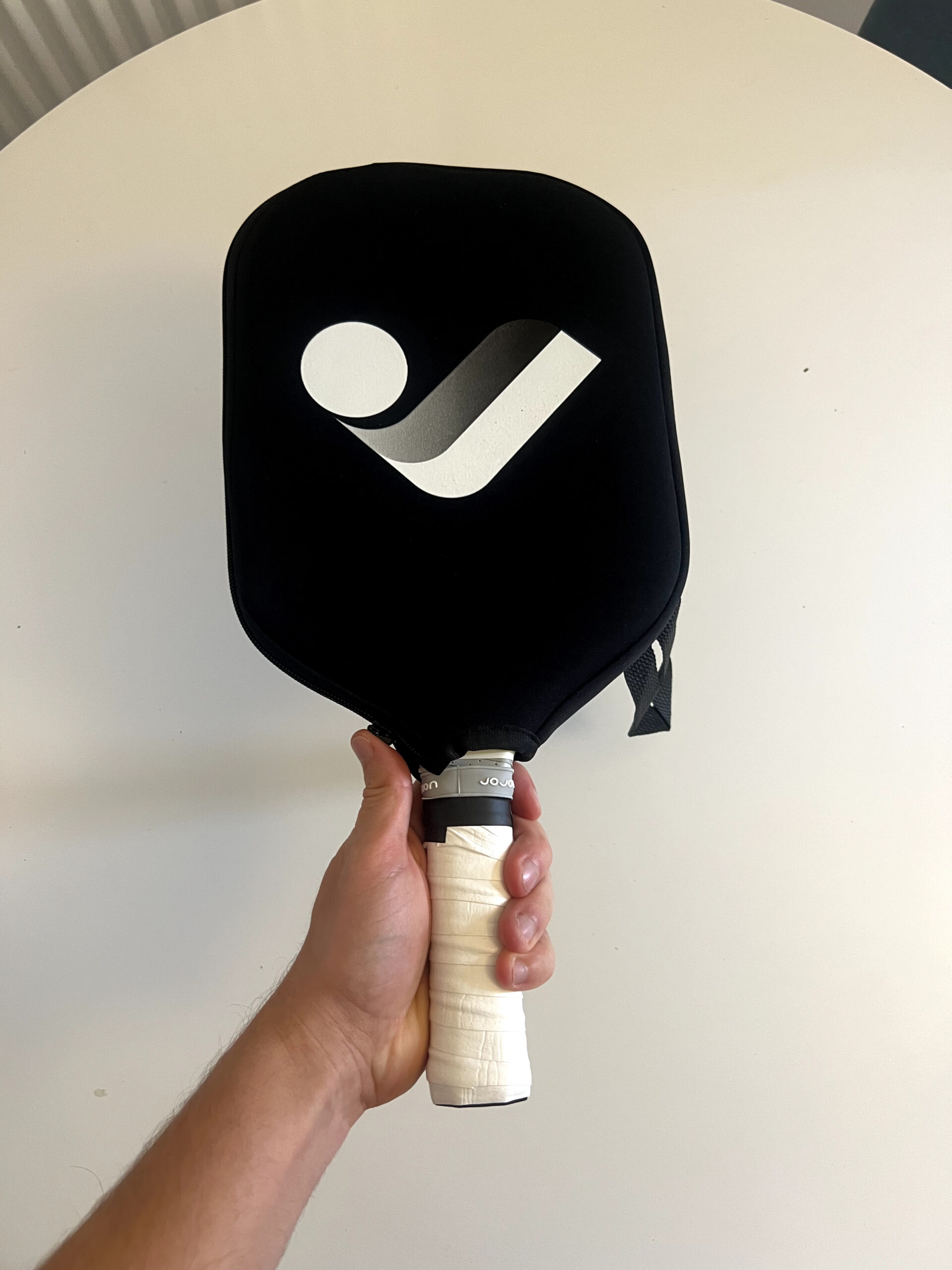
My Shark 100 came with a protective paddle cover. It is a useful extra rather than a reason to buy the paddle on its own, but I like having the face protected when the paddle is in a bag or being transported.
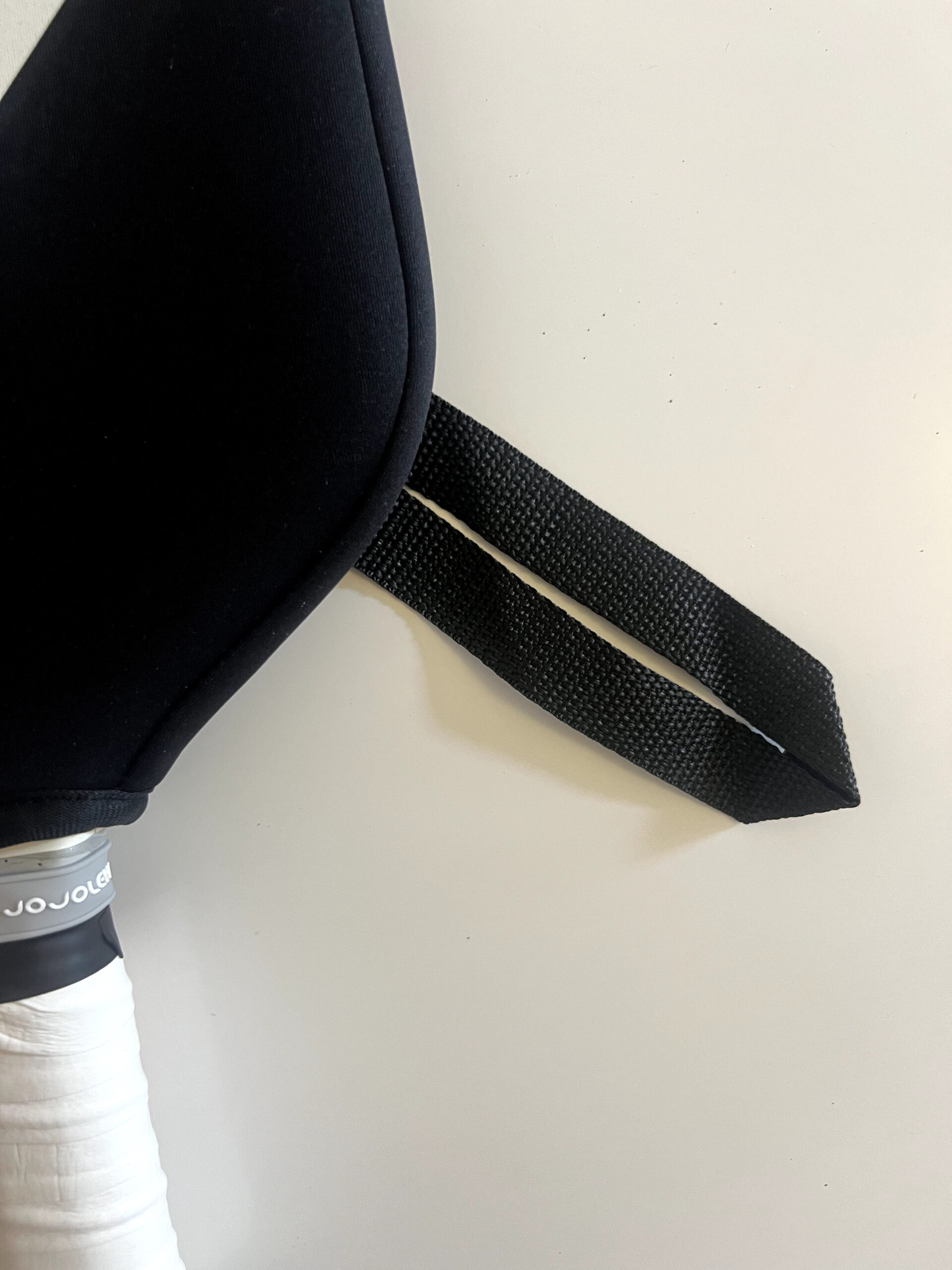
The cover also has a strap, so it can be hung on a hook or stored off the floor. It is a small detail, but it makes the included cover more practical around home or a club bag area.
USA Pickleball’s approved equipment database lists the JOJOLEMON SHARK 100 with a 16 mm polypropylene honeycomb core and carbon-fiber PTFE surface, with status Pass. I still recommend checking the current approval list before sanctioned competition because equipment approvals can change.
Check the SHARK 100 entry on USA Pickleball → If you want to understand what approval does and does not mean, see my pickleball paddle approval guide.
Durability: the strongest part of my long-term test
Durability has been excellent so far. I am a hard hitter, and after roughly 120 hours the face has not broken down. It looks used and the surface has picked up dirt, but that is very different from the early wear I experienced with my previous BAGAIL paddles.
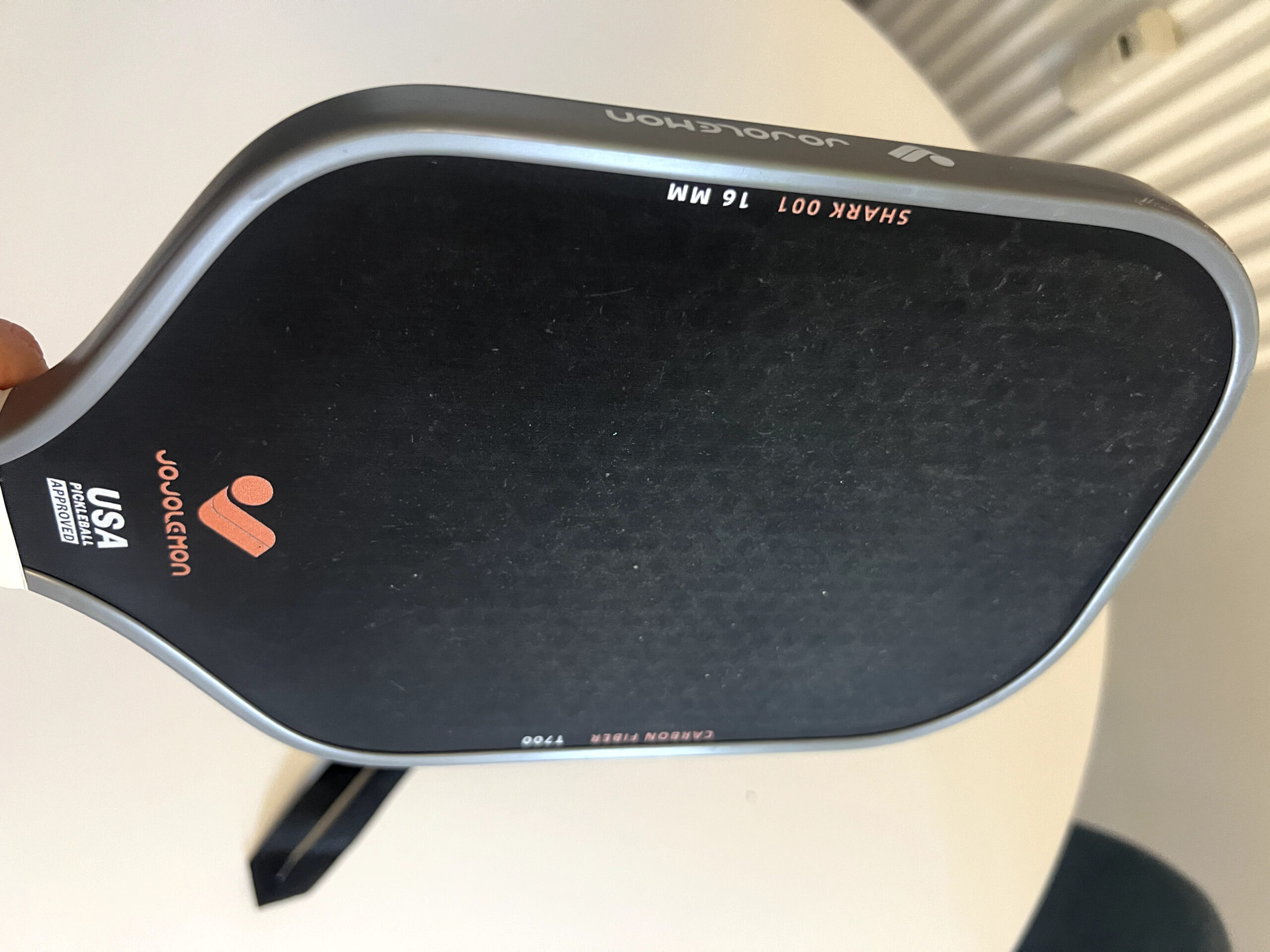
I also have a useful second durability sample: my girlfriend has her own Shark 100 and has played roughly as long as I have. After about the same amount of use — around 120 hours each — the two paddles look broadly similar. Neither face has shown the kind of early breakdown that concerned me on the BAGAIL set.
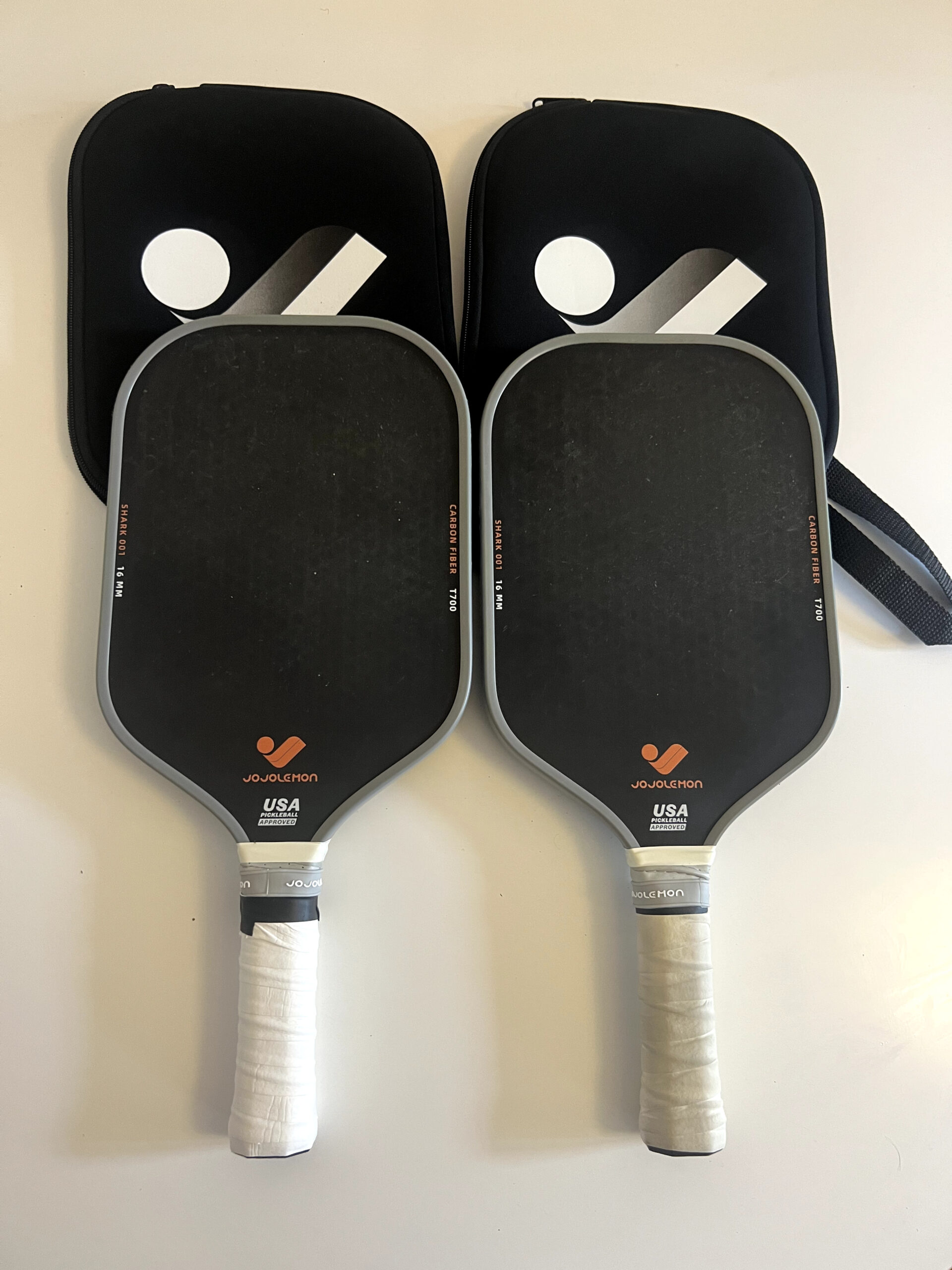
I cannot tell you how many hundreds of hours the paddle will ultimately last because mine has not reached that point yet. What I can say is that after the amount of play I have put through it, I have no current reason to replace it because of structural or surface failure.
For comparison, my BAGAIL paddle set showed obvious face wear after roughly 10 hours. The JOJOLEMON has been in a completely different durability class in my own use.
Power: one of its biggest strengths
I think the power is very good. Drives, harder serves and attacking balls come off the paddle with enough pace that I have never felt badly underpowered in competitive club play.
It also suits the way I play. I like being aggressive and I hit hard, so a paddle that feels too soft or dead would frustrate me. The Shark 100 gives me enough response to attack without feeling slow.
The premium JOOLA Perseus I tried briefly did feel more powerful, but the difference did not make the JOJOLEMON feel weak afterward. It made the JOJOLEMON feel like a strong-value paddle rather than a true top-end one.
Spin: good and clearly better than my beginner paddle
Spin is good. I can shape serves, drives and other topspin shots much more effectively than I could with the BAGAIL set.
I would not call the spin the absolute best I have ever felt. In my one-game test with the JOOLA Perseus, the more expensive paddle felt better here too. But the JOJOLEMON gives me enough spin that I do not feel seriously limited during normal club play.
Speed and hand battles: it feels quick
The paddle feels fast to me. I like it in quicker exchanges because it does not feel cumbersome, and I can get it into position quickly when the rally speeds up.
That combination of speed plus strong power is a big reason I have stayed happy with it. It feels more performance-oriented than the beginner equipment I started with rather than simply being a comfortable recreational paddle.
Control and consistency: my main criticism
This is where I think the Shark 100 leaves the most room for improvement.
Sometimes I hit a serve or a harder shot that feels as though it should have gone in one direction, yet the ball comes off noticeably worse than I expected. It does not happen on every shot, and some misses will obviously be caused by my own technique, but after a lot of hours with the paddle I still do not feel that the response is completely predictable.
That is the biggest difference I noticed when I briefly tried the premium Ben Johns JOOLA Perseus. In only one game, the JOOLA felt more consistent and easier to trust when I wanted the ball to leave the face exactly as expected.
I want to be careful with that comparison: one game is not a controlled head-to-head test, I did not measure spin RPM or launch angle, and I am not claiming the JOOLA is objectively better in every situation. It was simply a clear first impression that the premium paddle gave me more predictable control.
The grip is small for me — an overgrip fixed it
The stock grip feels a little small in my hand. That was easy to solve: after adding an overgrip, the handle feels right to me.
I would actually rather have a grip that is slightly too small and easy to build up than one that starts too large, so I do not see this as a major problem. But players with larger hands may want to budget for an overgrip immediately.
Sound and general feel
I like the sound of the paddle. It gives me a satisfying response on contact without anything that has bothered me over long sessions.
The overall feel is similarly positive. Even after many weeks, I have not developed a durability-related complaint, loose feeling or obvious reason to stop playing with it.
JOJOLEMON Shark 100 vs the Ben Johns JOOLA Perseus I tried
| Area | JOJOLEMON Shark 100 | My one-game JOOLA Perseus impression |
|---|---|---|
| Power | Great | Noticeably stronger to me |
| Spin | Good | Better in my brief test |
| Speed | Fast | Also felt high performance |
| Control / consistency | Main weakness | Biggest improvement I noticed |
| Durability evidence | ~120 hours from my own paddle | Not tested long enough by me to judge |
| Value | Major strength | Premium-price category |
I would not use this table to claim that every Perseus version beats the JOJOLEMON, because I only played one game with the JOOLA and did not document the exact generation. What it does show is why I think the Shark 100 is very good for its price while still leaving room above it for premium-level control and refinement.
Was it a good upgrade from BAGAIL?
For me, absolutely. The BAGAIL set was useful for getting started, but the JOJOLEMON is much better suited to how I play now.
The biggest upgrades were:
- far better long-term surface durability in my use;
- more usable spin;
- stronger power;
- faster handling;
- a more competitive overall feel.
The fact that I have put roughly 120 hours on it and am still happy using it is much more important to me than whether the specification sheet looks impressive.
Who I think should buy it
I think it makes the most sense for:
- players moving beyond cheap beginner paddles;
- intermediate club players who want strong power and spin without premium pricing;
- aggressive players who value speed and attacking potential;
- frequent players who care about durability;
- players comfortable adding an overgrip if the stock grip feels small.
I would be more cautious if:
- your number-one priority is maximum control and predictable soft-game response;
- you are already playing at a very high level and small differences in consistency matter a lot;
- you expect it to feel identical to a top premium paddle simply because the materials sound similar on paper.
Could I compete in tournaments with it?
Yes. I do not feel that this paddle prevents me from playing serious competitive pickleball. I think I could win matches and tournaments with it at my level.
That does not mean equipment stops mattering. At higher levels, the extra consistency I felt from a premium paddle could matter more because margins get smaller. My point is simply that the Shark 100 already gives me enough power, spin and speed to play competitively; its limitation is refinement rather than basic capability.
Value: this is where the Shark 100 makes the most sense
I think the JOJOLEMON is very good for its price. It has survived heavy use, still performs well, and gives me enough performance that I have not felt forced to replace it even after trying a much more expensive paddle. If you are deciding between paddle types rather than this exact model, my pickleball paddle buying guide explains the trade-offs between face, core, grip and playing style. You can also use my Pickleball Paddle Matcher to match your preferences against the source-backed paddle database.
I also liked the product enough to buy another Shark 100 for my girlfriend. That is not proof that it will suit everyone, but it is probably the clearest indication of how I feel about the value: I was willing to spend my own money on the brand again after using mine extensively.
Why I rate the JOJOLEMON Shark 100 4.3/5
My overall rating is 4.3/5. Power, spin, speed, durability and value are all strong enough that I am still happy competing with it after roughly 120 hours. Control consistency is the biggest reason it does not score higher.
This score follows The Pickleball Wise’s published rating method: category-relevant criteria total 100%, each criterion is scored from 1.0 to 5.0 from the documented first-hand evidence, and the weighted result is rounded to one decimal place.
| Criterion | Weight | Score | Evidence from my use |
|---|---|---|---|
| Power | 20% | 4.7/5 | A clear strength and a major upgrade from the BAGAIL starter paddles I used before it. |
| Spin | 15% | 4.5/5 | Good spin in my play and clearly stronger than my beginner paddle, while I did not run a laboratory RPM test. |
| Control & consistency | 25% | 3.4/5 | The main weakness: I occasionally get less predictable direction than I want, especially at higher pace. |
| Handling & feel | 15% | 4.4/5 | Fast in hand battles and generally solid; the stock grip feels small to me but an overgrip fixed that. |
| Durability | 15% | 4.8/5 | Still structurally strong after roughly 120 hours of frequent hard hitting, with far less surface breakdown than my starter paddles. |
| Value | 10% | 4.7/5 | I am still happy competing with it and liked it enough to buy another Shark 100 for my girlfriend. |
| Weighted rating | 4.3/5 | 4.315 before rounding. | |
Final recommendation
The JOJOLEMON Shark 100 has been a successful upgrade for me. After roughly 120 hours, I still like its power, spin, speed, sound and durability. The grip is easy to fix with an overgrip, and the paddle has held up extremely well despite frequent hard hitting.
The one area that keeps me from calling it a truly top-level paddle is control consistency. A premium JOOLA Perseus felt noticeably more predictable during my brief test. But that gap has to be weighed against price: I am still happy competing with the JOJOLEMON, and I do not think you need a $300-class paddle to play good pickleball.
Check the current JOJOLEMON Shark 100 price on Amazon →

Jonathan Grøn is a pickleball player and racket-sports enthusiast who focuses on practical doubles strategy, rules, skills, and training. He combines regular on-court experience with research from official rules, coaching resources, and other authoritative sources to create clear, useful pickleball guides.