Pickleball Paddle Cores: Honeycomb, Foam & Hybrids
A pickleball paddle’s core material matters, but the label “polypropylene,” “EPP,” or “EVA” does not tell you the whole playing character. Core thickness, density, cell size, foam placement, face layup, perimeter construction and total mass distribution all interact.
Use core material to understand construction—not as a shortcut to “power,” “control,” or quality.
The Three Core Families You Will See Most Often
| Core family | What it is | What to avoid assuming |
|---|---|---|
| Polypropylene honeycomb | Polymer cells arranged in a honeycomb structure | That every PP paddle feels the same |
| EPP foam | Expanded polypropylene foam | That “foam” automatically means soft or slow |
| EVA foam | Ethylene-vinyl acetate foam used in some full or hybrid constructions | That material name alone predicts rebound |
| Hybrid cores | Two or more materials or zones combined | That “hybrid” is a performance category rather than a construction description |
Polypropylene Honeycomb Is Still Common — but Not Uniform
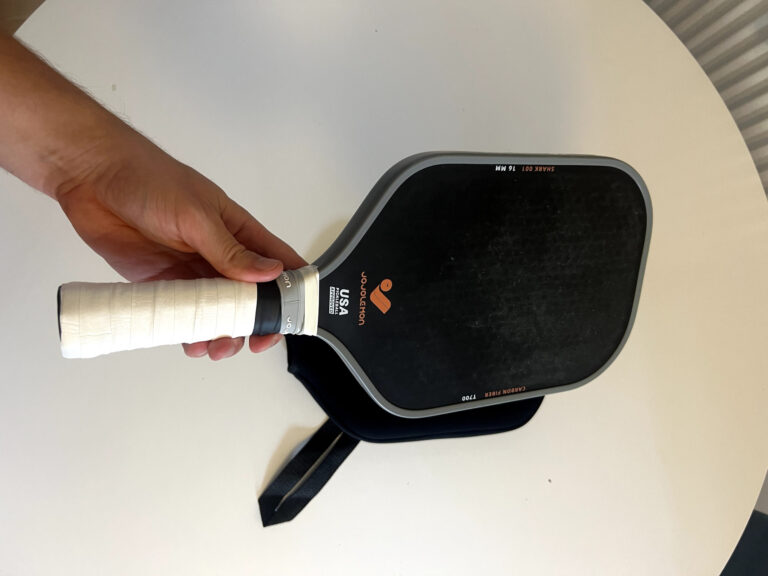
USA Pickleball’s current approved-paddle database contains many 2026 models using polypropylene honeycomb cores, but entries vary by thickness, cell size, face material and shape.
That means two 16 mm PP honeycomb paddles can still behave very differently. One may use a wider face and larger cells; another may add foam around the perimeter or use a different face layup.
Foam Is No Longer Just Perimeter Filling
Modern approved paddles increasingly use EPP and EVA in more substantial ways. Current USA Pickleball listings include full EPP/EVA foam constructions as well as hybrid cores combining polypropylene honeycomb with injected EVA foam or layered foams.
For example, current 2026 approved entries include paddles described as EPP + EVA foam and others described as polypropylene honeycomb plus EVA injection. That is why old “honeycomb vs foam” articles can oversimplify the current market.
Core Material vs Core Architecture
Material answers “what is it made from?” Architecture answers “where is each material, how thick is it, and how is it combined?” The second question is often more useful.
- Is the foam the entire core or only the perimeter?
- Is there a honeycomb center with foam around it?
- Are multiple foam densities layered?
- What is the total thickness?
- How wide and long is the paddle?
Those variables change the mechanical system together.
Do Not Buy From Core Material Alone
If two paddles use different core families, compare the result rather than the marketing story. Useful demo questions are:
- How predictable is the ball response on soft contact?
- How much depth do you get on a normal drive?
- How stable are off-center blocks?
- Does the paddle feel quick enough in hand battles?
- Does the response change dramatically when you miss the center?
Then connect those observations to thickness, shape, swing weight and construction. Our paddle-selection guide gives the full decision order, while the Paddle Finder lets you browse source-backed core and construction data on real models.
Approval Is Model-Specific
USA Pickleball requires models with significant core or surface differences to be separately designated for certification. If sanctioned competition matters, verify the exact model rather than assuming a new core variant inherits another version’s status.
Use the current Approved Paddle List as the legality reference.
The Useful Takeaway
Core material is one layer of the paddle. Read the core label, then immediately ask about architecture, thickness, face, shape and mass distribution. A material name can explain construction; it cannot replace testing the exact paddle.
Sources

Jonathan Grøn is a pickleball player and racket-sports enthusiast who focuses on practical doubles strategy, rules, skills, and training. He combines regular on-court experience with research from official rules, coaching resources, and other authoritative sources to create clear, useful pickleball guides.