Wheelchair Pickleball Rules: Two Bounces, Serving & Kitchen
Wheelchair pickleball uses the same basic game as standing pickleball, but a few rules change because the wheelchair is treated as part of the player’s body and because wheelchair players receive an additional bounce allowance. Those differences affect serving, the non-volley zone, faults and how rallies are judged.
This guide focuses on the wheelchair-specific rules in the 2026 USA Pickleball rules framework. If you are new to the sport itself, start with our guide to how pickleball is played, then use this page for the adaptations that apply when a player competes in a wheelchair.
Wheelchair pickleball rules at a glance
- A wheelchair player may let the ball bounce twice before returning it.
- The second bounce may occur anywhere on the playing surface.
- The wheelchair is considered part of the player’s body.
- For positioning rules, the large rear wheels are treated like a standing player’s feet or legs.
- On the serve, both large rear wheels must be on the playing surface behind the baseline and within the correct serving area.
- The smaller front wheels may extend into the court during the serve.
- Front wheels and rear stabilizing wheels may contact the non-volley zone while volleying; the large rear wheels may not.
- Wheelchair players can compete with or against standing players, with the wheelchair-specific rules continuing to apply to the wheelchair player.
The important idea is that wheelchair pickleball is not a separate sport with an entirely different rulebook. The adaptations modify specific situations while leaving the core scoring, court and rally structure intact.
The two-bounce allowance for wheelchair players
The most noticeable adaptation is the extra bounce. Under the standard game, a player normally must return the ball before it bounces a second time. A wheelchair player, however, may allow the ball to bounce twice before making the return.
This is different from pickleball’s ordinary “two-bounce rule.” In standard play, that phrase means the serve must bounce before the receiving team hits it and the return of serve must then bounce before the serving team hits its next shot. After those required bounces, standing players normally have to return each ball before a second bounce.
For a wheelchair player, the additional allowance continues throughout the rally. A groundstroke does not become dead merely because the ball has taken a second bounce before that player reaches it.
Where can the second bounce land?
The second bounce can occur anywhere on the playing surface. That matters when a player is chasing a ball toward the sideline, baseline or non-volley zone. You should not automatically call the rally dead simply because the second bounce is outside the court lines after a legal first bounce.
A practical way to officiate or self-officiate mixed play is to track which player is making the return rather than trying to apply one bounce limit to everyone on the court.
How serving changes in wheelchair pickleball
The service box, diagonal direction and other core serving concepts remain recognizable, but wheel position replaces foot position for the wheelchair-specific positioning test.
At the moment the ball is served, both large rear wheels must be on the playing surface behind the baseline. They also must remain within the imaginary extensions of the appropriate sideline and centerline that define the legal serving area.
The smaller front wheels are allowed to extend into the court. This is an important distinction: seeing a front caster beyond the baseline does not by itself establish a service fault.
A simple serving check
Before serving, a wheelchair player can use a three-part check:
- Confirm both large rear wheels are behind the baseline.
- Confirm those rear wheels are inside the lateral boundaries of the correct serving area.
- Set the chair so the service motion can be completed without a rear wheel crossing a prohibited line before contact.
That approach is easier to repeat than trying to reposition at the last instant.
How the Kitchen works for wheelchair players
The non-volley zone, commonly called the Kitchen, still restricts where a player can be in connection with a volley. But not every wheel is treated the same way.
USA Pickleball’s wheelchair guidance allows the front wheels and rear stabilizing wheels to contact the non-volley zone at any time. The critical components are the large rear wheels.
If a large rear wheel contacts the non-volley zone while the player is volleying, it is a fault. The same principle extends to something that is in contact with the volleying player. For example, a player cannot avoid the restriction by remaining outside the Kitchen with the rear wheels while using contact with a partner or another object in a way that triggers the non-volley-zone rule.
For the general concepts behind volleys, momentum and the non-volley zone, see our complete Pickleball Kitchen rules guide.
Momentum still matters after the volley
A Kitchen fault is not limited to the exact instant the paddle contacts the ball. Momentum can complete the fault afterward.
If the momentum from a volley causes a large rear wheel to enter the non-volley zone, the player commits a fault even if the ball has already become dead. Likewise, contact with something or someone that is touching the non-volley zone can matter under the wheelchair momentum rule.
This makes chair control part of legal volleying. Reaching a high ball near the Kitchen is not only about making contact; the player also needs enough braking and positional control to finish the action legally.
The wheelchair counts as part of the player’s body
For rule purposes, the wheelchair is considered part of the player’s body. This principle prevents ambiguous situations in which contact with the chair might otherwise be treated differently from contact with the player.
The large rear wheels are especially important because USA Pickleball uses them as the functional equivalent of a standing player’s legs for positioning. That is why they determine key service and non-volley-zone restrictions while the front casters receive different treatment in those situations.
Can wheelchair and standing players play together?
Yes. The 2026 guidance allows wheelchair players to compete in tournament events other than adaptive standing-only events, and they may partner with or play against standing players, adaptive standing players or other wheelchair players.
The rules follow the player rather than forcing the entire court to use the same mobility adaptation. If one player uses a wheelchair and three players are standing, the wheelchair-specific provisions apply to the wheelchair player while the standing players remain subject to their normal bounce and positioning rules.
Only wheelchair players may participate in wheelchair-only events.
Common situations that cause confusion
A wheelchair player lets the ball bounce twice
That can be legal. Do not call a double-bounce fault merely because a wheelchair player returns the ball after bounce number two.
The front wheel crosses the baseline during the serve
That is not automatically a fault. The 2026 wheelchair serving rule specifically focuses on the two large rear wheels, which must remain legally positioned at the moment of service.
A front caster touches the Kitchen during a volley
Front-wheel contact alone is permitted under the wheelchair-specific non-volley-zone provision. The large rear wheels are the key reference point for the wheelchair player’s Kitchen positioning.
A large rear wheel rolls into the Kitchen after the volley
If the volleying player’s momentum causes that contact, it is a fault. The fact that paddle contact happened before the wheel entered the zone does not erase the momentum rule.
A wheelchair player faces a standing player
The wheelchair player keeps the wheelchair adaptations. The standing opponent does not gain a second-bounce allowance simply because the match includes a wheelchair player.
How to make mixed games easier to officiate
Most confusion disappears if everyone agrees on the wheelchair-specific adaptations before the first serve. In recreational play, a 30-second rules check can prevent repeated debates during rallies.
Confirm three things: the wheelchair player has the two-bounce allowance, the large rear wheels are the reference point for the key service and Kitchen positioning rules, and the front/stabilizing wheels are treated differently in the non-volley zone.
Then call ordinary rules normally. There is no need to reinterpret every rally simply because one participant uses a wheelchair.
What does not change?
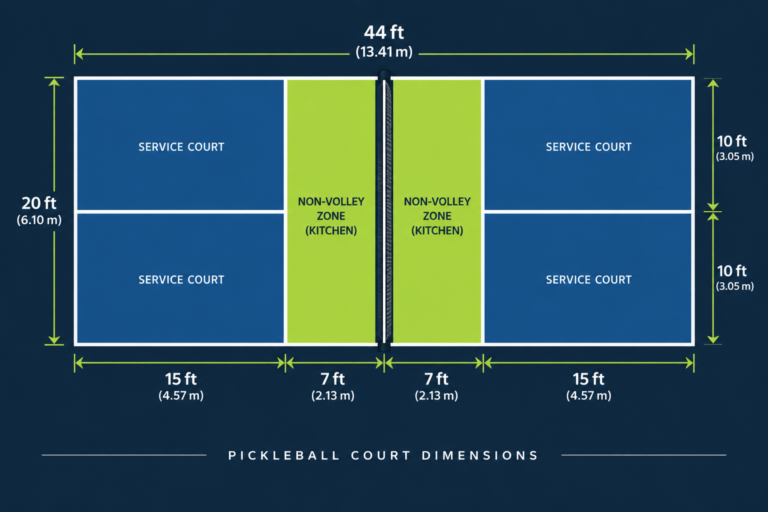
Unless a wheelchair-specific rule modifies the situation, the ordinary rules continue to apply. Players still use the regulation court and net, serve into the appropriate service court, follow the scoring format being used, and play under the same general definitions of live balls, faults and rallies.
That is a useful learning shortcut: start with standard pickleball, then layer the wheelchair adaptations on top. Trying to memorize wheelchair pickleball as a completely separate ruleset makes the game seem more complicated than it is.
Bottom line
The 2026 wheelchair pickleball rules make a few targeted adaptations rather than redesigning the game. The wheelchair player may use two bounces, the wheelchair counts as part of the body, the large rear wheels govern important positioning questions, and front or stabilizing wheels receive special treatment around the non-volley zone.
For players, partners and opponents, remembering those distinctions is usually enough to handle the situations most likely to arise in recreational or tournament play. For an event or disputed ruling, check the current USA Pickleball Official Rulebook and its Inclusive Play section because annual revisions can change exact wording.

Jonathan Grøn is a pickleball player and racket-sports enthusiast who focuses on practical doubles strategy, rules, skills, and training. He combines regular on-court experience with research from official rules, coaching resources, and other authoritative sources to create clear, useful pickleball guides.