Pickleball Singles Rules and Strategy Guide for 2026
Pickleball singles uses the same full-size court, Kitchen and two-bounce rule as doubles, but the scoring and serving sequence are simpler: you call two numbers, there is only one server per side, and your own score determines which side you serve from. Even score = right. Odd score = left.
The rules are the easy part. The bigger adjustment is tactical: one player now has to cover the whole court. That changes how valuable depth, recovery position and shot selection become.
This guide follows the 2026 USA Pickleball Official Rulebook and separates what the rules require from what is usually smart strategy.
The Singles Rules That Actually Change
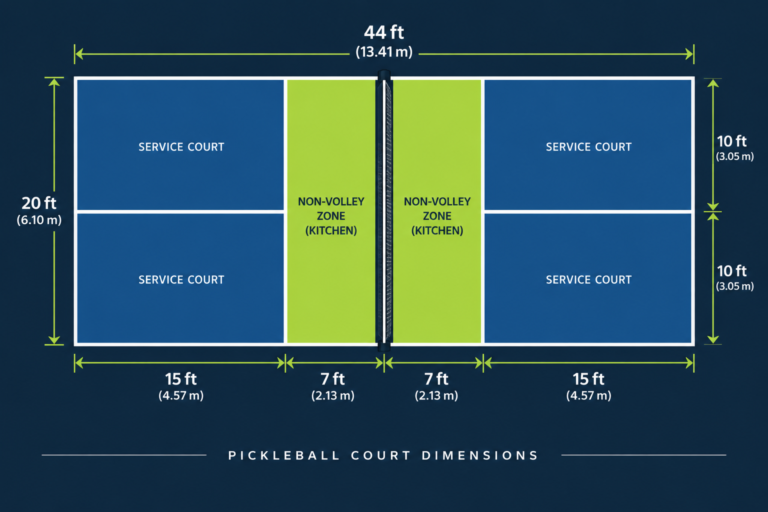
If you already know doubles, most of pickleball stays the same. The court is still 20 by 44 feet, the Non-Volley Zone is still 7 feet deep on each side, the serve must go to the correct opposite service court, and both the serve and return must bounce before either player may volley.
If you need those fundamentals first, see our guides to pickleball court dimensions, serving rules and Kitchen rules.
1. The score has only two numbers
In standard singles, call the server’s score first and the receiver’s score second. A score might be “4–2” or “7–6.” There is no third server number because there is no partner waiting for a second service turn.
Under standard side-out scoring, only the server scores a point. If the server loses the rally, service immediately passes to the opponent. There is no second server.
The 2026 rulebook also permits rally scoring as a provisional option in qualifying formats, so tournament players should check the event format rather than assume every match uses standard side-out scoring. Our pickleball scoring guide covers the broader scoring systems.
2. Your own score tells you where to serve
This is the singles rule worth memorizing:
- 0 or any even score: serve from the right/even serving area.
- Any odd score: serve from the left/odd serving area.
If you win a point while serving, you switch sides and serve again. If you lose the rally, your opponent takes the serve from whichever side matches their score.
Use the Score as Your Position Map
A useful way to avoid singles confusion is to stop trying to remember where you stood on the previous rally. Read the current server’s score instead.
| Server score | Serve from | What happens after a point |
|---|---|---|
| 0 | Right | Score becomes 1, so move left |
| 1 | Left | Score becomes 2, so move right |
| 4 | Right | If you lose the rally, opponent takes over from the side matching their score |
| 7 | Left | If you score, move right at 8 |
Shortcut: do not use your opponent’s score to choose your serving side. In standard singles, your own score is the map.
The First Three Shots: Where Rules Become Strategy
The rules tell you where the rally starts. Singles strategy is about using those first three shots to control how much court you must defend next.
Serve: buy a weaker return, not just a faster ball
A deep serve is a strong default because it keeps the receiver farther from the net and makes aggressive returns harder. USA Pickleball’s current singles guidance also recommends serving toward the “T” as a useful high-percentage pattern because it can reduce the return angles you must cover.
That does not mean every serve belongs down the middle. Mix in body and wider serves when they create a better next ball. The important question is: where will this serve make the return come from?
For a depth-focused practice method, see how to serve deep without hitting long.
Return: depth creates time to move forward
The return must bounce, but once you hit it you are free to advance. A deep return can keep the server behind the baseline while giving you more time to improve your court position.
USA Pickleball’s singles strategy guidance recommends deep returns and working toward the Kitchen line. Treat that as a strong strategic default, not a rule: if your return is short or you are off balance, charging forward blindly can expose you to an easy pass.
Third shot: attack the space the return created
The server must let the return bounce. After that bounce, the third shot is the first moment when the serving player can respond to the receiver’s movement.
If the receiver has moved forward, a low passing shot or a ball that forces them to hit on the move can be more useful than simply hitting harder. If the receiver stayed deep, you may have more space to work forward behind a controlled shot. In singles, the best target often depends on where the opponent is now and where they are moving, not on a fixed “always hit here” rule.
A Better Recovery Rule: Cover the Next Likely Ball
“Recover to the middle” is helpful but incomplete. The geometric center is not automatically the best spot after every shot.
Instead, use this three-step recovery check:
- Track your shot. Where did you send the ball?
- Read your opponent’s contact point. Are they stretched wide, balanced in the middle, deep, or moving forward?
- Recover to split their most likely angles. Move toward a position that shortens your next defensive run, then get balanced before they strike.
For example, after you pull an opponent far toward one sideline, the available reply angles are no longer symmetrical. Recovering to the exact center mark may not bisect those options well, so let the location of your shot and your opponent’s contact point shape your recovery.
Rules vs Strategy: Do Not Mix Them Up
| Situation | Rule | Strategy choice |
|---|---|---|
| Serving at an even score | Serve from the right | Choose depth and placement based on opponent position |
| Return of serve | Let the serve bounce | Usually prioritize depth and use the time to improve position |
| Third shot | Let the return bounce | Pass, drive, angle or work forward based on the receiver’s position |
| Kitchen | You may not volley while touching the NVZ | Advance when the ball and your balance justify it |
| Recovery | No rule forces you to stand in the center | Recover according to likely reply angles |
Three Doubles Habits to Drop in Singles
- Waiting for a partner to cover the open side. Every aggressive angle you create also changes the space you must recover.
- Treating the middle as automatically safe. Middle targets can reduce angles, but open-court opportunities matter more when one opponent covers everything.
- Rushing forward because “the Kitchen always wins.” Net pressure is valuable, but only if your approach shot lets you arrive balanced enough to defend a pass.
A Simple Singles Game Plan
If you are moving from doubles to singles, start with four priorities:
- Keep the serve deep with margin.
- Return deep enough to create movement time.
- Use the opponent’s position to choose the third-ball target.
- Recover for the next likely angle before trying to hit a winner.
That framework is deliberately simple. Singles rewards shot-making, but it becomes much easier when every shot is connected to the position you want for the next one.
Sources and Ruleset
This article was checked against the current 2026 USA Pickleball rules hub and official rulebook and USA Pickleball’s singles strategy guidance. Tournament or league formats can use additional rules or scoring options, so check the event rules when they differ from standard USA Pickleball play.

Jonathan Gron is a pickleball player and racket-sports enthusiast who focuses on practical doubles strategy, rules, skills, and training. He combines regular on-court experience with research from official rules, coaching resources, and other authoritative sources to create clear, useful pickleball guides.