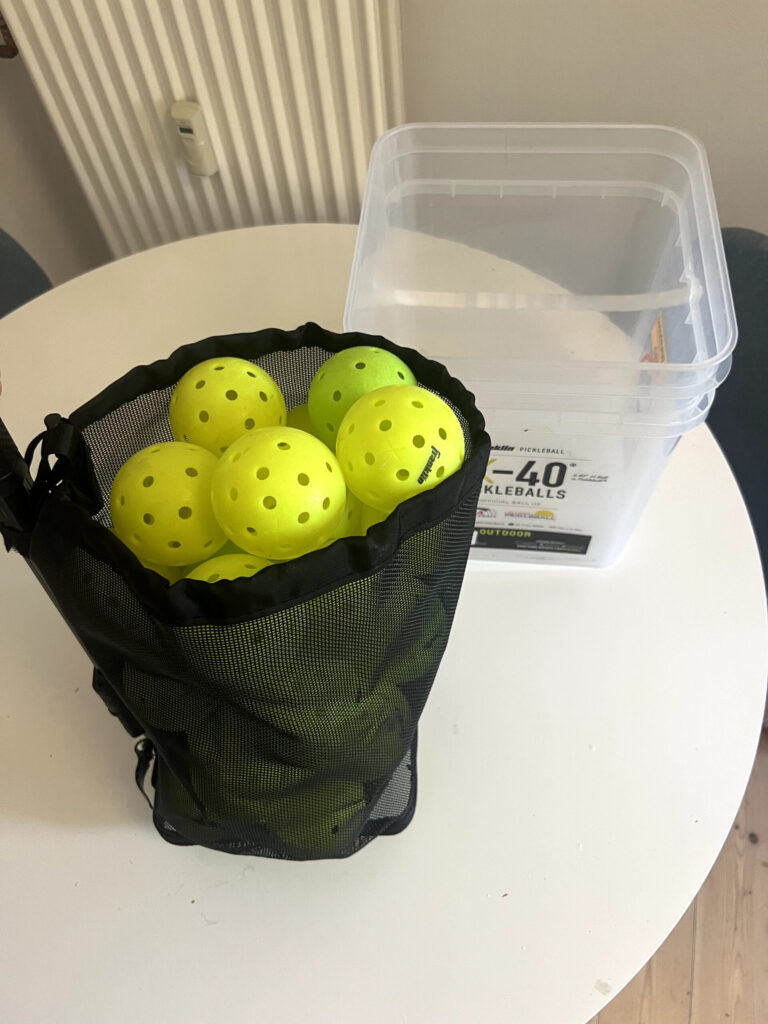
Pickleball Return Practice: An 80-Ball Routine for Depth & Control
A good pickleball return is not just a ball that lands in. In doubles, the return should usually do two jobs at once:
- push the serving team back;
- give you enough time to reach the Kitchen in balance.
That means return practice should not stop at contact. You should train depth + movement + target choice together.
This 80-ball return routine is designed to do exactly that. It progresses from simple depth to movement, then directional control, then variable serves and pressure.
The 80-ball structure
Use five blocks:
- 16 balls — reliable contact
- 16 balls — depth
- 16 balls — return + Kitchen movement
- 16 balls — target variation
- 16 balls — pressure and randomness
If you have more time, repeat the final two blocks. If you have less, use 8 balls per block.
Block 1: 16 reliable returns
Start with a large target and moderate serves.
Your goal is not to hit aggressive winners. Your goal is to create a repeatable return motion that gives you time to move forward.
Track only:
- in;
- out;
- net.
Focus on:
- balanced starting position;
- early preparation;
- contact in front;
- enough net clearance;
- a finish that lets you move immediately.
If you are struggling to get 14–15 of 16 in with a large target, stay here longer before making the drill harder.
Do not start too close to the baseline
One of the easiest ways to ruin return practice is to crowd the baseline.
If the server hits deep, you may get jammed or be forced to contact the ball while moving backward.
Give yourself enough space to handle a deep serve comfortably.
You can always move forward to a shorter serve.
Starting a little deeper often makes it easier to create a controlled, deep return and then move through the shot toward the Kitchen.
Block 2: 16 returns for depth
Now divide the opponent’s court into:
- short zone;
- deep zone.
Use cones or visual landmarks several feet inside the baseline.
Score each return:
- 2 points: deep zone;
- 1 point: return lands in but short;
- 0 points: error.
Maximum score: 32.
Your objective is not the back inch of the court. It is a large deep zone with margin.
Why return depth matters
A deeper return can:
- keep the server farther behind the baseline;
- increase the distance of their third shot;
- give you more time to reach the Kitchen;
- reduce easy third-shot drives;
- make the serving team’s transition harder.
Our return-of-serve strategy guide explains the tactical reasons in more detail.
Depth is not the same as pace
You can hit a hard return that lands short.
You can also hit a slower, higher return that lands deep and gives you more time to move.
For doubles, that second ball may be more useful.
Do not judge the return only by speed. Judge:
- where it lands;
- how much time it gives you;
- what third shot it creates.
Block 3: 16 return + Kitchen movement reps
This is the block many players skip.
After every return:
- hit the ball;
- move forward immediately;
- reach a balanced ready position near the Kitchen;
- split-step before the feeder’s simulated third-shot contact.
Do not sprint blindly.
The goal is to arrive under control.
Score each rep:
- 2 points: deep return + balanced Kitchen arrival;
- 1 point: only one of the two is good;
- 0 points: error or late/off-balance arrival.
Maximum: 32.
Why movement is part of the return
A deep return that leaves you standing at the baseline wastes much of its value.
The returner’s advantage comes from being able to move forward while the ball travels and while the serving team must let it bounce.
So the true skill is not:
hit return
It is:
hit return → move → become balanced before the third.
Use a split step before the third
If you are still running as the serving team contacts the third, your next volley becomes much harder.
Move quickly while you have time, then stabilize before opponent contact.
Our split-step guide explains how to time that transition.
Block 4: 16 target returns
Now add direction.
Use four broad targets:
- deep crosscourt;
- deep middle;
- deep line;
- deep body/backhand zone of the server.
Hit four returns to each.
Score:
- 3 points: target + useful depth;
- 2 points: correct target but shorter than intended;
- 1 point: legal return elsewhere;
- 0 points: error.
Maximum: 48.
Why deep middle is useful
A deep middle return can reduce the serving team’s angles and sometimes create communication questions about who should take the third.
It is also a relatively large target.
This makes it a strong pressure-safe option when you do not want to chase a sideline.
Why deep line is useful
A deep line return can:
- keep an aggressive poacher honest;
- force the server in front of you to hit the third;
- change a predictable crosscourt pattern;
- move the third-shot contact away from the middle.
Do not aim for the sideline itself. Use a large line-side zone with margin.
Why crosscourt is still valuable
Crosscourt often gives you more diagonal court length and can move the server away from the center.
It is especially useful when:
- the opponent’s backhand is crosscourt;
- the server is slower moving laterally;
- you can create depth without sacrificing control.
The best return target depends on the serving team’s tendencies, not one universal rule.
Use the return to shape the third shot
Your return target should have a reason.
Ask:
- Which player do I want hitting the third?
- Which side produces weaker drops?
- Who drives too aggressively from poor contact?
- Who struggles when moved wide?
- Which target reduces the third-shot angle?
That turns return practice into point construction instead of isolated accuracy.
Block 5: 16 pressure returns
The final block should feel less predictable.
Have the feeder vary:
- serve depth;
- serve direction;
- pace;
- body vs wide placement.
Before each return, choose a target only after reading the serve.
Score:
- 3 points: deep intended target + balanced Kitchen arrival;
- 2 points: good deep return but target or movement imperfect;
- 1 point: return in but short or poor movement;
- 0 points: error.
Maximum: 48.
Make the last four reps worth double
To create pressure, double the score value of reps 13–16.
Now late errors matter more.
The goal is not to create stress for its own sake. It is to see whether your routine and target selection remain stable when the rep has consequence.
Use a pre-return routine
Before each serve:
- confirm the server;
- choose a starting position;
- relax the grip;
- watch the server’s setup;
- read depth and direction;
- move through the return.
Keep the routine short enough that it can be repeated in a match.
Do not decide the exact target too early
You can have a preferred target, but the serve may change the decision.
If you planned a sharp crosscourt return and the serve jams your body, forcing that target may create an error.
A better decision is often:
read the serve first → use the best target your contact allows.
Track return errors by type
After the session, separate errors into:
- net;
- long;
- wide;
- late contact;
- jammed body serve;
- overhit while trying for depth.
This gives you more useful information than “8 misses.”
Track short returns separately
A return can be technically successful but tactically poor.
Track:
- deep in;
- short in;
- error.
If most returns are legal but short, your problem is not basic consistency. It is usable depth.
Practice forehand and backhand returns
Do not arrange every feed so the ball lands on your preferred side.
Have the server deliberately test:
- forehand;
- backhand;
- body;
- wide angle.
You want a return routine that survives normal serve variation.
Do not run around every backhand
If you constantly move around the backhand in practice, you may create positioning problems against good servers.
Train a stable backhand return so you can handle body and wide serves without unnecessary movement.
You can still use your forehand when the ball naturally allows it.
Add slice only if it helps the outcome
Slice can be useful because it can change trajectory, bounce and timing.
But it is not automatically better than a simpler return.
If slice reduces your depth or makes movement forward harder, it may not be the right option for that situation.
Our slice-return guide covers when the shot is tactically useful.
Return height can buy movement time
A slightly higher return can give you more time to move toward the Kitchen.
That can be especially helpful if:
- you start deeper;
- the serve pushes you backward;
- you are not naturally fast moving forward;
- you want a safer high-margin return.
High does not mean short or attackable. The goal is depth plus time.
Train the return against real serves
Hand-fed balls are useful for early technique, but return practice eventually needs an actual server.
Real serves add:
- different trajectories;
- spin;
- pace variation;
- body pressure;
- decision-making.
This is where the skill starts to transfer.
Add return + fourth-shot transfer
After the 80-ball routine, play 10 live sequences:
- server serves;
- returner hits the return and moves forward;
- server hits a live third;
- returner hits the fourth;
- stop the point.
Now evaluate:
- did the return make the third harder?
- did you arrive at the Kitchen in time?
- did your fourth keep the serving team back?
This is the real purpose of the return.
Use return + fourth as one skill
A strong return that creates a difficult third is only half the sequence.
You still need to handle the fourth.
If you reach the Kitchen late or off balance, the serving team may recover its positional disadvantage immediately.
Return practice should therefore connect to the next ball whenever possible.
Practice against deep serves first
Deep serves create the hardest common return problem.
If you can manage them well, shorter serves become easier to attack or redirect.
A useful progression is:
- deep moderate serves;
- deep faster serves;
- body serves;
- wide serves;
- random variation.
Do not overhit the return trying to create depth
Depth does not require maximum pace.
Common problems from overhitting include:
- long errors;
- flat low trajectories;
- rushed movement after contact;
- less directional control.
Use enough height and margin that the ball can travel deep consistently.
Common mistake: admiring the return
After a good return, move.
Do not watch the ball travel.
The moment after contact is valuable time you can use to get closer to the Kitchen.
Common mistake: sprinting through the third
Moving forward aggressively is good until it prevents you from becoming balanced.
If the serving team drives the third and you are still sprinting, the ball may arrive before your paddle is ready.
Move, then split-step.
Common mistake: tiny targets too early
Do not begin return practice by aiming for sidelines.
First earn:
- consistency;
- depth;
- movement;
- broad directional control.
Small targets can be added later.
Common mistake: measuring only return-in percentage
A player can make 95% of returns and still return poorly if most land short.
Track:
- in;
- deep;
- target quality;
- Kitchen arrival.
Those four measures tell you much more.
A shorter 40-ball version
If you have 10–15 minutes:
- 8 reliable returns;
- 8 depth returns;
- 8 return + movement reps;
- 8 target returns;
- 8 pressure returns.
Keep the same progression.
A weekly progression
Week 1: depth
Use large targets and focus on deep margin.
Week 2: movement
Add Kitchen arrival and split-step timing.
Week 3: target variation
Add crosscourt, middle and line.
Week 4: randomness and pressure
Use real serves, changing targets and scored final reps.
Then repeat with slightly harder standards.
The bottom line
A good pickleball return-practice routine should train more than getting the ball in.
Use this 80-ball structure:
- 16 reliable returns
- 16 depth returns
- 16 return + Kitchen movement reps
- 16 target returns
- 16 pressure returns
Then finish with return + fourth-shot transfer when possible.
The return is successful when it gives you two things:
a harder third shot for the serving team and enough time for you to establish Kitchen position.
Train those outcomes together, and your return becomes much more than a neutral start to the point.

Jonathan Grøn is a pickleball player and racket-sports enthusiast who focuses on practical doubles strategy, rules, skills, and training. He combines regular on-court experience with research from official rules, coaching resources, and other authoritative sources to create clear, useful pickleball guides.