Pickleball Paddle Spin: Grit, Friction, RPM & Surface Wear Explained
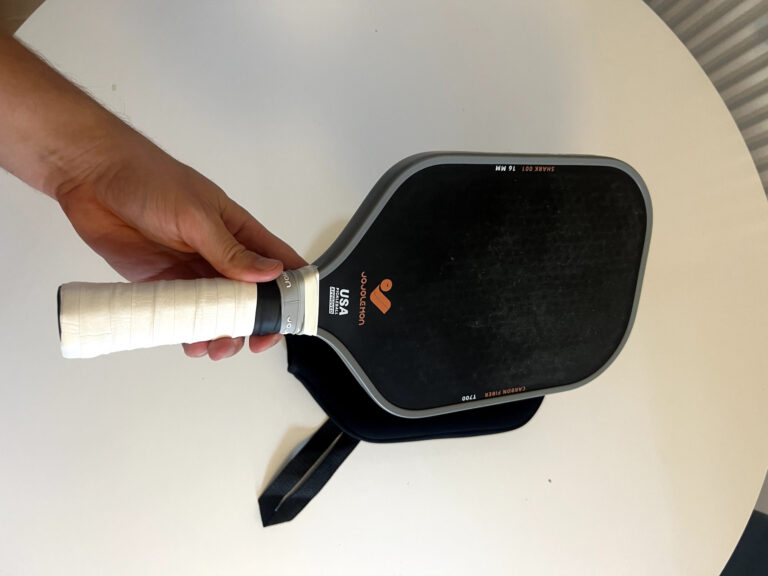
A gritty pickleball paddle can help create spin, but visible grit is not the same thing as usable spin. The ball only stays on the paddle for a very short collision, so spin depends on the interaction between surface friction, texture, paddle speed, swing path, contact quality and the ball itself.
That distinction matters when you compare paddles. A face that feels rougher to your fingers is not automatically the higher-spin paddle, and a paddle that produced excellent spin when new may change as its surface wears.
This guide explains what paddle surface texture actually does, why friction and RPM are different measurements, how current equipment testing approaches spin, and how to judge whether a paddle still gives you the spin you need.
Where pickleball paddle spin actually comes from
Spin is created when the paddle applies a tangential force to the ball instead of only pushing straight through it. On a topspin drive, for example, the paddle is moving both forward and upward relative to the ball. Friction between the ball and face helps convert that brushing component into rotation.
More useful friction can increase the paddle’s ability to grip the ball during the collision. But friction is only one part of the result. Your racket-path equivalent—your paddle path—still has to create the right directional force.
A high-spin paddle cannot manufacture heavy topspin from a completely flat swing. A skilled player can also create meaningful spin with a less aggressive surface by producing better paddle speed and path.
Grit, roughness, friction and RPM are not the same thing
| Term | What it describes |
|---|---|
| Grit / texture | The physical terrain or finish you can see or feel on the face |
| Surface roughness | Measured peaks and valleys in the face surface |
| Coefficient of friction | How strongly two surfaces resist sliding against each other |
| Spin rate | How fast the ball actually rotates after impact, commonly expressed in RPM |
These variables are related, but they are not interchangeable.
A surface can be visibly textured without producing the best ball-face friction. Two paddles can also have similar roughness measurements while producing different spin because their surface chemistry, construction and collision behavior differ.
Why the finger test is limited
Running your fingertips over a paddle is useful for noticing obvious texture differences or wear, but it is a poor performance test.
Your finger is not a pickleball. The pressure, material, speed and direction of contact are completely different. A surface that feels aggressively sandy may not generate more ball rotation than a subtler surface with better friction characteristics.
Use touch as an inspection tool, not as a substitute for spin testing.
How USA Pickleball evaluates paddle surfaces
USA Pickleball’s equipment program has evolved as paddle technology has changed. Its testing history says coefficient-of-friction testing was added in 2018 after new paddle coatings increased the need to evaluate friction, a significant contributor to spin. Later, optical surface measurement was introduced to characterize increasingly textured faces.
The equipment standards also regulate excessive surface features rather than simply requiring a paddle to feel smooth. Surface roughness and friction are measurable characteristics used in certification.
This matters because legality is based on standardized equipment evaluation—not whether a player or tournament opponent thinks a paddle feels gritty.
The move toward direct spin-rate testing
Surface measurements are useful proxies, but the outcome players actually care about is ball rotation.
USA Pickleball has therefore been developing direct spin-rate testing that measures the ball’s rotational behavior off the paddle face. In 2026, the organization continued field and validation work around this approach and published updates on the implementation timeline.
The direction is important: measuring actual spin performance can capture effects that a single static surface metric may miss.
Why RPM numbers need context
You will often see paddle reviewers publish spin results in revolutions per minute. Those numbers can be very useful—but only when the testing protocol is consistent.
RPM depends on variables such as:
- incoming ball speed,
- paddle speed,
- swing path,
- contact location,
- ball model and condition,
- temperature, and
- measurement method.
That means 2,000 RPM from one test is not automatically comparable with 2,000 RPM from another tester using a different setup.
For shopping decisions, compare paddles tested by the same source under the same protocol whenever possible.
How much does paddle material matter?
Face labels such as carbon fiber, fiberglass and aramid/Kevlar do not tell you spin performance by themselves.
The final surface depends on how the material is finished and manufactured. A raw carbon face may use a peel-ply texture. Another paddle may use a coating or molded texture. Two paddles advertised with the same face material can therefore have very different friction and durability.
Our paddle face-material guide explains why the material label is only one part of the construction.
Raw carbon does not automatically mean maximum spin
“Raw carbon fiber” became strongly associated with spin because many raw-carbon paddles used durable peel-ply textures that performed well. But the marketing term should not become a shortcut for performance.
Modern paddles use multiple approaches:
- peel-ply texture,
- molded texture,
- applied coatings,
- composite face layups, and
- combinations of surface treatments.
The useful question is not “Is it raw carbon?” but “How much repeatable spin does this finished paddle produce, and how well does that performance last?”
Why surface wear changes spin
A paddle face experiences thousands of ball impacts plus dirt, ball residue, sweat and cleaning. Depending on construction, the high-friction features can gradually wear or smooth.
You may notice:
- a visibly smoother central strike zone,
- less bite on topspin drives,
- slice returns floating more,
- roll volleys dipping less, or
- a clear difference between the center and unused areas near the edge.
Not every visual change means meaningful performance loss. The best evidence is a repeatable change in ball flight under similar technique.
Coating wear vs structural paddle failure
Loss of surface texture is different from core crush or face-to-core disbonding.
Surface wear primarily changes friction and spin. Structural damage can change rebound, sound, feel, stability and power.
If your paddle suddenly sounds different, develops soft or unusually springy areas, or changes rebound dramatically, investigate structural condition rather than assuming the problem is just worn grit.
See our core crush vs delamination guide for those warning signs.
Can you restore worn paddle grit?
You can clean contamination from a paddle, but you should not try to recreate factory texture with sandpaper, abrasive coatings or aftermarket grit.
Cleaning can restore performance that was hidden by dirt or ball residue. It cannot rebuild physical texture that has worn away.
Aggressive abrasion can also alter the surface and potentially make a competition paddle noncompliant.
Our paddle-care guide covers safer cleaning and storage.
Does a paddle eraser increase spin?
A cleaning block or manufacturer-approved eraser can remove residue from some raw-carbon surfaces. If contamination was reducing friction, the paddle may feel more consistent afterward.
That is cleaning, not resurfacing. The eraser should not be used as a way to intentionally roughen or modify the face.
Follow the paddle manufacturer’s care instructions because surface constructions differ.
Why topspin matters
Topspin makes the ball rotate forward. Aerodynamic forces help the ball curve downward during flight, allowing you to combine pace with net clearance more effectively than with a similarly launched flat ball.
That is useful on:
- third-shot drives,
- serves,
- roll volleys,
- speed-ups,
- passing shots, and
- attacking dinks.
More spin does not remove the need for margin. It gives you another way to shape the trajectory.
Why backspin matters
Backspin changes flight and bounce differently. Slice can help you keep a return lower, change timing and give an opponent a different incoming rotation to manage.
But maximizing backspin is not always the goal. A deep, reliable return that gives you time to reach the Kitchen is usually more valuable than a heavily sliced return that lands short.
See our slice-return guide for the technique and tactical tradeoffs.
Spin potential vs spin production
This distinction is useful when comparing paddles.
Spin potential is what the paddle can support under a standardized or skilled swing. Spin production is what you actually create with your mechanics.
If you change from a low-spin to a high-spin paddle but continue hitting flat through the ball, the improvement may be small. If you already use a fast low-to-high path, the equipment difference may be much easier to notice.
Why contact location matters
Spin tests and player technique work best with repeatable contact.
An edge mishit can reduce:
- paddle speed at the effective collision point,
- directional control,
- energy transfer, and
- your ability to brush the ball cleanly.
A paddle with high laboratory spin potential cannot compensate fully for inconsistent contact.
Does higher spin mean better control?
Sometimes, but not automatically.
Spin can improve trajectory control by letting you hit with more net clearance and still bring the ball down. It can also create sharper angles and dipping attacks.
But “control” also includes:
- rebound predictability,
- soft-game response,
- paddle-face stability,
- launch angle, and
- your ability to place the ball under pressure.
A high-spin paddle can still be too powerful, too springy or too demanding for a particular player.
Does more grit mean the paddle is illegal?
No. Legal paddles can have intentionally textured surfaces.
The issue is whether the finished paddle meets the applicable equipment limits and remains an approved model for the competition you are playing.
In May 2026, for example, USA Pickleball announced that a paddle model was removed from its approved list after additional testing found it exceeded allowable surface-roughness standards. That illustrates why approval status—not appearance—is the practical tournament check.
Use our paddle-approval guide when you need to verify a specific model.
Can normal wear make an approved paddle illegal?
Ordinary wear usually reduces texture rather than adding it, but paddle condition still matters. Competition rules prohibit problematic surface features and alterations, and a damaged or modified face should not be assumed legal just because the model was approved when new.
If you intentionally alter the surface, the fact that the original model appears on an approved list does not protect the modification.
How to test whether your paddle has lost spin
You do not need laboratory equipment to detect a large performance change, but use a repeatable test rather than memory.
Test 1: Same-ball baseline drives
- Use the same ball model and similar conditions.
- Hit 20 controlled topspin drives from the same position.
- Use the same target and approximate effort.
- Watch net clearance and how sharply the ball dips.
If possible, compare with footage from when the paddle was newer.
Test 2: Center vs edge texture
Compare the heavily used center with an unused area near the edge. A large tactile or visual difference can support the suspicion of wear, though it does not quantify RPM loss.
Test 3: Side-by-side paddle comparison
If you have access to a newer paddle of the same model, alternate every five balls. Side-by-side testing is much more reliable than comparing today’s feel with a memory from six months ago.
Test 4: Slow-motion video
Record similar shots and compare trajectory and bounce. Consumer video will not give precise RPM without a validated method, but it can reveal a meaningful change in ball shape.
Why ball condition affects your spin test
A worn, soft or dirty ball changes the collision too. If you test an old paddle with an old ball and compare it with memories of a new paddle and new ball, you are changing multiple variables.
Use several balls in similar condition and rotate them during testing.
Temperature can change what you feel
Pickleballs become mechanically different as temperature changes, and paddle/ball collision behavior can feel different too. Outdoor conditions also change court grip and player movement.
If you are tracking paddle spin over time, compare under reasonably similar conditions rather than treating one cold-weather session as proof that the face is worn out.
How to compare spin when shopping
A useful order is:
- Find independent spin testing that uses a consistent protocol.
- Compare models within the same tester’s database.
- Check whether the result is for the exact generation and thickness you are considering.
- Look for durability observations, not only day-one RPM.
- Demo the paddle with your own topspin and slice mechanics if possible.
Then combine spin with swing weight, stability, power and feel. A paddle that wins the RPM chart but makes you late at the Kitchen may not improve your actual game.
Day-one spin vs durable spin
This is one of the most important buying distinctions.
A paddle can test extremely well when new but lose a meaningful amount of surface performance quickly. Another paddle can start slightly lower and retain its friction much longer.
For a player who uses one paddle for hundreds of hours, retained performance can matter more than the highest initial number.
Look for long-term testing when available, especially if you play several times per week.
When should spin loss make you replace a paddle?
Replace for spin only when the loss actually matters to your game.
Good reasons include:
- your normal topspin no longer produces the trajectory you rely on,
- the central face is substantially smoother than the perimeter,
- cleaning no longer restores performance, and
- a controlled side-by-side test shows a meaningful difference.
If the paddle remains predictable and your shots still behave normally, cosmetic smoothing alone is not a strong reason to discard it.
Common spin myths
“The roughest paddle always spins the most”
No. Finger-perceived roughness is not the same as dynamic ball-face friction or measured spin performance.
“Raw carbon always spins more than fiberglass”
No. Surface finish and complete construction matter more than the material label alone.
“A paddle eraser restores worn grit”
No. It can remove contamination from compatible surfaces; it cannot rebuild texture that has physically worn away.
“More RPM automatically means a better paddle”
No. Spin is one performance dimension. Maneuverability, stability, power, launch and feel still matter.
“If a paddle is approved, any surface modification is fine”
No. Approval applies to compliant equipment, and intentional alterations must still meet equipment rules.
FAQ
What makes a pickleball paddle generate more spin?
Useful surface friction plus paddle speed, an appropriate swing path and clean contact. Surface texture can contribute, but technique remains essential.
Is paddle grit the same as spin?
No. Grit describes surface texture. Spin is the ball’s actual rotation after contact. Roughness and friction influence spin but do not equal RPM.
Does pickleball paddle spin wear out?
It can. Some surface textures or coatings gradually wear, especially in the central strike zone. The rate depends on construction, use and care.
Can I sand my paddle to restore spin?
No. Intentionally abrading or roughening the face alters the paddle and can violate equipment requirements. Clean the surface according to manufacturer guidance instead.
How should I compare paddle RPM?
Compare results from the same tester and protocol. RPM from different setups may not be directly comparable because ball, speed, contact and measurement methods affect the number.
Does higher spin help a third-shot drive?
Yes, when your technique creates topspin. More rotation can help a driven ball clear the net and then dip, but placement and the fifth-shot plan still matter.
Bottom line
Pickleball paddle spin is not simply “grit.” Surface roughness and friction influence how the paddle interacts with the ball, while RPM measures the rotational outcome. The best way to judge spin is with consistent testing plus your own repeatable ball flight—not a fingertip test or a material label. When shopping, care about both day-one spin and how well the surface holds up, then weigh that against the paddle’s speed, stability, power and feel.

Jonathan Grøn is a pickleball player and racket-sports enthusiast who focuses on practical doubles strategy, rules, skills, and training. He combines regular on-court experience with research from official rules, coaching resources, and other authoritative sources to create clear, useful pickleball guides.